
Published Nov 16, 2026
AI Content on Instagram: Labels, Reach and Brand Trust
A practical guide to Instagram AI labels, virtual-profile disclosure and reach claims, with checks for product imagery, synthetic testimonials, brand partnerships and paid reuse.
Category: SEO & Web Marketing · By metricfixer AI Studio
An AI-generated room, a retouched face and a virtual influencer can all appear in an Instagram feed, but they create different expectations. This guide explains how to distinguish visual assistance from fabricated evidence, handle Instagram's content and profile labels, assess claims about reach, and review product imagery before publishing or turning it into advertising.
Practical starting point: ask what a viewer could reasonably believe is real: the person, the place, the product, the result or the experience. Verify that impression first. Then decide which AI, identity and commercial disclosures are needed. A label is not a substitute for an accurate message.
Contents
Executive summary
The useful distinction is not simply human-made versus AI-made. It is illustration versus evidence. A fictional campaign scene can be presented as a creative concept. A fabricated customer, product demonstration or personal experience needs a different response: the claim itself must be corrected, not merely decorated with an AI notice.
Meta's published approach to manipulated media uses labels and context, while retaining the ability to remove material that breaks other rules. Publication permission, recommendation eligibility, commercial disclosure and legal compliance are therefore separate checks.
Instagram's 31 August 2026 update renamed its account-level "AI creator" label to AI-generated profile. A brand should therefore review the account's identity as well as individual posts.
This review is dated 14 November 2026. Its practical recommendation is to preserve an evidence file, explain material fabrication where the audience encounters it, and approve paid reuse separately from organic publication.
Update, 15 November 2026: the promoted-post section adds selected-market disclosure checks and examples of advertising and viewer-facing AI labels.
Classify the visual change, not just the tool
Start with the change to the audience's understanding. The same application can correct exposure, remove an object or invent an entire person. Conversely, a misleading image can be made without generative AI. An internal field that says only "AI used: yes/no" is too crude for an editorial decision.
The following table is a metricfixer review framework, not a list of Instagram's automatic labeling triggers. It helps a reviewer identify the factual impression that needs checking before applying the platform and legal rules discussed below.
| Visual treatment | What could change for the viewer? | Recommended review |
|---|---|---|
| Crop, exposure correction or noise reduction | Usually presentation, unless an important detail or limitation is hidden. | Compare with the original. Do not treat an editing tool's AI feature as proof that the photographed event was invented. |
| Generative expansion | The image may acquire architecture, people or surroundings that were never captured. | Check whether the added area implies a real location, property feature, audience or event. |
| Background replacement | A genuine product can appear in an invented setting. | Keep the product faithful and explain a simulated setting when it could be mistaken for a real installation or visit. |
| Substantial face or body alteration | The image can imply a change in appearance or a product result. | Reject fabricated efficacy evidence. Separate expressive styling from a claim about what a treatment or product achieved. |
| Fully generated still image | The person, place or depicted occurrence may never have existed. | Describe the image as a concept or simulation where relevant; do not present it as documentary proof. |
| Generated video, voice or lip movement | A person may appear to say or do something that was not recorded. | Review image and audio independently, including permissions, the message and the media-level disclosure requirement. |
| Virtual try-on or product visualization | A simulation may be mistaken for tested fit, material behavior or actual performance. | Verify each implied characteristic against the real product. Do not let a visualization stand in for a test. |
For example, placing an unchanged photograph of a lamp inside an invented living room is different from generating a lamp that has a larger shade, a different cable or a brighter light output. The first requires a context review; the second may misrepresent the product itself. Calling both "AI lifestyle imagery" hides that difference.
Review the format as well as the asset
For a single feed image, inspect the visible crop, first lines of the caption and the impression created before additional text is opened. For a carousel, review every slide: a real first image should not silently lend credibility to later synthetic results. Put essential context on the relevant slide when that slide needs to make sense independently.
For a Reel, review the cover, opening sequence, voice, subtitles and any product demonstration. For Stories, review each frame with a claim rather than assuming that an earlier disclosure explains everything. These are editorial safeguards, not a claim that every Instagram format exposes identical disclosure controls.
How Instagram's AI labels fit together
Media labels explain creation, not truth
Meta's AI-labeling announcement describes the use of industry signals, including C2PA and IPTC information, and creator disclosure. It specifically requires disclosure for organic content containing photorealistic video or realistic-sounding audio that was digitally created or altered, and warns that failures may lead to penalties. Do not generalize that wording into a requirement to manually label every minor photo adjustment.
Automatic detection and the creator's obligation are different. A system may attach an AI label to a still image even when the creator did not select a disclosure setting. Equally, the absence of a label does not establish that an image was photographed or that a claim is true.
Meta's July and September 2024 updates acknowledged that minor AI retouching could trigger a broad label. They changed "Made with AI" to "AI info" and described moving information about AI-only edits into the post menu, while keeping a more visible label for detected generated content. Those dated announcements explain the distinction; they are not a guarantee of today's placement on every screen.
In its September 2026 hands-on reporting, The Verge documented newer "AI Content" wording and inconsistent labeling results. That is evidence of observed interface behavior, not a complete detection benchmark. Check the actual app, format and viewer experience rather than treating an old screenshot as a permanent specification.
Operationally: inspect the current mobile publishing flow for the AI disclosure control, make a truthful selection, and check the published result. Do not assume a desktop composer or scheduling service exposes every equivalent setting. If a necessary disclosure cannot be made reliably, pause that publishing route instead of using the interface gap as a justification.
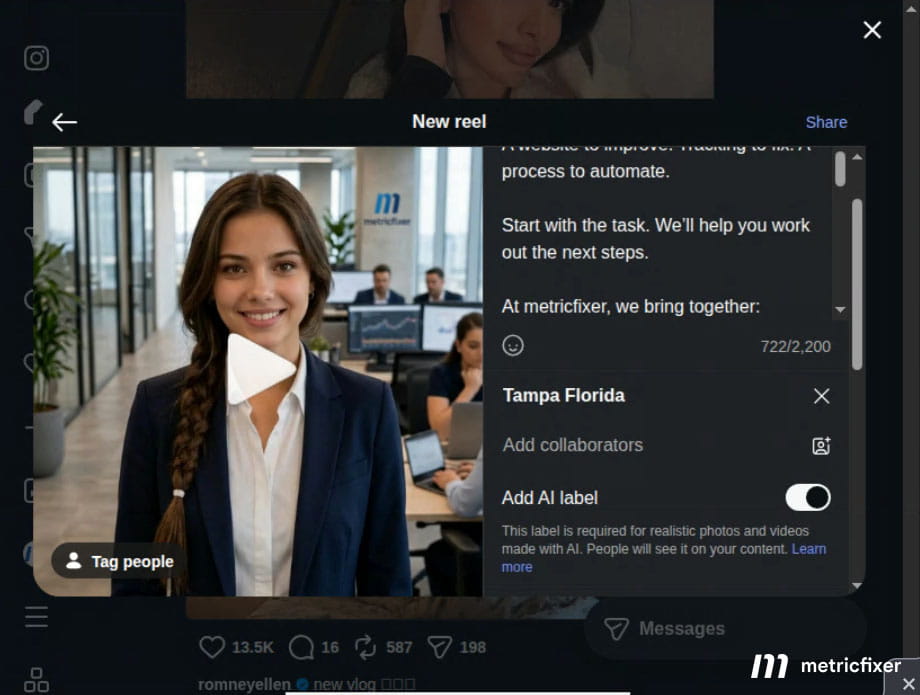
The separate label for an AI-person profile
Under Instagram's August 2026 profile-label announcement, accounts featuring an AI-generated person should use AI-generated profile, available through Edit profile. Creators who merely use AI in their creative process do not need this identity label. Instagram says proactively applying it does not change the profile's reach.
Detected, unlabeled AI-person profiles may become ineligible for recommendations. Instagram describes notification and Account Status checks, with two routes to address the restriction: add the appropriate label or appeal an erroneous decision. Eligibility is not a promise of a particular number of impressions. The profile label also does not replace the separate review of each asset.
Provenance is useful, but not a truth certificate
C2PA Content Credentials record signed information about an asset's origin and editing history. That helps explain a production chain; it does not independently establish that a product works, a review is genuine or a depicted event happened as described. A genuine camera photograph can still be staged or accompanied by a false caption.
Keep the original and final files, available credentials and a short description of the edits. Do not make stripping provenance or repeatedly re-exporting until a label disappears part of the workflow. If the label appears misleading, investigate the editing history and use available reporting channels; do not promise the client that a platform-applied label can always be removed.
AI content, recommendations and the limits of reach claims
Three questions need separate answers: can the material stay on Instagram, can it be recommended beyond the existing audience, and how does it perform when shown? Meta's Recommendation Guidelines explanation explicitly distinguishes permitted content from content eligible for recommendation. An account can therefore have a distribution issue without the affected post being deleted.
Meta's ranking overview describes several systems for Feed, Stories, Reels and other surfaces, combining predictions and user feedback. It does not provide a universal reach multiplier for an AI label. This review did not establish a published, across-the-board penalty that can explain every AI post's performance.
That does not make disclosure irrelevant to distribution. The account-level identity rule described above is a concrete exception. More generally, a viewer's response to a synthetic scene is a different question from whether a platform directly applies a policy restriction. A visually impressive Reel can still be unhelpful, repetitive or disappointing to its intended audience.
Originality is not a synonym for camera footage
In its Instagram originality announcement, Meta explained replacing identical reposts with the original in recommendations and restricting repeat aggregators, with qualifications for materially transformed content. These are rules about contribution and reuse, not a simple camera-versus-generator test.
As an editorial inference, an original synthetic animation and an unmodified repost of someone else's real footage should not be placed in the same "original content" category just because one uses AI and the other does not. However, making a small AI change to someone else's work does not prove recommendation eligibility, permission or copyright clearance.
Read executive commentary at the right level
The 9 July 2026 conversation with Adam Mosseri frames AI as a potential tailwind for authenticity and discusses creator identity and recommendations. It is useful strategic context, not a published scoring formula or a promise that generated content will receive preferential distribution.
For a live problem, begin with the available Account Status information and the affected posts. Record a specific restriction separately from an unexplained performance decline. Do not call every weak result a "shadowban," and do not treat a clean status screen as proof that all other performance conditions are unchanged.
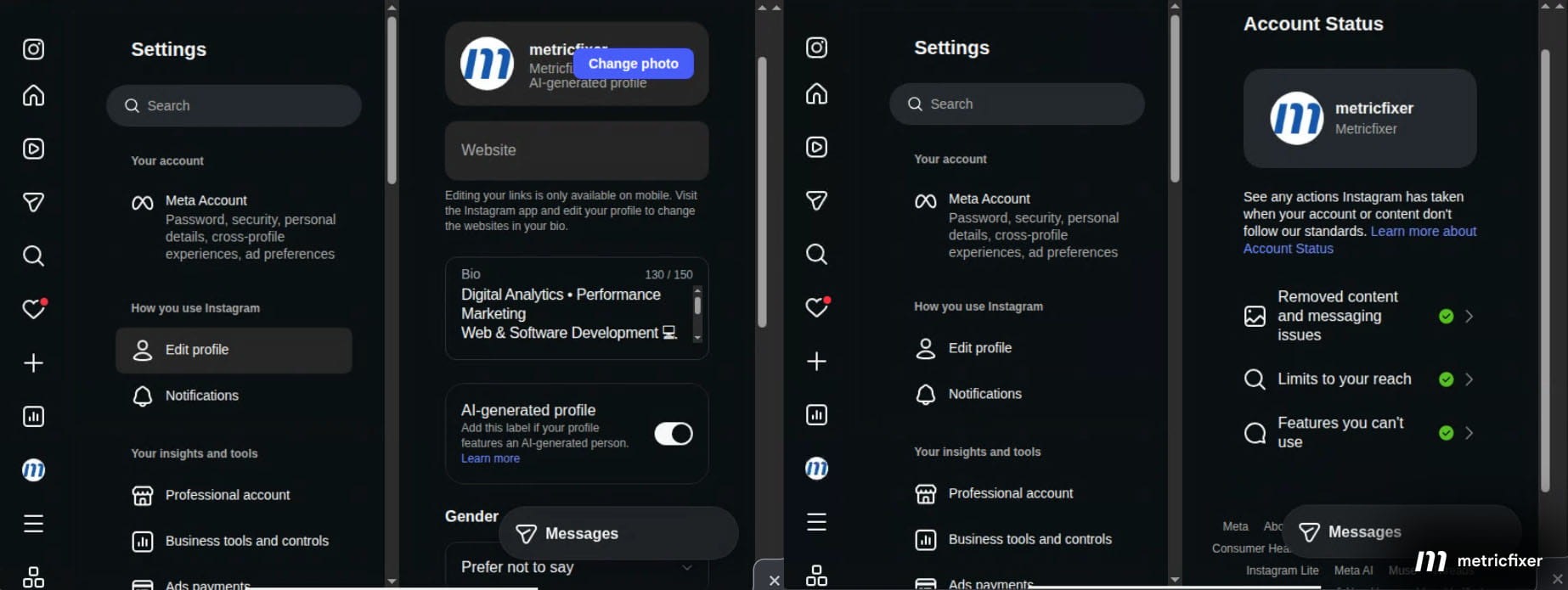
Virtual people and synthetic testimonials
A fictional presenter can explain a product without pretending to have bought it. The risk changes when the script becomes "I wore this for a month," "this fixed my skin" or "my patients recommend it." Now the image and first-person language jointly suggest a real experience, identity or qualification.
The U.S. FTC guidance on reviews and testimonials does not impose a blanket prohibition on AI avatars or virtual influencers. It distinguishes their use from fake or false underlying testimonials and warns that an avatar's presentation can still be deceptive. It also addresses unauthorized celebrity avatars that appear to give genuine endorsements.
For a brand, the practical distinction is between an openly fictional spokesperson delivering approved information and a fabricated witness offered as evidence. A profile description cannot turn an invented customer experience into a real one. Nor should a realistic synthetic portrait be used to invent a doctor, employee or satisfied client who does not exist.
Our recommended character brief should establish who operates the account, what is fictional, whose likeness or voice is involved, and which statements the character must never make. Review the whole presentation: account name, biography, posts, comments and any scripted replies. Avoid a transparent main post followed by comments that falsely insist the persona is a real customer.
For a real person's digital double, obtain a written, use-specific permission record before production. Define the allowed statements, alterations, channels, markets, duration and paid reuse. This is a risk-control recommendation, not a claim that a single release resolves every privacy, publicity, employment or intellectual-property issue.
Product images and brand partnerships
Protect the product facts before improving the scene
Use an approved reference set for the exact product variant: photographs, dimensions, materials, finishes, included accessories and supported capabilities. Compare the generated result against that set, not against whether it looks plausible. Assign someone who knows the product to approve the final visual.
For a generated interior, check scale, installation requirements and what is actually included. For apparel, check seams, length, opacity, fit and fabric behavior. For jewelry, check stone size, closures and finish. For food, check quantity and ingredients. These are review prompts, not claims that every listed detail can be validated from a generated image.
"AI-generated background; product photograph unchanged" is a useful explanation only when the product really is unchanged. "AI visualization of a proposed interior; not a completed installation" can clarify a concept. Neither phrase should be used to excuse a visually inaccurate product or a result that the business cannot substantiate.
The UK's ASA makes the distinction explicit in its guidance on AI disclosure: a disclosure is unlikely to repair a fundamentally misleading message. Its example includes synthetic cosmetic results that do not reflect real-world performance. For before-and-after content, the safest editorial decision is to use genuine, supportable evidence or stop presenting the image as proof of a result.
Disclose the commercial relationship separately
Instagram's branded-content guidance treats compensation, including free gifted products or services, as relevant to branded content and requires the appropriate partner disclosure. An AI notice describes production. A Paid partnership label describes a commercial relationship. Neither answers the other's question.
The FTC's Disclosures 101 guidance likewise covers material connections beyond cash payments. It advises placing disclosure with the endorsement, not only in a profile or behind "more." For Stories, it describes readable on-image disclosure; for video, disclosure should be in the video rather than only its description.
For example, an AI-generated model in a sponsored Reel may need context about the synthetic scene and a clear commercial disclosure. A brand posting its own product is not automatically the same relationship as an independent creator promoting that brand. Classify the actual arrangement instead of turning every commercial-looking post into an invented partnership.
Legal transparency beyond Instagram's interface
European Union: the obligations are already applicable
The European Commission confirms that Article 50 transparency obligations apply from 2 August 2026. For a professional brand workflow, separate the provider of the AI system from the business using it. The Commission describes a limited transition until 2 December 2026 for the machine-readable marking obligation for certain systems already on the market; this is not a general postponement of a brand's deepfake-disclosure duties.
Article 50 distinguishes machine-readable marking by providers from disclosure by deployers of deepfake images, audio or video. The provider-side exception for standard assistive editing is not a universal exemption for everything a brand calls "retouching." Artistic, creative or fictional works have a qualified disclosure provision, not a blanket exclusion.
The Commission's guidance also makes clear that deepfake analysis is not confined to impersonating a famous person: objects, places, entities and events can be relevant. Where disclosure is required, it must be clear and distinguishable at first exposure. Embedded metadata alone is not enough. A brand should therefore assess whether the visible platform experience actually communicates the necessary information, rather than assuming that a menu item settles the legal question.
Do not import the human-review exception for certain public-interest text into the separate rule for deepfake visuals. Having an editor approve a realistic synthetic video does not, by itself, remove its disclosure obligation. Scope, context and the applicable exceptions still require a case-specific assessment.
United States and United Kingdom: do not confuse AI disclosure with permission to mislead
For U.S.-facing brand work, the FTC guidance discussed above supplies two important checks: genuine underlying endorsements and clear material-connection disclosure. It is not an exhaustive account of state laws, likeness rights or sector-specific requirements. A team should identify relevant markets before commissioning a synthetic person or a sensitive product demonstration.
For UK advertising within its remit, the ASA's June 2026 guidance emphasizes that existing advertising rules apply regardless of how content is produced, and responsibility does not transfer to an automated tool. Check misleadingness, endorsements and audience suitability, rather than looking only for an AI-specific checkbox.
These layers can apply together. A post may satisfy Instagram's disclosure setting yet still communicate an unsupported commercial claim. Conversely, an internal legal review does not remove the need to follow the platform's own publication rules.
A publication workflow with a separate advertising review
The following is a proposed operating process for a brand or agency. It is not Instagram's internal moderation flow, and none of its approval steps guarantees distribution or ad acceptance.
- Define the intended impression. Write one sentence describing what the audience is meant to believe. Identify the target markets, format, account identity and whether paid reuse is planned.
- Collect the evidence. Obtain original assets, the editing history, product references, permissions and support for factual claims. A polished export without this context is not a complete delivery.
- Review the final visual and script. Check all slides, frames, voices, subtitles and the caption. Reject an invented endorsement or unsupported result before discussing how to label it.
- Make separate disclosure decisions. Review the media, the account identity, commercial relationships and jurisdictional duties. Record both the chosen disclosure and the reason for any not applicable decision.
- Publish and inspect. Check the actual viewer presentation, not only the editor preview. Save the approved version, publication time, post identifier, disclosure wording and relevant screenshots.
- Correct problems and review paid reuse. Pause reuse while a material error is unresolved. Route an erroneous restriction through the available review process; route a misleading asset back to production. Reapprove the asset before boosting or creating a partnership ad.
Workflow: define the message → verify evidence and rights → review visual accuracy → assess media, identity, commercial and legal disclosures → publish and inspect → monitor and correct → perform a fresh advertising review before paid reuse.
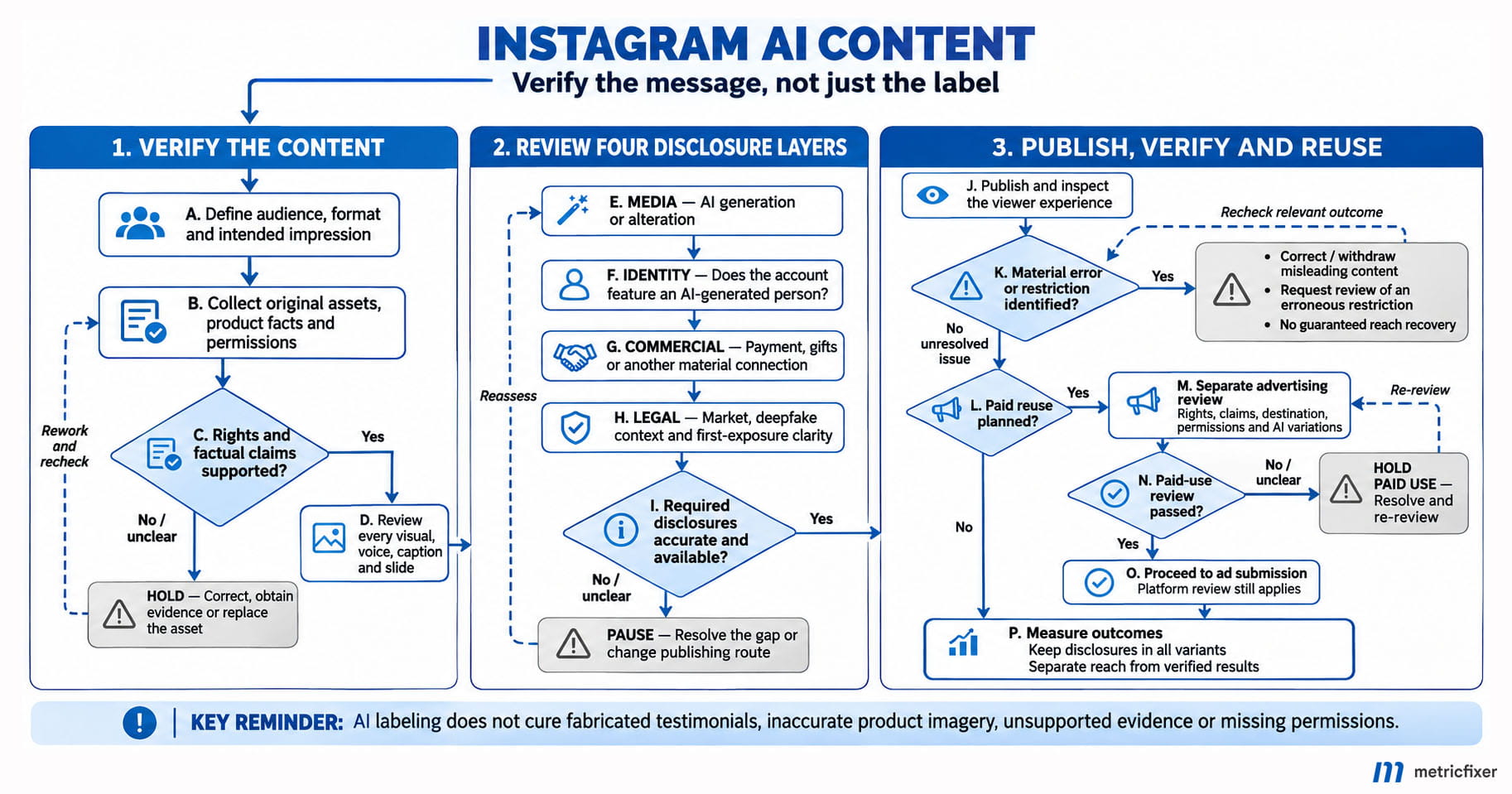
Why the advertising review must be separate
In its 1 June 2026 advertising-transparency update, Meta announced an expanded "About this ad" destination and detection of industry signals from third-party AI tools, alongside labels for its own generative advertising features. The announcement also notes regional variation. Organic and paid presentation should not be assumed to match.
Before launch, recheck the rights to the person, voice, music and source material for the specific paid use. Review the destination page, product claims, partner authorization and any automated creative changes that will be enabled. Ask whether a crop, translation, expansion or generated variation can change the already-approved message.
For a correction, retain the original approval record and document what changed. If the misleading impression cannot be corrected in the existing format, withdraw or replace the material rather than adding an inconspicuous disclaimer. An appeal about a label is not a substitute for correcting an actual product error.
What changes when you promote an Instagram post
A post that was reviewed for organic publication needs a fresh check before paid promotion. Treat the approved post as the starting material, not as evidence that every advertising disclosure has already been handled. Review the final ad, its intended markets and the actual relationship between the publisher and the business being promoted.
Read the advertising prompt as a separate check
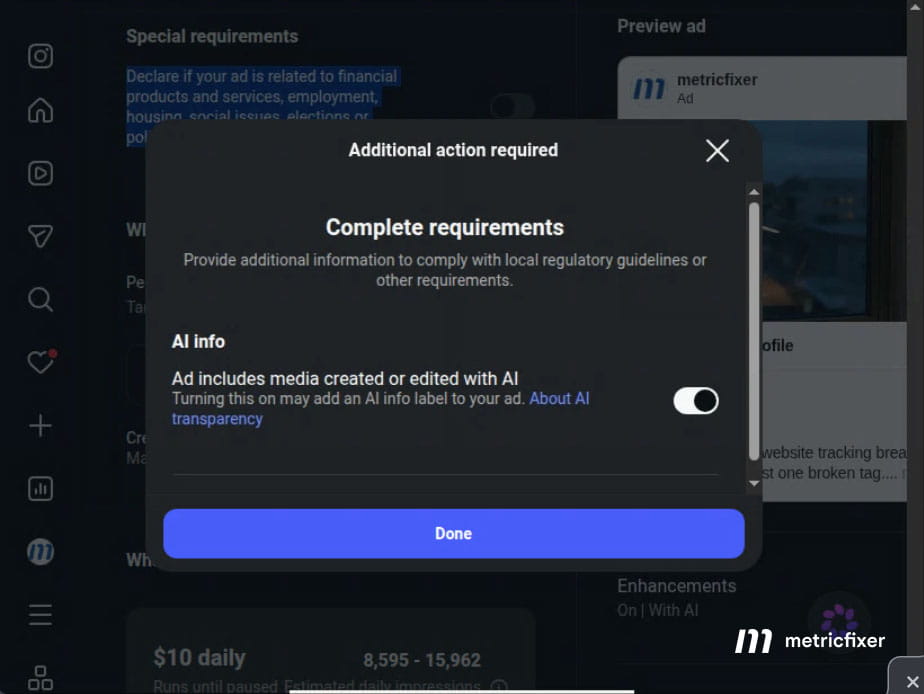
An advertising-setup screenshot supplied for this article shows an Additional action required window headed Complete requirements. Its AI info control asks whether the ad includes media created or edited with AI. The accompanying sentence says that enabling it may add an AI info label to the ad. This is an advertising declaration, not the account-level AI-generated profile setting.
The window refers generally to local regulatory guidelines or other requirements. It does not name a country, cite a law or explain the trigger for this particular account. Its appearance therefore cannot establish that all advertisers worldwide must make the same declaration, that every AI edit has the same legal treatment, or that enabling the control guarantees a particular visible label.
Answer the question truthfully for the actual asset and follow the requirements shown for the intended advertising setup. Meta's June 2026 advertising-transparency update describes AI information within About this ad, detection of third-party AI signals and regional differences. It does not make a single account's screen a universal menu route or a country-by-country legal checklist.
Keep advertising, partnership and AI disclosures separate
Paid distribution: an advertising identifier such as Ad or Sponsored tells the viewer that the placement is an advertisement. Meta's advertising-transparency materials also distinguish information about the advertiser, payer or beneficiary. None of those details explains whether a face, voice or scene was generated.
A commercial relationship: a creator's payment, gift or other relevant connection to a brand raises a separate disclosure question. As the FTC's endorsement guidance explains, a platform's built-in disclosure tool is not automatically sufficient in every presentation. Conversely, do not activate Paid partnership simply because a brand pays to distribute its own post; first establish whether there is a branded-content relationship to disclose.
AI involvement: a media-origin label explains something about production, not who paid for distribution or whether an endorsement is genuine. Keep the existing post's context, complete any additional advertising declaration that applies, and inspect the paid presentation separately. Do not assume that a label visible in the ordinary feed will occupy the same position in an ad, a Story or a different placement.
Selected markets: different reasons to disclose
The comparison below was checked for this addition on 15 November 2026. It separates AI-specific duties from commercial-disclosure rules and regulator recommendations. It is not a list of countries where a particular Instagram switch is available, or an exhaustive international compliance guide. The EU row can apply alongside national rules; the New York row adds a state-specific issue to the U.S. federal baseline.
| Market and source | What the rule or guidance addresses | Practical consequence for a promoted post |
|---|---|---|
| European Union | AI Act Article 50 requires covered deployers to disclose deepfake image, audio or video content, subject to its scope and exceptions. The Commission's guidance explains first-exposure disclosure and the distinction from provider-side machine-readable marking. | Assess the actual content, context and applicable timing; buying distribution is not the sole trigger. Where disclosure is required, check that the audience can perceive it without opening a menu. Do not treat every AI-assisted edit as a deepfake or a metadata flag as complete compliance. |
| France | For covered commercial influencers, Article 5 of the influencer law addresses altered body or facial appearance with Images retouchées, and AI-produced faces or silhouettes with Images virtuelles. Clear, readable, understandable equivalent wording adapted to the format is permitted. Article 5-2 separately addresses disclosure of commercial intent when it is not already clear from context. | Check both the creator's status and the specific visual treatment. A generic AI badge is not automatically equivalent to the information required. These provisions are not a blanket instruction to add the same wording to every brand-owned advertisement. |
| Poland | UOKiK's influencer-advertising guidance calls for clear commercial identification and recommends two-level labeling: the platform's functionality plus the creator's own disclosure. It gives understandable Polish wording such as reklama and warns against obscure abbreviations. | For a covered influencer collaboration, make the commercial relationship clear to the audience as well as reviewing AI disclosure. The two-level recommendation concerns advertising recognition; it is not a separate Polish requirement to turn on an AI switch for every post. |
| United Kingdom | CAP Code section 2 requires recognizable advertising. The ASA's AI-disclosure guidance applies existing rules rather than a blanket requirement to label every use of AI. | Make the advertising nature clear and assess whether omitting information about AI would mislead. A disclosure cannot repair a fundamentally false product demonstration or invented endorsement. Check the rules for the actual sector and audience too. |
| United States: federal baseline | FTC guidance addresses material brand connections and clear, noticeable disclosure with an endorsement. Video disclosures should not exist only in the accompanying description. | An AI label does not explain an undisclosed brand relationship. Review the endorsement and the viewer's experience, including viewing without sound. This federal guidance does not settle additional state-specific AI, likeness or sector rules. |
| New York, United States | The synthetic-performer disclosure law took effect on 9 June 2026. General Business Law section 396-b requires covered producers or creators with actual knowledge to conspicuously disclose a synthetic performer in the advertisement. Its definition concerns an apparent human performer not recognizable as an identifiable natural performer. | Assess synthetic people in ads intended for this market specifically, rather than assuming a generated background triggers the same rule. The statute contains exceptions, including audio advertisements, AI used solely for translation of a human performer, and qualifying promotion of expressive works. |
For a multi-market campaign, record the intended audiences, relevant rules, disclosure language and final placement for each version. If those requirements differ, consider separate localized assets rather than assuming one English badge is adequate everywhere. Neither a missing interface control nor an accepted ad proves that all legal duties have been satisfied. Other markets require their own review.
Check what viewers actually see
A second screenshot supplied for this article shows AI content beneath the account name and above a video in Instagram's feed. The marking belongs to the surrounding interface; it is not text burned into the video. The visible capture does not establish that this viewing instance is a paid ad, or whether the label came from a creator declaration, metadata or another platform process.
The two screenshots therefore illustrate different stages, not a verified before-and-after experiment. One shows an advertising declaration; the other shows a viewer-facing media label. Their different wording is worth preserving, but it does not prove that selecting the advertising control caused that particular feed label.
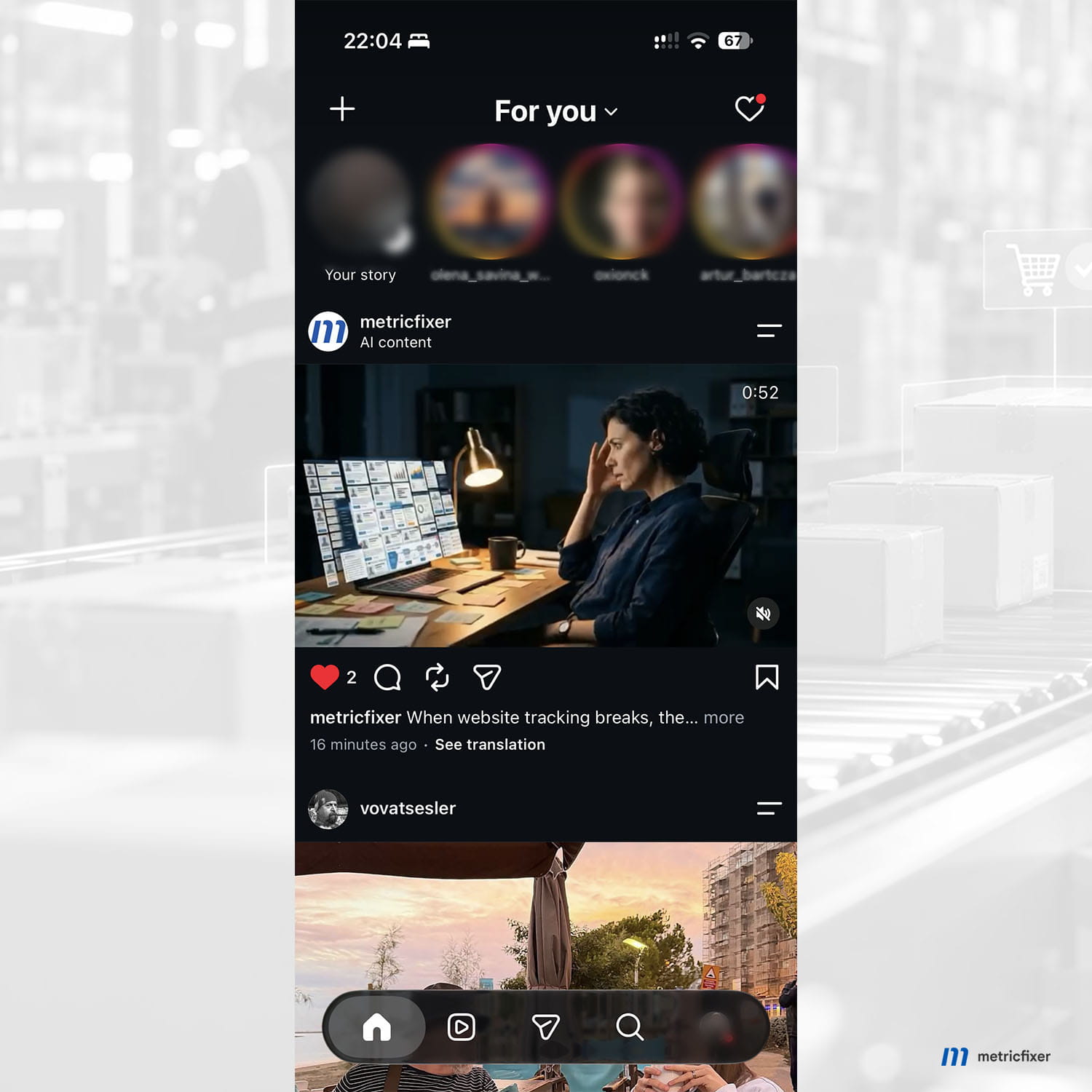
Inspect the actual paid placement when it is available and authorized, separately from the ordinary feed view. Check the disclosure's location, contrast, language and legibility, and whether a crop, caption truncation or playback mode hides necessary context. Where a disclosure must be perceptible at first exposure, do not assume information behind About this ad is sufficient. This is a placement-specific check, not a universal demand to burn an AI watermark into every video.
A practical pre-promotion check
- Identify the use: distinguish a brand's own ad, a creator collaboration and a partnership ad. Record the markets and the versions that will actually be distributed.
- Recheck the declarations: preserve necessary organic context, answer the advertising AI question truthfully, and apply commercial-relationship disclosures only where the relationship warrants them.
- Review the presentation: check previews, enabled creative variations and the available viewer experience. Resolve an unreadable or missing required disclosure before continuing the affected paid use.
- Keep separate evidence: archive the source post, advertising settings and viewer capture with their dates and identifiers. Do not describe an ordinary feed screenshot as proof of an ad impression or a particular legal outcome.
The launch decision should follow those checks, not the presence of a single checkbox. The goal is a truthful advertisement whose commercial nature and material use of AI are understandable in the markets where it is shown.
How to measure reach without inventing an AI penalty
A useful test asks a narrow question: does a particular AI-assisted production approach improve useful audience response for this account and content type? It does not try to identify Instagram's entire ranking system from two posts.
Use the following as a measurement design, not as a platform benchmark. Compare several matched creative pairs or batches with a similar subject, intended audience, format, duration, offer and publishing window. Rotate the order where practical. Record paid amplification, collaborations, account restrictions and major changes in the publishing schedule.
Keep all required disclosures in every variant. Do not test compliance by withholding a mandatory label from one version. An AI-assisted and a non-AI variant also differ in the material viewers see; a performance difference cannot automatically be attributed to the label alone.
| Question | Evidence to record | What it does not prove |
|---|---|---|
| Was there an eligibility issue? | Available Account Status notices, affected content and the dates of any restrictions or reviews. | A quiet status screen does not prove that a post will receive recommendations. |
| Was the content distributed differently? | Reach, views and follower/non-follower breakdowns where available, using consistent observation windows. | One lower result does not identify a platform-wide AI penalty. |
| Did viewers find it useful? | Available viewing metrics, shares, saves, substantive comments and profile actions, with clearly stated denominators. | More views alone do not show better understanding or trust. |
| Did it help the business? | Qualified inquiries, attributable visits and sales, plus returns or complaints about mismatched expectations where relevant. | A platform-reported action is not automatically a verified customer or sale. |
Choose observation windows before examining the outcome: for example, a 24-hour checkpoint and a seven-day comparison for comparable feed posts or Reels. Treat Stories separately, and archive the available observations before they become difficult to recover. These are example review windows, not an Instagram rule or a claim that distribution ends after seven days.
Report the number of posts and the spread of results, not just the best-performing example. When the sample is small or conditions changed, describe the result as directional. Organic distribution is not randomized audience assignment, and repetition does not remove every confounding factor.
For commercial measurement, keep Instagram visibility separate from lead and revenue verification. The same distinction is developed in metricfixer's guide to why Meta Ads leads can differ from WhatsApp or CRM records. For discovery outside Instagram, see the separate guide to Google Search Console platform properties; Google-side visibility is not a measurement of Instagram recommendations.
An AI creative brief and team checklist
Give the creator or agency a brief that separates permitted invention from facts that must remain unchanged. The template below is an operational recommendation and can be adapted to a single image, a carousel or a video series.
| Brief field | What to specify |
|---|---|
| Purpose and audience | The intended message, audience, markets, format and expected organic or paid use. |
| Non-negotiable facts | Approved product variant, dimensions, appearance, functionality, factual statements and supporting evidence. |
| Permitted invention | Exactly what may be generated: for example, an expressly fictional backdrop, not the product or a customer's result. |
| People and voices | Whether characters are real or fictional, permission records, permitted statements and prohibited first-person experience claims. |
| Production record | Source files, tools and relevant settings, significant edits, final versions and available provenance information. |
| Disclosure plan | Media and profile checks, commercial relationships, jurisdictional review and wording appropriate to each placement. |
| Approvals and reuse | Named product and editorial reviewers, rights scope, paid-use authorization, review dates and the person responsible for corrections. |
| Success criteria | The audience or business outcome, comparison approach and evidence that will be recorded after publication. |
Final team checklist
- The product owner has checked the visual against the real item, and every claimed result has supporting evidence.
- No invented person is presented as a real customer, employee or qualified professional; permissions cover any real likeness or voice.
- Media disclosure, profile identity, commercial relationships and applicable legal duties have been reviewed separately.
- Essential context remains understandable in the actual crop, slide, frame and viewer presentation.
- The approved files, evidence, rights and publication record have a named owner, with a correction route.
- Paid reuse has a separate approval, and performance reporting distinguishes restrictions, audience response and verified business outcomes.
The objective is not to make AI invisible. It is to make the boundary between creative invention and real-world evidence understandable. That gives a brand a more useful standard than either "label everything" or "avoid the label at all costs."

Methodology and sources
This is a document-based review prepared on 14 November 2026. It prioritizes Meta's dated policy and product announcements, Instagram's published profile-label explanation, European Commission materials, and FTC and ASA guidance. Source links are attached to the relevant claims rather than collected into a repeated reference list.
The review distinguishes the 2024 media-label explanations, the August 2026 profile-label change, and the June 2026 advertising update. Older announcements explain the origins of a rule or interface distinction; they are not treated as evidence that every account currently has the same controls. Some Instagram pages were available through indexed or archived copies rather than direct retrieval, including the profile announcement and branded-content guidance. The latter was checked in a 6 May 2026 archived version; live settings and wording should be rechecked before use.
The Verge's reporting is used only for its observed labeling behavior, and the Mosseri interview for strategic context. Neither is treated as a substitute for platform policy or a controlled experiment. No live Instagram account audit, labeling experiment or causal ranking test was performed for this article.
The scenario table, brief, checklist and measurement design are metricfixer's editorial synthesis. They do not establish universal detection accuracy, a numerical reach effect, guaranteed appeal outcomes or complete legal coverage. The legal discussion focuses on selected EU, U.S. and UK issues relevant to brand publishing; sector-specific rules and other markets need separate assessment.
Promoted-post addition, 15 November 2026: the new section supplements the original review with French legislation, Polish UOKiK guidance and New York law alongside the EU, FTC and ASA materials. Two supplied interface screenshots support only the visible wording and placement discussed. They do not establish account ownership, a particular legal trigger, paid delivery or causation between an advertising declaration and a feed label. No account access or new live-platform test was performed. Meta's detailed AI-info Help Center page was not retrievable for this addition, so no exhaustive regional availability list is asserted; the platform discussion relies on its accessible newsroom update and the supplied interface observations. These checks do not constitute a fresh audit of every earlier section.
This article is for editorial, marketing and operational information only and is not legal advice. metricfixer is not affiliated with or endorsed by Meta, Instagram, the European Commission, the FTC, the ASA or the other organizations mentioned. Platform rules, interface wording, regional availability and legal requirements may change. An AI label does not establish product accuracy, ownership, consent, advertising approval or recommendation eligibility.
Expert help with this topic
 Meta Ads Full Setup
Launch Meta Ads from an agreed strategy with conversion readiness and 30 calendar days of initial management.
 Meta Ads Management
Manage Meta Ads around one primary objective with a coherent strategy and sufficiently representative business-outcome data.
 Meta Conversions API Gateway Integration
Implement a scoped Meta-specific Conversions API Gateway route for named website events and validation.
 Expert-Led Meta Ads Account Audit
Get a Meta Ads diagnosis led by a specialist with at least 8 years of PPC experience and delivered as a prioritized PDF report.