Published Nov 19, 2026
AI Content on Pinterest: Labels, Discovery and Commercial Risk
A practical research guide to AI content on Pinterest: labels, discovery, product accuracy, commercial disclosures, tool restrictions and a publish-and-verify workflow.
Category: SEO & Web Marketing · By metricfixer AI Studio
AI content on Pinterest is not just a question of whether a generated image needs a label. A Pin can also promise a real product, a workable recipe, a finished renovation or a trustworthy recommendation. This research examines AI disclosure, discovery, commercial use, platform tools and legal obligations, then turns them into a publication workflow for creators, publishers, retailers and agencies.
Practical default: use AI to explain or illustrate an idea, not to manufacture evidence that a product, person, result or experience is real. Check the asset, its claims, its destination and its rights together. Treat AI disclosure, advertising disclosure and product accuracy as separate checks. Research reviewed on .
Contents
Executive summary
Pinterest's documentation describes AI identification and controls rather than a blanket prohibition on generated content. The important distinction is between permitted content, useful content, correctly disclosed content and commercially eligible content. Passing one test does not answer the others. Pinterest's AI overview places AI material under its existing content policies; its enforcement framework distinguishes removal from restrictions on distribution.
The current publishing documentation includes creator-operated AI disclosure controls, not just automatic detection. Organic Pins and promoted Pins also have different disclosure presentations. Teams should therefore inspect the actual publishing route and published surface instead of following a screenshot or tutorial from the initial 2025 rollout. The relevant starting points are Pinterest's Pin-creation instructions and AI-label documentation.
For metricfixer, the most useful editorial test is the Pin-to-page promise: what does a reasonable viewer think this image proves, and does the destination deliver that promise? A fictional room presented as inspiration is a different proposition from the same room presented as a completed client project. An attractive generated meal is not evidence that a recipe has been cooked successfully. These are editorial distinctions, not an official Pinterest list of approved uses.
Two less obvious issues deserve attention. Pinterest documents an ai_disclosures field for catalog media, while its Creative GenAI business terms restrict the use of covered tool outputs to Pinterest. A retail feed and a reusable cross-platform creative library therefore require different checks. See the catalog specification and Creative GenAI terms.
Do not build a strategy around either of two unsupported absolutes: that an AI label always destroys reach, or that disclosure has no possible distribution consequences. The reviewed public sources do not provide a universal numerical AI penalty, a guaranteed reach equivalence, or a reliable measurement of the proportion of Pinterest content that is AI-generated. This article separates documented behavior from proposed operating practices and unanswered questions.

What counts as AI content on Pinterest?
Start with the production process, not an AI detector's score. Record what was generated, what was merely edited, what came from a camera or another creator, and what the final Pin asks the audience to believe. This working classification is a metricfixer editorial framework; it is not a substitute for the wording of a particular platform control or law.
| Production scenario | Question to resolve | Recommended record |
|---|---|---|
| AI helps write a title or description for a genuine photograph | Does the text introduce invented features, experience or factual claims? | Original photo, checked description and the actual extent of AI assistance. |
| Routine image processing or non-generative correction | Was anything material to the scene or claim changed? | Source file and edit history, particularly when a label appears unexpectedly. |
| Generative background, object replacement or scene extension | Does the edit change apparent size, context, accessories, performance or authenticity? | Original product or scene, generated elements and approved final composition. |
| Fully generated illustration, room, outfit or meal | Is this a concept, or is it being presented as something that exists or has been tested? | Production record, intended meaning and any independent evidence for the accompanying claim. |
| Synthetic person, voice or testimonial | Could the audience infer a real identity, endorsement or lived experience? | Rights and permissions where relevant, character status and substantiation of every testimonial claim. |
| Reposted, collaged or supplier-provided media | What is known about the source, transformations and reuse permissions? | Supplier declaration, original asset reference and the rights chain. |
What disclosure does not permit
Pinterest's community guidelines continue to govern harmful misinformation, impersonation, privacy violations, child safety and prohibited sexual or violent material, including synthetic media. Their spam provisions also matter when production is automated. Labeling a file does not exempt its content or the behavior used to distribute it.
For an ordinary brand workflow, the practical consequence is to stop and escalate material that invents a real person's participation, fabricates a sensitive event or uses another person's identity without the necessary permission. Do not treat disclosure as permission to publish something that fails an independent safety, rights or deception check. Likewise, automation should serve an approved publishing process, not mass-produce repetitive posts or manufacture engagement.
A Pin can contain several of these layers at once. A real chair photographed by the retailer may sit in a generated room, appear beside a synthetic person and link to an affiliate review. The production record should preserve those distinctions rather than reducing everything to a single yes/no field.
Also separate AI used by Pinterest to interpret or recommend content from AI used to create the uploaded content. Pinterest describes AI-based discovery and assistance in its creator guidance. A photograph being processed by those systems does not, by itself, establish that its creator generated the photograph.
What changed, and what the dates mean
Historical announcements explain the direction of travel; current help pages are more useful for operating a publishing workflow. Neither proves that an individual account has every feature. The table deliberately separates announcement dates from claims about universal availability.
| Date or document | What the source establishes | What not to infer |
|---|---|---|
| 30 April 2025 | Pinterest announced a broader rollout of AI labels, detection using metadata and classifiers, and an appeal route in Introducing Gen AI labels. | That all uploads are detected correctly, or that the launch presentation describes every later publishing surface. |
| 16 October 2025; updated 12 December 2025 | The AI-content controls announcement introduced topic-based preferences; its December update added food and drink. | That these are an all-AI blocking switch, or that an initial device rollout remains the current availability list. |
| 2 August 2026 | The European Commission identifies this as the application date for AI Act transparency obligations, with a narrower transition for some provider-side marking duties. | That every AI-assisted Pin requires the same legal notice, or that every creator received a December extension. |
| 6 October 2026 | Pinterest announced Beauty Guides, initially described for US iOS users, using AI to turn selected visual inspiration into guidance. | That the underlying Pin is necessarily AI-generated, or that automated guidance verifies a real result. |
| Documentation reviewed on 18 November 2026 | Help pages describe creator disclosure, different organic/ad label presentations and catalog AI metadata. | A confirmed launch date for each feature or a hands-on test of every account, app version and country. |
The legal date above comes from the Commission's application timetable. The specific duties are discussed below. Public help pages can change without a detailed version history; this research did not reconstruct every intermediate rollout.
How AI labels and creator disclosures work
Creator disclosure at upload
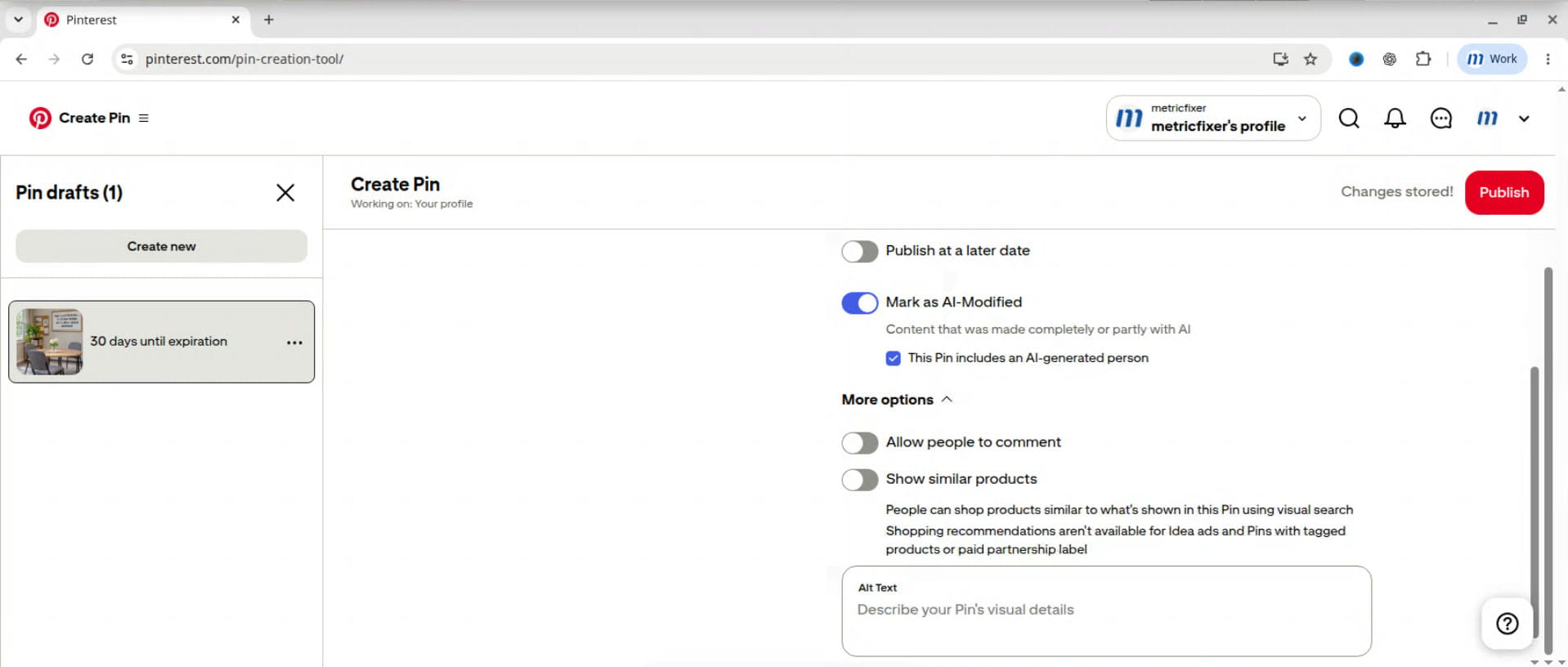
Pinterest's creation guide documents a Mark as AI-Modified area with controls for content made wholly or partly with AI and content containing an AI-generated person. The guide includes these controls in desktop image and video workflows and in some mobile instructions. It is therefore no longer accurate to describe Pinterest disclosure as exclusively automatic.
Use the controls truthfully for the asset being uploaded. Do not turn on a synthetic-person answer merely because AI helped write a caption; conversely, do not treat a realistic virtual presenter as a real photographed customer. Check the actual wording in the account. The documentation does not establish one identical interface across every format, publishing partner and device.
Organic and promoted presentations
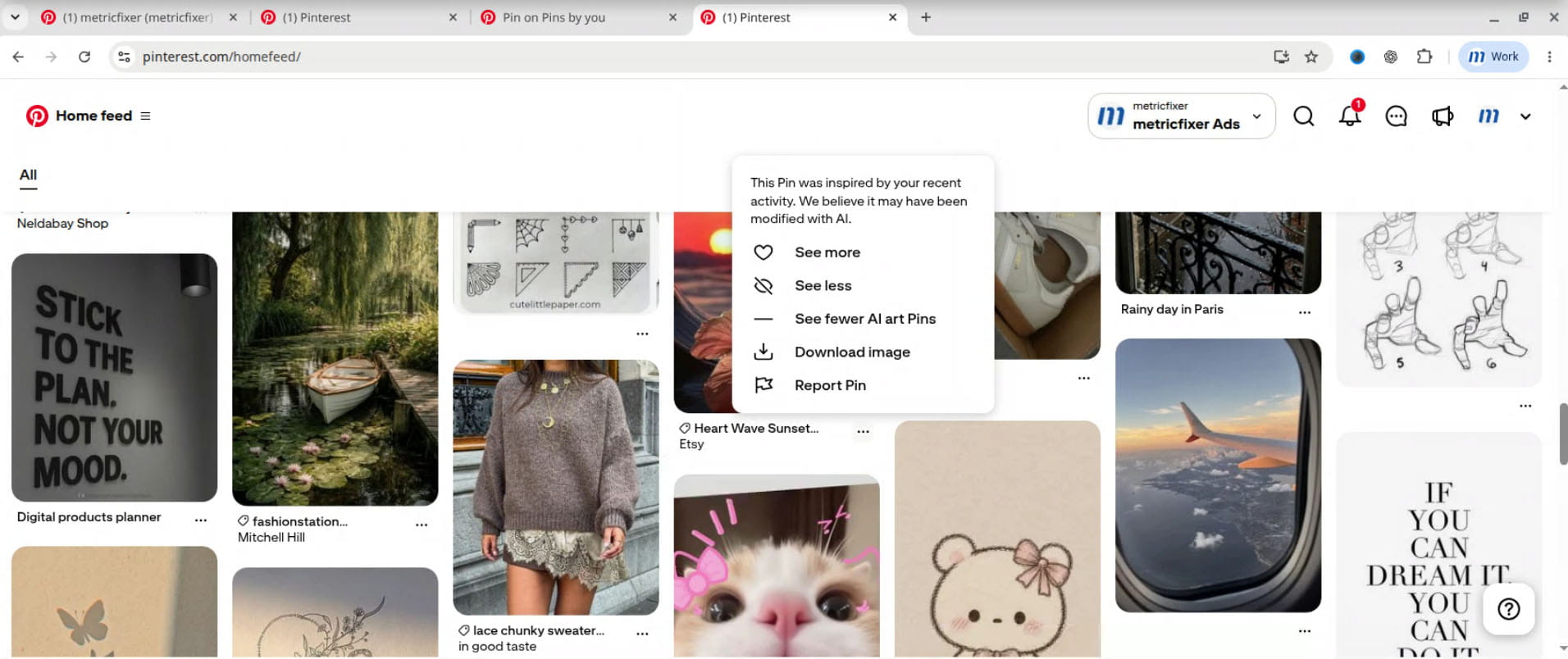
The label guide places the organic AI modified badge at the lower left of a Pin's close-up view. For ads, it describes disclosure inside the menu opened through the ellipsis rather than the same close-up badge. Ad details can distinguish owner-declared AI modification or a synthetic person from a system-generated indication that AI may have been used.
These different surfaces create a practical verification task: review the version viewers actually encounter. An organic screenshot is not proof of the ad presentation. A successful upload is not proof that every intended disclosure is visible. For video, inspect both the cover and the playback context rather than assuming the image-Pin presentation applies unchanged.
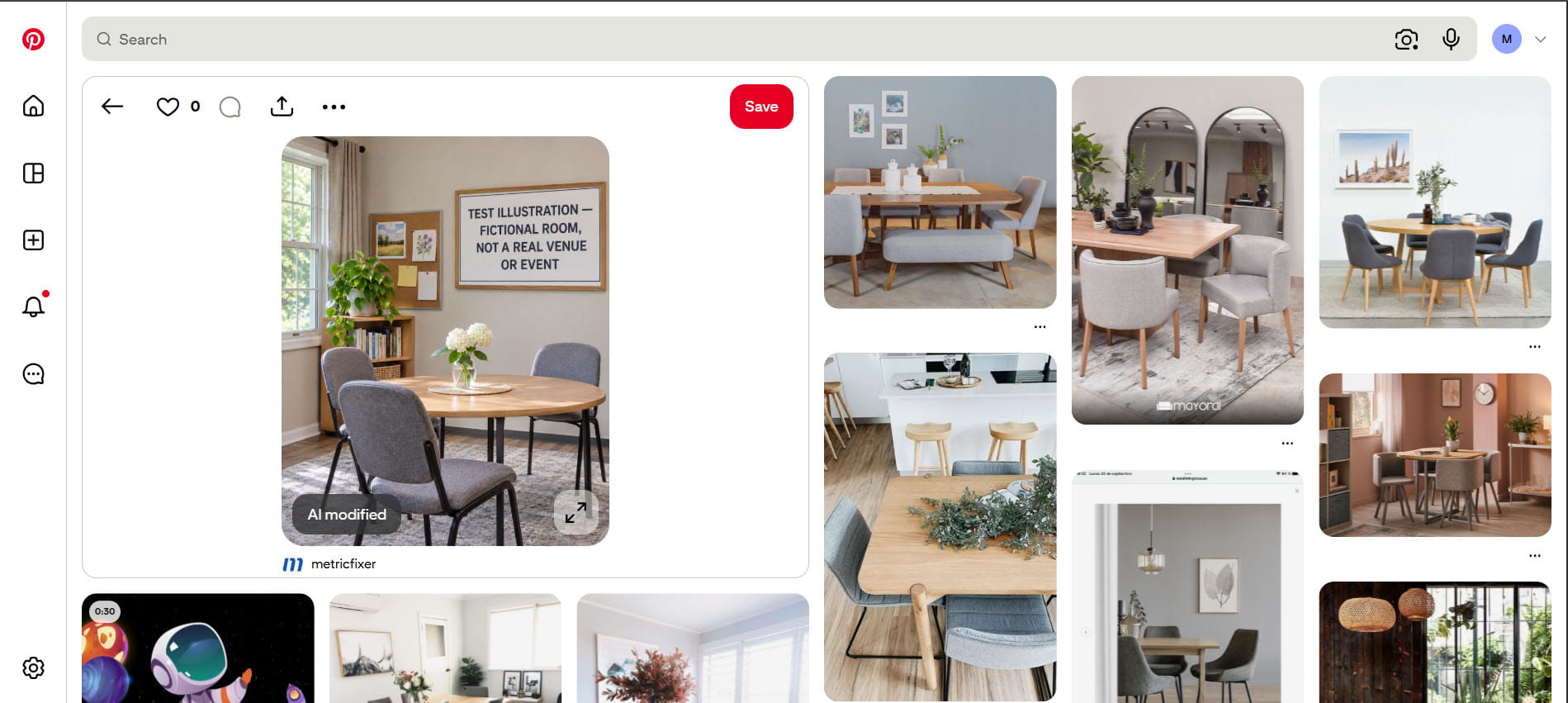
A reader-facing explanation can add information that a generic badge cannot: for example, AI-generated room concept; not a completed installation, or Actual product photographed in an AI-generated setting. These are proposed wording examples, not prescribed Pinterest language or guarantees of legal sufficiency. Use them only when they accurately describe the work.
Do not assume the existence of a native control creates a universal duty to label every AI-assisted sentence. Equally, do not assume an absent control eliminates a legal or commercial disclosure obligation. The applicable test depends on the material, the claim, the audience and the relevant rule.
Metadata, Content Credentials and false positives
Pinterest describes both IPTC metadata analysis and automated classifiers. Owner disclosure is another documented input. A system can therefore label content without an obvious visible watermark, while imperfect detection means an unlabelled image is not proof of human origin. Neither the presence nor the absence of a badge establishes whether the scene is truthful.
The IPTC Photo Metadata user guide distinguishes digital-source categories, including generative creation and composites involving generative material. In the vocabulary, trainedAlgorithmicMedia and compositeWithTrainedAlgorithmicMedia refer to different production histories. Preserve an accurate history rather than assigning the same status to an untouched camera photo and a newly generated scene.
C2PA's explainer describes a system for verifiable provenance assertions. That is not a guarantee that a pictured event happened or that a commercial claim is substantiated. The reviewed Pinterest materials do not establish a universal end-to-end promise to preserve or display every C2PA credential on every Pin. Do not turn a standards capability into an unsupported platform claim.
Our recommended production practice is to keep an original file, a working file and the exact published export, together with a short explanation of the transformations. Preserve legitimate provenance through ordinary export where the tools allow it. Do not strip metadata or repeatedly re-encode an image to evade a truthful label. When a label appears wrong, investigate the edit chain and use the appeal route instead.
Content supplied by a photographer or supplier needs the same discipline. Ask whether generative fill, replacement, synthesis or an AI export option was used; a file described casually as a photograph may have a more complicated history. An external AI detector's percentage is not a substitute for this evidence and is not a verified explanation of Pinterest's decision.
Viewer controls, recommendations and reach
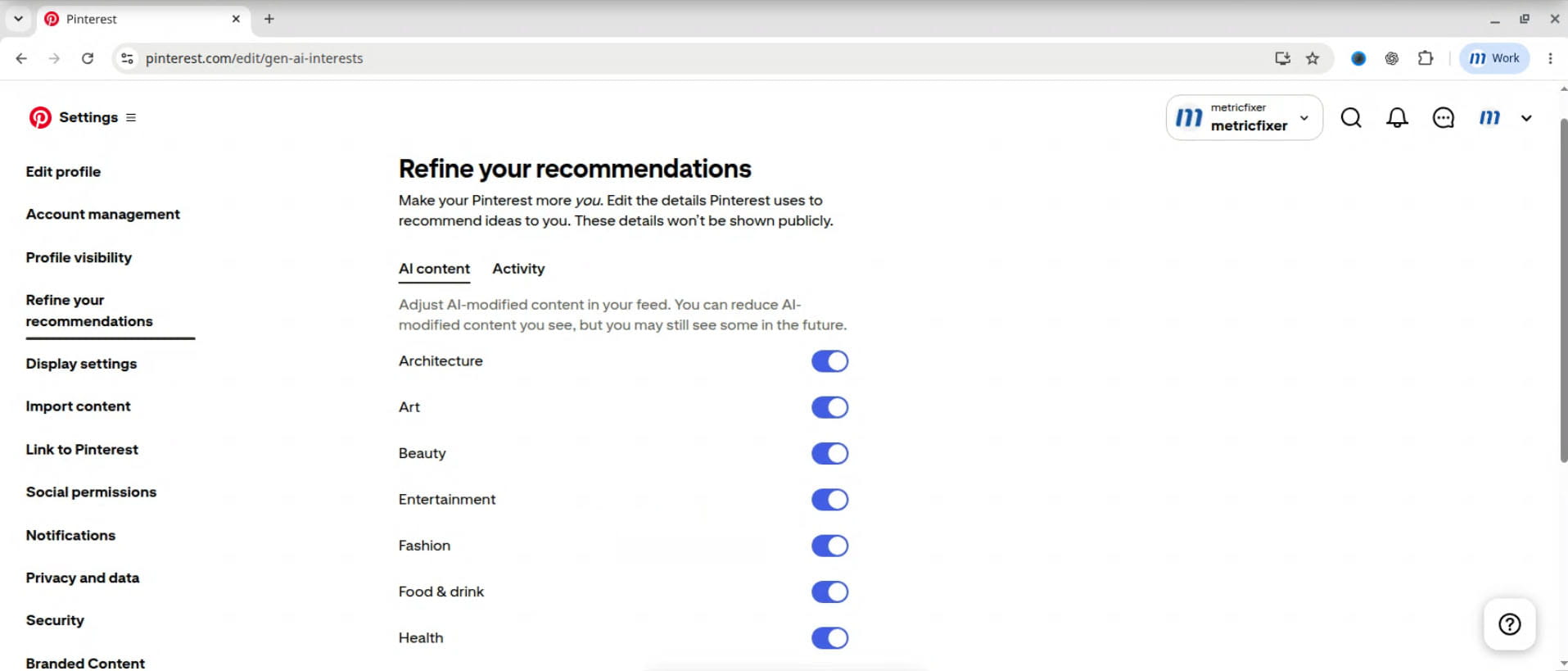
Pinterest lets people request less AI-generated content in supported topics. Its recommendation settings explain that these preferences refine recommendations; the home-feed settings do not control ads. Treat the feature as personalization, not a promise to remove all generated material from the service.
The historical announcement named an initial set of categories, with food and drink added later. For an operating guide, the topics and controls visible in the current account are the useful evidence. Do not keep repeating an early statement that a device is unsupported when later documentation or account behavior differs. This article has not verified a universal device-by-device rollout.
Pinterest's creator-facing AI guidance emphasizes inspirational, actionable and relevant content and describes limiting unhelpful or spam-like material. Its enforcement documentation also allows distribution restrictions separately from outright removal. The creation method is not the only variable in either explanation.
Operational inference: audience preferences can change which viewers a generated image is likely to reach. That does not reveal a universal ranking coefficient. An attractive but impossible craft pattern can also lose usefulness for reasons that have nothing to do with the badge itself. To diagnose performance, separate personalization, topic demand, creative quality, policy restrictions and the destination experience.
There is no defensible basis in the reviewed public documentation for a claim such as “AI-labelled Pins lose 40% of reach” or “remove the label to recover traffic.” Nor is there a published safe daily quantity that makes bulk generation acceptable. Treat those claims as unsupported unless a clearly described, relevant study supplies the missing evidence.
Search visibility and the Pin-to-page promise
Pinterest's creator resources describe a visual discovery journey and opportunities to send people to content, products and businesses. See its creator guide. For a publisher, however, the useful objective is not merely to make a striking image appear in search. It is to attract someone whose intended next action the destination can actually support.
Our recommended optimization unit is the whole chain: image → title and description → destination → promised outcome. Review these together. A Pin titled “Build this exact storage bench” should not land on a page containing only a generated picture and generic advice. A fictional concept can instead be presented as a concept, with a destination that explains its limitations and supplies practical alternatives.
Make titles and descriptions specific to the material actually shown. Choose a board and related topics that match the intended use, not every popular adjacent keyword. Build genuinely different treatments when they answer different user needs; changing only a background or a few words is not a substantive editorial reason to publish hundreds of near-identical assets. Pinterest's community rules address spam, misleading behavior and deceptive destinations.
Do not confuse a description with alternative text. Pinterest's alt-text instructions describe an accessibility feature used by screen readers. Write useful visual descriptions there; do not use the field as a keyword reservoir or as the only place for a disclosure that other viewers need to see.
The linked website is a separate publishing surface. A Pinterest disclosure does not inspect the page's factual claims, explain every generated illustration on the site or establish search-engine eligibility. The companion metricfixer article on AI content on websites addresses that separate SEO and editorial responsibility layer.
For landing-page quality assurance, test the actual destination on a mobile device. Confirm that the promised item or instructions are easy to find, the image is not contradicted by the page, material limitations are clear, and the visitor is not unexpectedly redirected somewhere unrelated. These are proposed operating checks, not an assertion that Pinterest uses each item as a disclosed ranking factor.
Practical scenarios for creators and brands
The following examples apply the article's editorial framework. They are not an official whitelist, an exhaustive legal classification or a guarantee of approval. The important question is what the finished publication communicates, not whether an isolated production step sounds harmless.
| Scenario | Useful treatment | Failure to avoid |
|---|---|---|
| Generated interior concept | Present it as a visualization. Explain what is conceptual and provide realistic dimensions, materials or alternatives where relevant. | Calling it a completed client installation or implying every depicted feature can be bought or built. |
| Real product in a generated background | Keep the product itself faithful. Check scale, color, included accessories and the implied use. | A new background quietly changes the product's apparent capacity, materials or performance. |
| Virtual model wearing an item | Distinguish a synthetic presentation from a customer photograph; verify the garment depiction and fit claims. | Inventing a buyer, body result, celebrity endorsement or tested fit. |
| Recipe illustration | Use actual preparation evidence for a claimed tested result. Label a generated concept as such. | Presenting an invented dish image as proof that the instructions produce that result. |
| Crochet, sewing or DIY pattern | Validate the instructions and, when claiming reproducibility, document a real sample. | Selling a pattern whose supposed finished example cannot be produced from the supplied instructions. |
| Travel inspiration | Clearly separate fantasy environments or design studies from real places and accommodation. | Using a generated location as evidence that a hotel, attraction or viewpoint exists. |
| Beauty or home-improvement before/after | Use evidence appropriate to the claim; distinguish illustration from an observed outcome. | Replacing the result with a generated improvement while retaining a real-world efficacy claim. |
| Educational or editorial graphic | Check the facts and make the illustration's role clear. Supply the actual explanation on the destination page. | Generated diagrams, quotes or expert identities being treated as verified evidence. |
| Affiliate product recommendation | Explain the commercial relationship and the basis for recommending the real item. | Invented testing, fictional reviews or a link to a different product from the one shown. |
| Reused or collaged image | Check source permissions and preserve the production history of each important element. | Assuming attribution, a save button or another platform's label grants reuse rights. |
A useful review question is: What would have to exist outside this picture for the claim to be true? A real customer, a buildable design, a tested recipe, a stocked product or permission from the depicted person may be necessary. Generating a convincing image does not create that missing evidence.
For cross-platform reuse, repeat the destination and disclosure review rather than carrying over an assumed approval. The separate metricfixer guides to AI content on Instagram and AI content on TikTok examine different interfaces and publishing contexts.
Affiliate content, products and paid promotion
AI production is not a business model by itself. Pinterest's creator guide discusses routes such as traffic to a business, affiliate opportunities and brand partnerships. That is not evidence of an automatic payment for each generated Pin, nor of a general entitlement to revenue simply because material receives impressions.
Affiliate and commercial disclosure
The commercial and branded content guidelines require transparency about commercial relationships and place conditions on affiliate activity, including original value, authentic operation and avoiding manipulative or excessive posting. They also contain specific commercial-disclosure requirements for EEA residents. These provisions are separate from identifying AI production.
For example, “AI-generated styling concept” explains the image, while “I may earn a commission from purchases through this link” explains an economic relationship. Neither statement replaces the other. The final wording and placement should fit the actual arrangement, the applicable rules and the viewer's encounter with the recommendation. A native paid-partnership function, where available and appropriate, should not be fabricated for an unpaid test.
Our recommendation for affiliate Pins is to document the recommendation's basis: personal testing, verified specifications, research or a clearly identified design concept. Do not claim a product was tested merely because the generated scene looks like an authentic review. Make the linked item identifiable and explain material differences when a Pin illustrates a style rather than the exact product.
Merchant and advertiser eligibility
Affiliate permission should not be confused with merchant eligibility. Pinterest's merchant guidelines distinguish merchants from affiliate marketers and require trustworthy shopping information and purchasable products. For a retailer, the visual, listing, price, availability and destination must refer to the actual offer. Being able to publish an organic Pin does not establish catalog or shopping eligibility.
Promotion adds the advertising guidelines, including requirements around truthful claims, intellectual property and the destination. Check an existing organic asset again before paying to distribute it. An AI badge cannot turn a fabricated endorsement, an unsupported efficacy claim or a nonexistent offer into an acceptable ad.
For agencies, make the client approve the exact image and its meaning, not just a folder of candidate renders. Preserve the approved version, the product evidence, the permitted placements and the decision on disclosures. Reopen the review if automatic creative changes or a later edit alter what viewers are being promised.
Catalog AI disclosures and feed quality
The retail catalog specification documents ai_disclosures under optional shopping-ad fields. It associates media URLs with disclosure values such as ai_modified and synthetic_performer, addressing realistic AI-generated or modified media and synthetic humans. A technically optional feed column does not settle whether disclosure is required by another rule or by law.
The following is an illustrative value for that field, using fictional URLs. It is not a complete catalog, an API request body or evidence that another platform's feed will map the field automatically.
[
  {
    "url": "https://example.com/assets/chair-scene-v2.jpg",
    "disclosure": ["ai_modified"]
  },
  {
    "url": "https://example.com/assets/virtual-presenter-v1.mp4",
    "disclosure": ["ai_modified", "synthetic_performer"]
  }
]
Match each entry to the media actually supplied. The specification also warns that replacing image content without changing its URL may prevent the image from updating. Treat an asset change as a versioned change, not simply a replacement of bytes behind an old address.
Our recommended implementation is to keep a media-level register beside the product feed. Store the product identifier, source asset, published URL, transformations, disclosure decision and approving owner. Generate the feed field from that register rather than asking an operator to remember which of thousands of files contains a synthetic person.
Validate the feed serialization used by the actual connector. A JSON value embedded in CSV needs the correct escaping for that transport. A connector that silently drops an unfamiliar column has not preserved the disclosure merely because the original spreadsheet contained it. Inspect the ingested result and, where possible, the published asset. Do not claim support for a particular connector without testing it.
Keep the product truth check independent. A syntactically valid field does not tell you whether a sofa has been enlarged, a bottle's label altered, accessories invented or a virtual model assigned an unsupported result. Review representative products and every higher-risk change before scaling the process. Sampling is a quality-control method, not permission to publish known inaccuracies elsewhere in the feed.
Pinterest's own AI tools and training controls
Creative tools do not remove publisher responsibility
Pinterest Performance+ creative includes features such as generative backgrounds alongside resizing and other optimizations. Do not classify every optimization as generative production. Check the actual feature, eligible asset and output rather than assigning one label to the whole product family.
Important reuse restriction: the reviewed Creative GenAI business terms grant use of covered outputs only on Pinterest and prohibit their publication elsewhere. They also put output evaluation on the user, provide no guarantee of uniqueness or rights clearance, prohibit personal data in inputs, and forbid removal of generated watermarks or authenticity metadata. This is a restriction on those covered Pinterest tools, not a claim about every externally generated image uploaded to Pinterest.
For a cross-platform campaign, therefore, approve the production route before generating the master asset. Do not assume that a tool built into an advertising account grants the same reuse rights as a separate creative license. Archive the applicable terms and give the production team a clear placement list.
The separate GenAI acceptable-use guidelines govern use of Pinterest's own generative features, alongside its other policies. They should not be mistaken for a complete statement of the rules for all third-party AI tools. Supplier contracts, input rights and destination-platform requirements remain separate checks.
Training preferences are not feed preferences
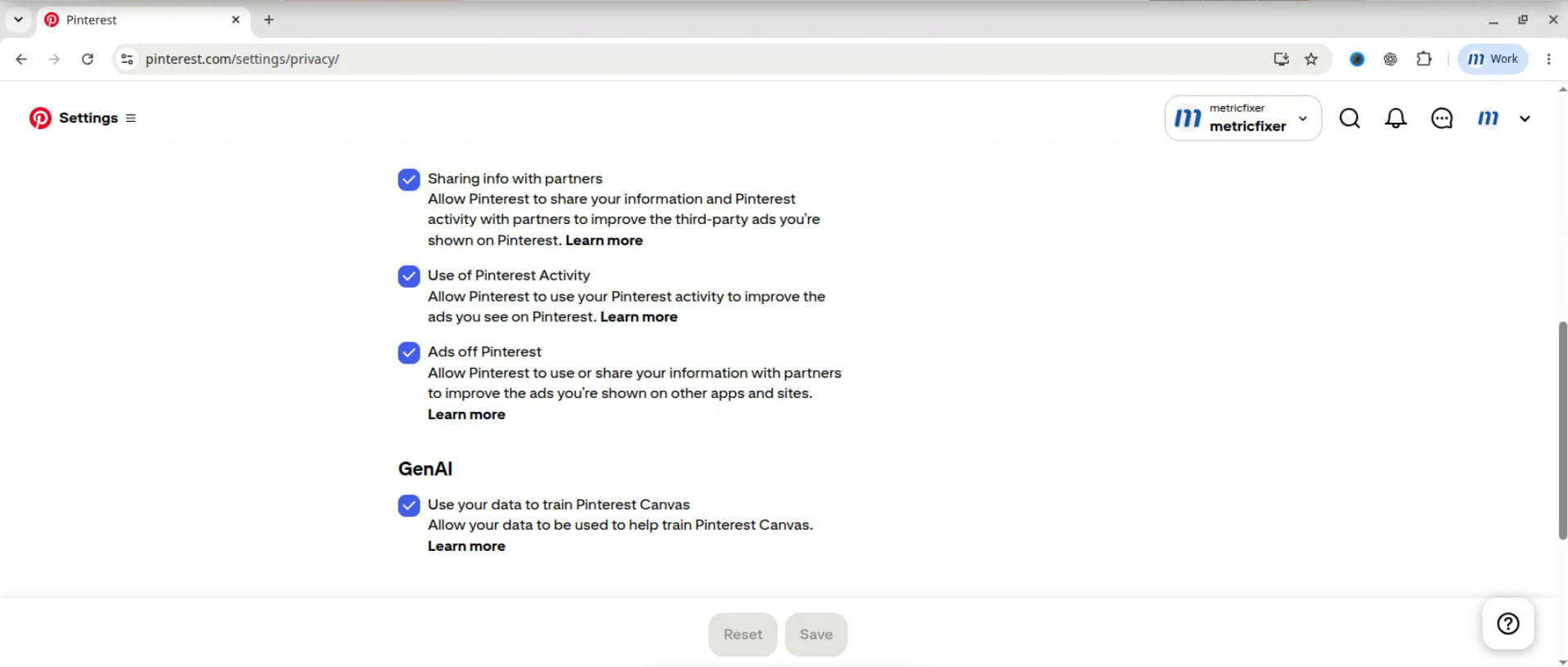
Pinterest's GenAI settings documentation describes a privacy control for using data to train Pinterest Canvas. The documented route is through settings and privacy/data options, using Use your data to train Pinterest Canvas. Pinterest says users under 18 are opted out and cannot opt in.
This is a different decision from seeing less AI in recommendations or declaring how a Pin was made. The documentation does not establish that switching it off erases past learning, prevents every other form of AI processing or controls copies held by third parties. Do not represent a model-specific setting as a universal opt-out from all AI.
Pinterest's October 2026 Beauty Guides announcement illustrates another distinction: platform AI can interpret inspiration and suggest steps or products. Our editorial conclusion is that such assistance should not be treated as independent proof that the source image depicts an achievable result. A creator's responsibility for the underlying claim is not transferred to an automated interpretation layer.
Legal disclosure and intellectual property
Law, platform policy and contractual tool restrictions operate at different levels. The following is an operational overview focused on the EU, with selected US and UK examples. It is not a worldwide compliance determination for every account or a substitute for advice on a specific campaign.
EU AI Act: distinguish provider duties from publisher duties
Article 50 separates provider-side machine-readable marking of certain synthetic outputs from deployer-side disclosure. The latter covers deepfake image, audio and video content and certain AI-generated text published to inform the public on matters of public interest. It is not a single rule requiring the same label on every use of AI.
For public-interest text, the provision includes an exception involving human review or editorial control and editorial responsibility. Do not transfer that exception automatically to deepfake imagery. Creative, fictional and similar works have a calibrated disclosure rule rather than a blanket exemption. The article also addresses clear, accessible information at the first interaction or exposure.
The Commission's transparency FAQ distinguishes professional deployers from purely personal, non-professional use. A business should not assume that publishing through an individual creator account makes a commercial workflow private activity.
The obligations apply from 2 August 2026. The Commission's timetable describes a transition until 2 December 2026 for certain provider marking obligations concerning earlier systems. That is not a general extension of creators' deepfake-disclosure duties. As of this article's review date, the August date is already in the past.
The Commission's Article 50 guidelines published on 12 November 2026 help explain contextual assessment. An AI-generated background does not automatically make a truthful product presentation a deepfake; changing how the product itself or its use is represented can change the assessment. A platform control may help implement disclosure, but its mere existence does not establish compliance with every legal requirement.
Our practical recommendation is to record the legal classification separately from the platform's classification. Review realistic depictions of real people, places, products and events with particular care. Where the law requires information at first exposure, do not assume that a notice buried in an optional menu is enough. Obtain jurisdiction-specific advice when the difference is material.
US and UK: a label does not repair a false claim
The US Federal Trade Commission's reviews and testimonials FAQ does not treat every virtual influencer as inherently prohibited. The crucial issue includes whether the underlying testimonial falsely represents an experience or endorsement. A synthetic character cannot truthfully report having bought and used a product merely because the audience has been told the character is AI-generated.
A useful UK example is the ASA's 9 April 2025 Henry's Boots ruling, involving Facebook advertising and an unsupported presentation of a shoemaker, handmade goods and a closing-down story. This was not a Pinterest enforcement case. Its relevance is the advertising claim: a manufactured story requires more than an attractive image and an AI disclaimer.
Copyright, likeness and the rights chain
The US Copyright Office's January 2025 report announcement on copyrightability explains that human-authored expressive contributions can be protected while prompting alone does not establish the required authorship. This is a US position, not a universal ownership rule for every jurisdiction.
Keep three questions separate: does the generator's contract permit the intended use; does the result attract relevant protection; and could publication infringe someone else's rights? Pinterest's terms and copyright policy do not turn an uploaded file into rights-cleared material.
For commissioned work, request the source assets, input permissions, tool identity and applicable license, important edits, any likeness or voice permissions, and the intended placements. Do not promise a client exclusivity simply because nobody else used the exact same prompt. Where a brand needs a defensible exclusive asset, treat the human creative contribution and rights documentation as part of the production budget.

Measure results without inventing an AI penalty
Pinterest's analytics documentation distinguishes impressions, saves, Pin clicks and outbound clicks. A Pin click can open the Pin; an outbound click concerns an action leading away from Pinterest. These are different stages, not interchangeable traffic totals. Compare the relevant organic, paid and earned views with their actual definitions.
Build a creative register that connects the published Pin to the production scenario, topic, format, publish date, destination and observed disclosure. This is a proposed internal dataset; the reviewed documentation does not establish a universal analytics filter that cleanly separates all AI content for you.
| Question | Useful comparison | Interpretation limit |
|---|---|---|
| Was the content distributed? | Impressions over comparable time since publication, separated by topic and placement. | A change does not identify whether labeling, seasonality, demand or account conditions caused it. |
| Did it help someone plan or collect ideas? | Saves and save rate for comparable creative purposes. | A save does not establish a purchase or prove that the idea is workable. |
| Did it send people to the intended destination? | Outbound clicks and outbound-click rate, not close-up clicks alone. | Platform clicks are not guaranteed to equal measured website sessions. |
| Did the destination fulfill the promise? | Relevant on-site actions, qualified leads, purchases and support feedback. | Attribution settings and tracking coverage affect observed outcomes. |
| Did the image create a harmful expectation? | Product complaints, returns, clarification requests and qualitative feedback. | These require business records and judgment, not a single Pinterest engagement metric. |
For reporting, outbound clicks / impressions expresses outbound-click rate before percentage formatting. State the time window, numerator, denominator, traffic scope and whether figures are provisional. The same discipline applies to any internally calculated rate.
Match comparisons by topic, account, format, country where available, destination and time since publication. A new generated holiday Pin and an established evergreen photograph are not a controlled experiment. Treat small samples and simultaneous changes cautiously. Where practical, compare multiple creative approaches that are all truthful and correctly disclosed; never suppress a required disclosure to manufacture a test condition.
The business question is not “Did AI win?” It is whether a particular production method delivered useful, accurately represented content more efficiently, without increasing complaints or creating an unsustainable maintenance burden. Track production and review time as well as visible platform outcomes.
Appeals, corrections and existing Pins
Identify the decision before choosing a remedy. The AI-label help page points owners to support for a disputed label. The enforcement policy addresses content and account measures, while the copyright procedure serves a different legal purpose. An AI-label complaint is not automatically a copyright claim or an appeal of an advertising restriction.
| Problem | Evidence to preserve | Recommended action |
|---|---|---|
| A label appears inaccurate | Source file, edit history, published export, Pin reference and a screenshot of the label. | Explain the actual production process through the documented support route; do not promise a particular review time. |
| Content is restricted, removed or an ad is rejected | The notice, stated policy, affected account or asset and the version reviewed. | Use the relevant review route and address the stated reason, rather than assuming the presence of AI explains everything. |
| The image or destination makes an incorrect claim | Original publication, corrected facts and the extent of reuse. | Pause further use, correct or withdraw the material, and check other placements under your control. |
| Someone has reused protected material | Ownership or authorization evidence and precise references to the disputed material. | Use the applicable rights procedure accurately; generated appearance alone does not prove infringement. |
Audit existing Pins by risk, not simply by whether AI appeared somewhere in production. Prioritize real-product representations, purported testimonials, health or efficacy claims, nonexistent destinations and paid assets. For lower-risk concepts, check whether the framing remains clear and the linked page still fulfills the original promise.
Do not assume editing one source updates every saved, downloaded, republished or externally copied version. Record what you changed and what remains outside your control. Do not mass-delete useful, truthful content merely because it used AI, and do not repeatedly reupload the same disputed asset to try to escape a label or restriction.
A publish-and-verify workflow
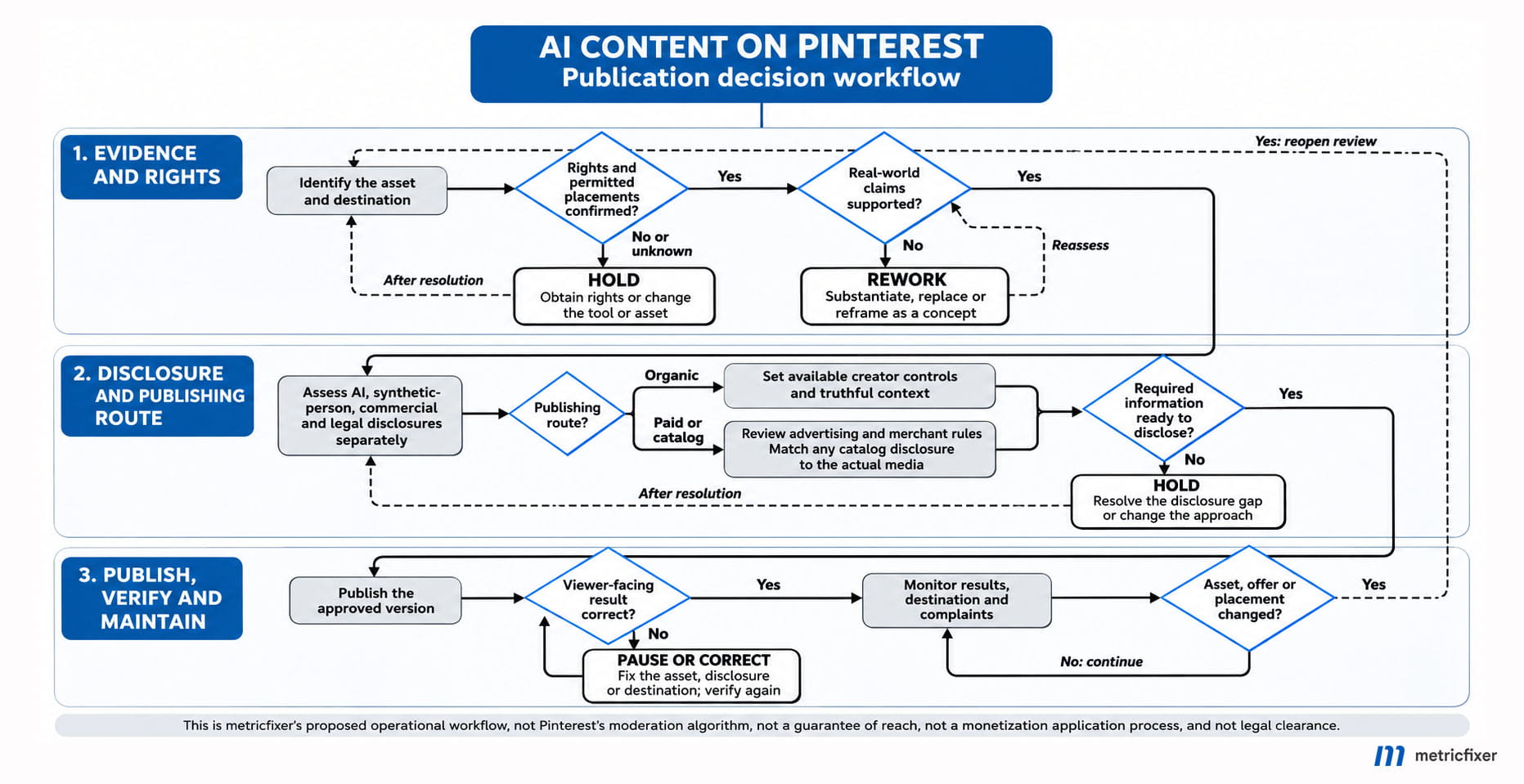
The following is metricfixer's recommended operating process, not Pinterest's internal moderation pipeline. Its purpose is to stop a production team from treating disclosure as the only decision.
Text workflow: identify the asset and destination → document source rights and tool restrictions → verify the implied real-world claim → classify platform, legal and commercial disclosures separately → review the exact publishing or catalog route → publish only the approved version → inspect the viewer-facing result → measure, correct and recheck when the asset or offer changes. If evidence, rights or required disclosure is missing, stop and resolve the gap before publication.
Publication checklist
- [ ] Production history: the original sources, generated elements and final exported version are recorded.
- [ ] Rights and placements: the inputs and output can be used in the intended account, countries and platforms; covered tool-specific restrictions have been checked.
- [ ] Claim and evidence: the image does not invent a product, tested result, customer experience or completed project.
- [ ] Destination: the linked page fulfills the Pin's promise and remains accurate on mobile.
- [ ] Disclosures: AI production, synthetic people, commercial relationships and any applicable legal information have been assessed separately.
- [ ] Publishing route: native controls and catalog fields, where relevant, match the actual asset; promotion has received its additional review.
- [ ] Viewer verification: the published organic or promoted version, crop, text, destination and disclosure have been checked and recorded.
- [ ] Ownership after publication: someone is responsible for changes, complaints, appeals, offer expiry and later reuse.
For a solo creator, this can be a small asset register rather than a complex system. For an agency or large retailer, connect it to approvals and feed generation. The amount of documentation should match the risk and scale, but the underlying questions do not disappear when production becomes faster.
The durable principle is simple: AI can help create the presentation; it cannot stand in for the evidence behind the promise. A useful Pinterest strategy starts with something worth discovering and a reliable next step, then chooses the production method and disclosure that accurately represent it.
Methodology and sources
This research reviewed public primary sources available on 18 November 2026: Pinterest's help center, creator resources, newsroom, community and commercial policies, catalog documentation, tool terms and enforcement materials; IPTC and C2PA documentation; European Commission AI Act materials; the US FTC and Copyright Office; and the UK's ASA. Sources are linked at the points where they support the discussion rather than repeated as a numbered bibliography.
Official policy text was used for obligations, help documentation for described product behavior, and dated announcements for rollout history. Editorial workflows, hypothetical scenarios, suggested wording and measurement designs are metricfixer's analysis, not statements of Pinterest's internal systems. The article does not rely on third-party estimates of the share of Pinterest content generated with AI, anecdotal claims of a universal reach penalty or generator marketing promises as evidence of platform permission.
Verification limits: no logged-in Pinterest account, catalog ingestion, paid campaign or controlled distribution experiment was operated for this research. The screenshot positions are editorial capture requests, not evidence of a test already performed. Public pages and indexed versions can differ in recency; where a device-specific rollout or exact implementation was not reliably established, the article avoids a universal availability claim. Current UI wording and the terms applicable to a particular account should be rechecked before implementation.
The legal section is selective and jurisdiction-dependent. Commission guidance is interpretive material, not a replacement for the regulation or authoritative court interpretation. The ASA example concerns Facebook ads and is included for its claim-substantiation reasoning, not as Pinterest enforcement evidence. The US copyright discussion is not presented as a worldwide ownership rule.
This is part 1.5 of metricfixer's AI-content series. It complements the website and platform-specific guides while focusing on Pinterest's distinctive connection between visual inspiration, practical action and commerce.
This article provides editorial, technical and operational information, not legal advice or a guarantee of publication, distribution, monetization or advertising approval. metricfixer is not affiliated with Pinterest or the other platforms, standards bodies and regulators mentioned. Policies, interfaces, availability and legal interpretations may change. Publishers, advertisers and their advisers remain responsible for the content, rights, claims and disclosures relevant to their own use.