
Published Nov 12, 2026
AI Content on Websites: SEO, Disclosure and Editorial Responsibility
AI can help produce useful website content, but it does not transfer editorial responsibility. This guide separates SEO quality, legal disclosure and provenance, with practical checks for articles, products and synthetic media.
Category: SEO & Web Marketing · By metricfixer AI Studio
AI can help a website publish better explanations, clearer product information and more accessible media. It can also produce convincing errors, invented experience and thousands of pages with little reason to exist. This guide separates the questions that publishers need to answer: what search engines expect, when readers must be told about AI use, what provenance metadata can establish, and who takes responsibility for the finished page.
Practical starting point: assess the content before choosing the label. Verify its claims, usefulness and permissions; identify the rules that apply to its audience and format; then check both the visible page and the files actually delivered to visitors. A disclosure is not a substitute for any of these checks. Research checked: 11 November 2026.
AI disclosure: AI tools were used for research synthesis and drafting of this article.
Contents
Executive summary
Using AI is not, by itself, a reason that a page must disappear from search. Google's guidance allows appropriate AI assistance, while its spam policies target practices such as producing large volumes of low-value material to manipulate rankings. Bing likewise warns about scaled generation without adequate oversight. The useful question is whether the finished page deserves to exist, not whether a detector assigns it a reassuring score.
Disclosure has several different purposes. A visible note informs the reader. Provenance metadata records information about an asset's origin. A merchant feed may require specific attributes. A legal obligation depends on jurisdiction, role, content and context. Meeting one of these requirements does not automatically meet the others.
For EU-facing publishing, the central distinction is between provider-side marking under Article 50(2) and deployer-side disclosure under Article 50(4) of the AI Act. The latter addresses deepfakes and certain public-interest text, not every sentence touched by AI. The editorial-review exception for text is not a general exemption for synthetic images or video. Article 50 and the Commission's implementation explanations should be read together.
Our recommended default is a risk-based editorial workflow: useful content, checked evidence, an accountable publisher, an appropriate disclosure decision and final-delivery verification. Keep worthwhile pages; repair weak ones; stop publishing material whose substance cannot be defended.

What counts as AI content on a website?
For an editorial audit, record what AI actually did. The following categories are a practical inventory, not statutory definitions.
| Use of AI | What reaches the reader | Main review question |
|---|---|---|
| Internal assistance | Ideas, outlines or research leads that an editor develops independently. | Were the underlying sources checked rather than treated as verified because a model suggested them? |
| Editing and translation | A revised or translated version of existing material. | Did the process change meaning, qualifications, measurements or legal and technical terminology? |
| Generated text | Articles, FAQs, descriptions, comparisons or local landing pages. | What evidence and distinctive value support the published claims? |
| Generated or altered visuals | Illustrations, product scenes, portraits, screenshots or apparent documentary photographs. | Could someone mistake the image for evidence of a real product, person, interface or event? |
| Synthetic audio and video | Narration, translated speech, virtual presenters or generated scenes. | What could viewers infer about identity, consent, authenticity and actual experience? |
A page can contain several categories at once. A human-written investigation might have a generated hero image and synthetic narration. An AI-assisted product description might accompany an unmodified photograph. Evaluate the components separately rather than assigning one vague label to the entire URL.
Also distinguish content production from a live service. A website chatbot introduces interaction-related questions beyond this article's publishing workflow. Article 50 has a separate provision for direct interaction with AI; an editorial note attached to a blog post is not a substitute for assessing that feature. The interaction and content provisions are distinct.
What Google and Bing actually evaluate
Google: usefulness is not the same as human-only production
Google's AI-content guidance rejects both simplistic extremes: appropriate automation is not prohibited, and using AI does not earn a ranking advantage. The current website guidance also tells publishers to check accuracy and trustworthiness, including generated titles, descriptions, image alternatives and structured data.
The distinction matters in everyday publishing. Turning verified specifications into readable product copy is a different editorial task from inventing a review of a product nobody tested. Summarising primary documentation with a checked implementation example is different from rewriting competing articles without adding anything useful. These are practical applications of the quality principle, not platform-approved safe harbours.
Google's people-first content questions ask about original information, substantial analysis, clear sourcing and genuine experience. A competent editor should therefore ask what readers gain from this page that they would not gain from the source material alone. Sometimes the answer is original research; sometimes it is a careful comparison, a tested procedure or an explanation that makes a difficult task understandable.
Scaled content abuse is about the publishing pattern
Scaled content abuse covers large amounts of unoriginal, low-value content created primarily to manipulate search rankings, regardless of the production method. Google's examples include generation, scraping, superficial transformation and combining other pages without adding value. The same policies address doorway pages aimed at similar searches.
Consider a company generating hundreds of near-identical city pages despite offering no distinct local service information. Replacing the city name and adding an AI-written introduction does not establish a useful local page. Conversely, a genuinely helpful catalogue is not automatically abusive because it contains many URLs. Review the purpose, data and differences between pages.
Bing: editorial oversight is explicit
Bing's Webmaster Guidelines identify large-scale generation without oversight, quality control or editorial review as a practice that may lead to exclusion from indexing. The guidelines also connect content clarity, accuracy and originality with eligibility across search and AI-grounding experiences. They do not promise visibility merely because someone approved the draft.
Editorial conclusion: review quality and the production system together. A good sample page cannot validate an unchecked pipeline, and a human byline cannot make fabricated evidence genuine. Neither engine's reviewed guidance supports a universal safe percentage of AI-written words.
Separate indexing, ranking and AI visibility
A page not appearing where you expect is a symptom, not an explanation. Google describes discovery, crawling, indexing and serving as separate processes. Use that distinction before attributing a problem to AI.
| Stage | What to investigate | What the observation does not prove |
|---|---|---|
| Discovery and crawling | Internal links, sitemaps, server responses, crawler access and relevant logs. | An unfetched URL does not establish a judgement about AI authorship. |
| Indexing | Indexing reports, canonical selection, duplicate content and indexing directives. | Crawling does not guarantee index inclusion. |
| Ranking and traffic | Query-level changes, competing results, seasonality, technical changes and policy issues. | A traffic decline after adopting AI does not isolate AI as the cause. |
| AI-answer visibility | Eligibility, actual citations and the limits of the reporting available. | Being indexed does not guarantee selection as an AI-answer source. |
For Google's AI Overviews and AI Mode, a supporting page must be indexed and eligible to appear with a snippet. Google says there is no special schema or additional technical file required for inclusion, and inclusion is not guaranteed. These AI-feature requirements concern how a page can be used as a source, not whether its author used AI.
Keep citation visibility separate from visits and conversions. For that measurement layer, see metricfixer's comparison of Bing AI Performance and Google AI visibility reporting.
When traffic falls, follow a diagnostic process rather than purchasing a rewrite solely to make the text look less machine-generated. Google's traffic-drop guidance covers technical failures, updates, spam issues and changing demand. A manual action is different from an algorithmic change; the absence of a manual action is not a certificate of content quality.
What human editing needs to add
For this workflow, editorial review means being able to approve, change or reject the substance. It is not replacing a few words or clicking an approval button. A useful review leaves a record of what was checked and who could defend the result.
Verify consequential claims against their sources. Open the underlying document. Check its date, jurisdiction, product version, sample and limitations. A source mentioning a feature does not necessarily show that the feature is available to every account. A study observing an association does not automatically establish causation.
Remove invented experience. Do not publish first-person testing, customer interviews, quotations, case-study results or expert credentials that did not exist. A generated screenshot can illustrate a concept only when its nature is unmistakable; it should not stand in for evidence of a real interface. A review based on specifications should say so rather than pretending to be a hands-on test.
Check the less visible output. A reliable article can still be misrepresented by an exaggerated SEO title, an inaccurate image description or invented ratings in structured data. Google's generative-AI guidance explicitly extends accuracy checks to metadata. Treat these fields as published claims.
Match the reviewer to the risk. A copy editor can improve clarity without being qualified to validate a medical instruction, legal interpretation or engineering safety calculation. Our recommendation is to require subject-matter review where a plausible error could cause significant harm, and to withhold material when adequate verification is unavailable.
Retain a useful evidence record. Save the source references, important revisions, approvals and permissions needed to explain the publication. Do not automatically retain unnecessary personal data or confidential prompts. Ask contractors to provide the same evidence rather than a bare assurance that the output is original.
For bylines, use real, accountable contributors and accurately describe their role. A fictional expert biography is not a shortcut to trust. Google's guidance on who created a page and how it was produced is a reason to make authorship informative, not decorative.

Why AI-detector scores are not an editorial standard
Research does not support treating every detector as either useless or infallible. A 2025 shared task using the RAID benchmark reported strong detection within a fixed collection of domains and models represented in training. A separate 2025 practical evaluation found substantial weaknesses when detectors encountered unfamiliar domains, datasets and models.
Earlier research published in Patterns also documented false accusations against non-native English writing in its test samples. That is evidence of a particular failure mode, not a current error-rate estimate for every commercial product.
The operational lesson is narrower and more useful: a detector result is not proof of authorship, factual accuracy, originality, legal compliance or search eligibility. Before using a tool even for triage, evaluate it against your languages, formats and known human-written material. Never use its score as the sole basis for accusing a contributor, deleting a page or approving a legal disclosure decision.
For a publishing team, sources, version history and a substantive review record usually answer the important questions more directly. Rewriting correct material merely to lower an AI score does not add evidence or reader value.
EU rules: what website publishers must distinguish
The EU AI Act does not create one identical label requirement for every use of AI. Start with the actor, the content and the audience. Under its scope provisions, relevant obligations can also reach providers and deployers outside the EU where the system's output is used in the Union. A company's registration country alone does not settle the analysis.
Providers mark outputs; deployers disclose particular uses
Article 50(2) concerns providers of systems generating synthetic text, images, audio or video. It requires machine-readable marking and detectability, subject to technical qualifications and exceptions, including certain standard-editing or non-substantial changes. Article 50(4) addresses deployers publishing particular kinds of content. The two obligations have different scope.
A business using a generator for its own publication will often need a deployer analysis. A business developing or supplying a generator under its own name may have provider obligations as well. Outsourcing production is not a reliable way to avoid responsibility; record who controls the system use and publication.
Public-interest text has a specific editorial exception
The text-disclosure provision concerns AI-generated or manipulated text published to inform the public on matters of public interest. Its exception requires human review or editorial control and a natural or legal person holding editorial responsibility. The Commission explains that substantive scrutiny matters: spelling checks or formal approval alone are insufficient.
Do not limit public interest to election news or assume that a commercial website is outside the category. A company can publish analysis of public health, consumer safety or economic developments. Assess the actual subject and purpose. Conversely, this provision should not be described as requiring an identical banner on every ordinary product sentence.
Our recommended evidence is a named review role, the relevant sources, substantive changes and a recorded approval decision. These records help explain the workflow; they are not a statutory template or an automatic legal safe harbour.
Deepfakes require a separate decision
The Act's definition covers AI-generated or manipulated image, audio or video that imitates existing people, objects, places, entities or events in a way that falsely appears authentic or truthful. It is not limited to face-swapping. The Commission's interpretation considers plausibly real subjects and the audience's expectations, so a realistic fabricated scene cannot be dismissed merely because it does not copy one named person.
For a website, consider a generated factory photograph, a virtual apartment interior, an apparent executive interview or a product demonstration that never occurred. The question is what the audience is likely to understand as real. A clearly conceptual diagram raises different questions from a photorealistic image presented as documentary evidence.
Human approval of the accompanying article does not remove a separate deepfake-disclosure duty. The text exception is not a universal exemption. For evidently artistic, creative, fictional or satirical works, Article 50 provides an adapted manner of disclosure that does not hamper enjoyment; it does not simply say that creative work needs no disclosure. Check the applicable provision rather than borrowing an exception from another format.
Dates and guidance: avoid outdated rollout summaries
Article 50 generally applies from 2 August 2026. The consolidated Act, Article 111(4) gives providers of systems placed on the market before that date until 2 December 2026 to meet Article 50(2). That limited transition is not a blanket postponement of publishers' Article 50(4) duties.
The Commission's guidelines were published on 20 July 2026. The Code of Practice on Transparency of AI-generated Content is a voluntary compliance tool, not a voluntary replacement for the law. Likewise, the EU labelling icons are optional and do not, by themselves, establish compliance.
The Commission's FAQ says content generated before 2 August 2026 does not require retrospective labelling under these provisions, while encouraging disclosure where possible. Keep creation and modification dates during an audit; do not turn that point into a broad exemption for newly generated replacements or misleading legacy content.
US and UK rules: different frameworks, similar publishing risks
United States: check the specific obligation and the actor
For a US-facing website, start with the applicable activity rather than importing the EU test unchanged. Federal consumer-protection requirements and state-specific rules can address different conduct. This review is not a survey of all state laws or sector-specific requirements.
The FTC's Consumer Reviews and Testimonials Rule addresses fabricated or false reviews, including material that pretends to come from a nonexistent person or someone without the claimed experience. An AI-generated testimonial presented as a real customer's experience is therefore a substantive problem, not just a missing-label problem. AI assistance with a genuine review should not be confused with inventing the reviewer or the experience.
California also illustrates why publication dates matter. Its AI Transparency Act became operative on 2 August 2026, and SB 1000 was signed on 30 September 2026 as an urgency measure. The enacted text removed the former million-user threshold for covered providers and revised the verification and latent-disclosure provisions. Repeating an older summary can therefore misstate who is covered.
These provider duties are not equivalent to a general instruction that every blog author must put a visible label on every AI-assisted paragraph. However, a publisher that also offers a public generator must assess that additional role. Separate platform and device provisions have their own scope and timing. Obtain a jurisdiction-specific assessment where the business goes beyond ordinary publishing.
United Kingdom: no general regime does not mean no responsibility
The UK government's 18 March 2026 report described the absence of a general AI-content labelling requirement. A 29 October 2026 parliamentary answer still described a taskforce developing proposals, not an enacted universal labelling regime. Those policy discussions should not be presented as current blanket duties.
Existing obligations remain relevant. The CMA's guidance for publishers of consumer reviews requires reasonable and proportionate measures to prevent and remove prohibited review material; using a third-party supplier does not eliminate the publisher's responsibilities. Its guidance on AI agents also stresses accurate customer-facing information and avoiding misleading impressions about human involvement.
For an ordinary website, the practical conclusion is to distinguish a legal AI-label requirement from the broader obligation not to mislead. A caption explaining that a showroom image is generated cannot justify false claims about what customers will receive.

How to disclose AI use on the page
Use disclosure to explain the particular thing a reader might misunderstand. A site-wide policy can describe the editorial process, but it should not carry all the burden for an asset encountered on another page.
For covered EU disclosures, information must be clear and distinguishable by the time people first encounter the content. The Commission explains that a person should not need a technical inspection tool to discover the disclosure. Article 50(5) and the Commission's explanation are the legal basis; our implementation recommendation is to keep the relevant note next to the article, image or player rather than behind a tooltip or footer link.
| Mechanism | What it does well | What it does not replace |
|---|---|---|
| Article-level note | Explains material AI involvement in the text and the actual editorial process. | Fact-checking, a real responsible publisher or an image-specific disclosure. |
| Caption or player notice | Identifies a synthetic scene, altered image or generated voice at the point of use. | Permissions, truthful commercial claims or required metadata. |
| Editorial AI policy | Explains standards, oversight and correction procedures across the site. | A clear notice attached to content that requires its own disclosure. |
| Alternative text | Communicates an image's purpose and relevant meaning accessibly. | A visible disclosure for sighted readers. |
| Provenance metadata | Provides machine-readable origin or editing information. | A reader-facing explanation or proof that the depicted claim is true. |
W3C's image-accessibility guidance distinguishes informative, functional and decorative images. Write alt for the image's purpose. Include synthetic status when it is important to understanding the image, but do not replace the description with a long legal disclaimer. A genuinely decorative image may use alt=""; essential disclosure must still be available accessibly elsewhere.
For example, the following is a wording pattern for an illustrative scene, not a prescribed legal formula. Replace the sample path with the approved asset and adapt the description to the real image.
<figure>
  <img src="/media/approved-concept-illustration.webp"
       alt="AI-generated illustration of an editor checking sources beside a draft article.">
  <figcaption>
    AI-generated editorial illustration. It does not show a real office,
    person or documented event.
  </figcaption>
</figure>
For text, a useful disclosure might identify the actual roles: AI drafted a translation; a named editor checked it against the original. Only say that after the review occurred. A generic statement that an article was reviewed by experts is worse than an honest, narrower explanation when no such experts were involved.
For audio and video, consider the viewer's first encounter, including autoplay, muted playback, accessibility and direct file access. A note below the fold may not accompany the experience you intend to explain. The hosting and embedding decision creates additional operational questions, covered in metricfixer's guide to website video hosting.
Content Credentials, watermarks and metadata
These mechanisms are related but not interchangeable. An IPTC field can describe a file's digital source. A watermark can carry a signal within the media. C2PA Content Credentials provide signed, tamper-evident provenance information linked to an asset. None should be treated as a universal verdict on factual truth.
The C2PA explainer explicitly separates verifiable provenance from whether the content is true, accurate or factual. A signed record can establish something about origin and editing without proving that an apparent event occurred. Absence of credentials likewise does not prove that a photograph is fake.
Provenance can also become incomplete during distribution. The Content Authenticity Initiative's documentation discusses lost metadata and recovery through supported watermark or fingerprint mechanisms. Durable credentials are an implementation capability, not a guarantee that every cropped or converted copy will retain a complete record.
Our recommended delivery check is simple: retain the original file, then inspect the version served by the live website. Test responsive variants, thumbnails and files delivered through the image CDN. Record whether relevant metadata is preserved and whether a provenance-aware transformation is needed. Do not copy an old cryptographic manifest onto changed pixels and assume the signature remains valid.
A visible caption, correct provenance handling and accurate content should work together. Publishing credentials without a readable explanation can leave the audience uninformed; publishing a caption while stripping required metadata can leave a distribution obligation unmet.
Ecommerce has additional Google requirements
A merchant should not assume that general Search guidance is the complete specification for product data. Google Merchant Center has explicit requirements for AI-generated content used in its product submissions.
For AI-generated images, Google requires appropriate embedded source metadata and instructs merchants not to remove relevant tags. Its documentation identifies IPTC DigitalSourceType values including TrainedAlgorithmicMedia, CompositeSynthetic and AlgorithmicMedia. These describe different origins; preserve the correct classification rather than assigning every processed image the same value.
For generated product titles and descriptions, the documented fields are structured_title and structured_description, with digital_source_type set to trained_algorithmic_media and the text in content. These are product-data attributes, not an instruction to add a similarly named schema property or HTML meta tag to every website article.

Operationally, compare the product record, page, image and submitted data. AI must not invent materials, compatibility, dimensions, accessories or performance. A generated lifestyle scene should not change the product being sold. For large catalogues, metricfixer's image-remediation and upscaling guide covers the separate task of improving image delivery without inventing product detail.
Keep three checks distinct: whether the product information is accurate, whether the image could mislead a person, and whether the submission retains the required source information. Passing one is not evidence that the other two passed.
Practical scenarios for website teams
The following scenarios apply the distinctions above. They are editorial starting points, not exhaustive legal classifications; use the actual market, publication purpose and asset to make the decision.
| Scenario | What to verify | Recommended publishing decision |
|---|---|---|
| An AI-assisted explainer based on official documentation | The current source, exceptions, original contribution and real editorial review. | Publish once supported. Assess public-interest text rules and describe material AI involvement accurately. |
| A translated technical or legal guide | Meaning, negations, numbers, terminology, local applicability and consistency with the source version. | Require a qualified language and subject review. Do not imply local legal validation merely because the text was translated. |
| Thousands of product descriptions | Authoritative product attributes, unsupported additions, feed fields and category-level error patterns. | Constrain generation to verified data; combine automated validation with proportionate human review and escalation. |
| Near-identical city or service pages | Real local availability, unique information and a reason for each URL to exist. | Consolidate or rebuild weak pages instead of disguising duplication with rewritten introductions. |
| A comparison presented as a hands-on review | Whether the tests occurred and what the evidence supports. | Replace invented experience with a clearly described desk-based comparison, or perform and document the tests. |
| A photorealistic generated office or factory image | Whether readers may believe it depicts the business's actual premises, staff or operations. | Use a real photograph where evidence matters. Otherwise assess disclosure and explain its illustrative nature at the point of use. |
| A generated diagram or conceptual illustration | Accuracy, legibility, accessibility and whether any element could be mistaken for observed data. | Verify the explanation. Distinguish invented examples from measurements; assess the asset rather than automatically calling it a deepfake. |
| A synthetic voice reading an article | Text accuracy, voice permissions, possible impersonation and the player experience. | Identify generated narration where appropriate and assess disclosure separately from the article's text review. |
| Health, financial, safety or public-interest instructions | Qualified review, applicable rules, evidence and consequences of error. | Hold publication when adequate verification is missing. A disclaimer is not a substitute for reliable instructions. |
| Reviews supplied by users or a third party | Authenticity, evidence of experience, moderation signals and how summaries and ratings are produced. | Investigate suspect material and operate a review-control process. Do not manufacture replacement praise with AI. |
Audit existing content without deleting everything
Build an inventory around risk, not detector percentages
Record the URL, page purpose, production method where known, responsible editor, source evidence, asset origins, review status, disclosure decision and relevant distribution channels. Use an unknown status where records are missing; do not convert uncertainty into a confident AI-authorship claim.
Prioritise misleading product visuals, fabricated reviews, invented credentials, consequential instructions and large template families with recurring errors. Commercial importance and potential harm should influence the order alongside traffic. A popular page with a serious false claim is not safe merely because it ranks.
Choose the action that fixes the actual problem
Keep accurate, useful material. Improve pages missing evidence or clarity. Consolidate redundant pages where a better destination genuinely serves the same need. Remove content that should not remain available. For a useful page that should not appear in search, consider an appropriate indexing decision rather than deleting it solely because AI was involved.
Where noindex is the chosen technical measure, Google must be able to crawl the page to see it; blocking the URL in robots.txt is not an equivalent implementation. Google's indexing-control documentation explains the distinction. More importantly, excluding a deceptive page from search does not correct what direct visitors still see.
Do not make mass redirects to an unrelated homepage or rewrite every URL merely to change the perceived writing style. Preserve a before-and-after record so that substantive corrections can be separated from changes to titles, templates, navigation or indexing settings.
Fix the production system, then monitor outcomes
If the same error appears across a template family, correct the input, prompt constraints, source data or approval process. Repairing individual outputs while leaving the faulty pipeline running only creates a growing correction queue.
Monitor technical access, index inclusion, query-level impressions and clicks, useful actions and user complaints. Compare like-for-like groups where possible and record concurrent changes. Treat improvements as observations, not proof that one label or rewriting method caused recovery.
Google warns that some changes can take months to be reassessed and that improvements do not guarantee better results. Its diagnostic guidance supports patient, evidence-based evaluation rather than a promised recovery deadline.
A publish, revise, disclose or stop workflow
The following is metricfixer's recommended control process, not a regulator's decision tree. Apply it to the complete publication and repeat the relevant checks when an asset, audience or distribution channel changes.
Workflow: identify the text and assets being published; verify usefulness, facts and permissions; assess applicable roles and rules; evaluate text and media disclosure separately; meet any metadata or channel requirements; inspect the live output; publish and monitor. A failed check leads to revision or a publication hold, not an automatic pass after adding an AI label.
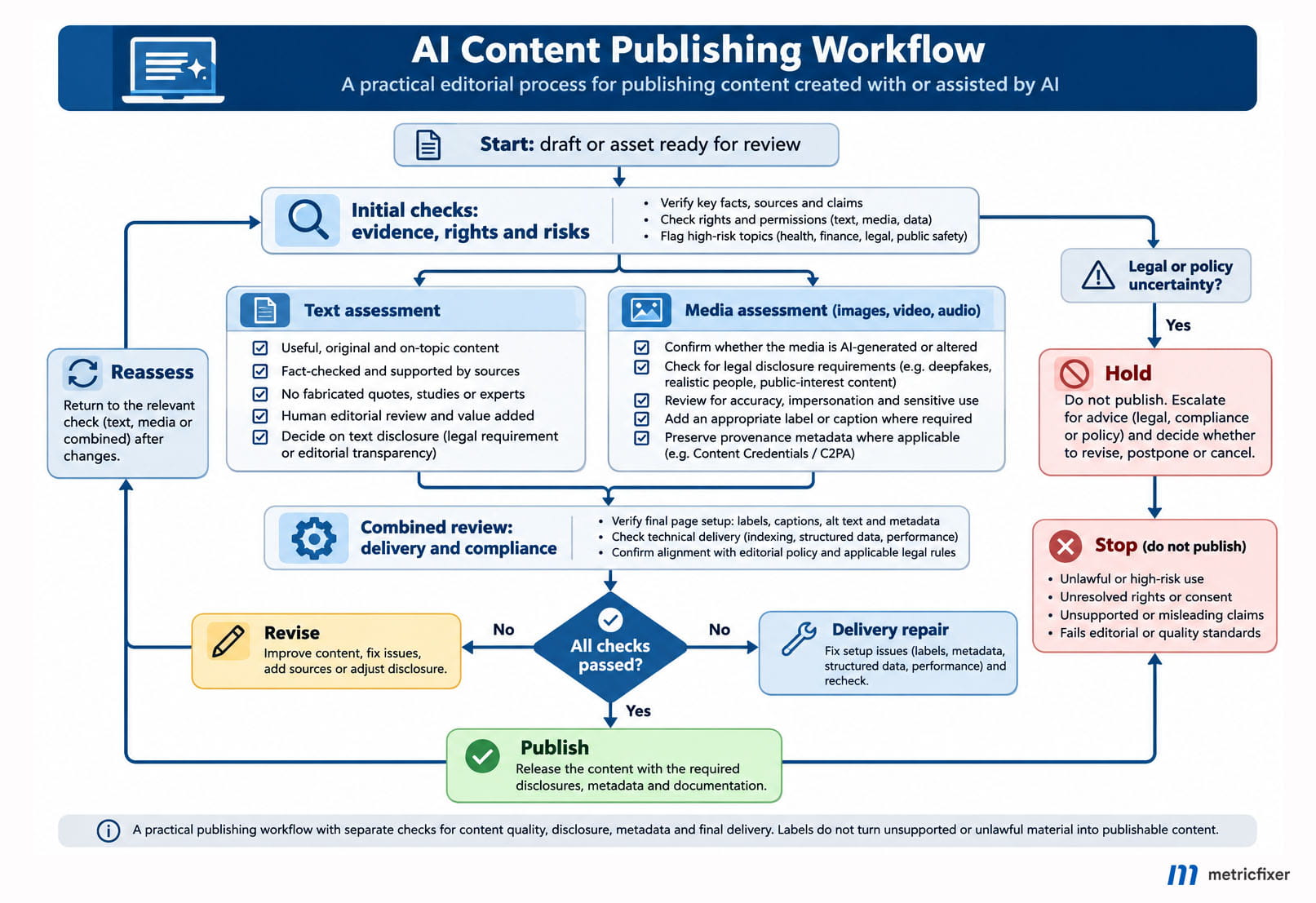
Before approval, the accountable reviewer should be able to answer five questions:
- Value and evidence: does the page help its intended reader, and can its material claims be substantiated?
- Identity and permissions: are experience, authorship, likenesses, voices and source-material permissions represented accurately?
- Disclosure: have the applicable rules and any exceptions been assessed separately for the text and each relevant asset?
- Delivery: are notices accessible and source information handled correctly in the actual page, files and feeds?
- Accountability: is someone responsible for corrections, complaints and reassessment after material changes?
The outcome need not always be publish or delete. Revision, a clearer explanation, a different image, a qualified review or a narrower claim can resolve the real problem. Where the evidence or rights cannot be established, hold the material. The goal is a defensible publication, not merely a disclosure badge.
Methodology and sources
This source-based review was checked on 11 November 2026. It prioritises Google Search Central and Merchant Center documentation, Bing Webmaster Guidelines, the consolidated EU AI Act and Commission implementation material, FTC guidance, UK government and CMA publications, and C2PA/W3C technical documentation. Links appear beside the claims they support rather than as numbered footnotes.
The legal discussion distinguishes legislation from guidance, voluntary compliance tools and editorial recommendations. California's recent amendment was checked against the chaptered SB 1000 text reproduced by LegiScan and the Governor's signing announcement; the legislature's own pages were not retrievable in this review. The US comparison is selective, not a 50-state assessment.
The detector discussion uses published 2023 and 2025 research to show both capabilities and limitations under different test conditions. It does not estimate the accuracy of every detector available in 2026. No controlled ranking experiment, site-wide AI-content audit or production metadata-survival test was conducted for this article. Tables, checklists and the workflow are practical recommendations, not observed outcomes or guarantees.
Copyright ownership and the full range of advertising and social-platform rules are outside this instalment. For a real deployment, verify rights, current provider terms and market-specific requirements separately.
This article provides general editorial, technical and operational information, not legal advice. AI transparency, consumer-protection, privacy, intellectual-property and sector-specific duties depend on jurisdiction, role and use. Search eligibility, rankings and AI citations are not guaranteed. metricfixer is not affiliated with Google, Microsoft, the regulators or the standards organisations mentioned. Laws, guidance, platform policies and technical implementations may change after the research date.
Expert help with this topic
 AI-Assisted Technical SEO Audit
Investigate technical search barriers with human-designed scenarios, reviewed evidence and practical priorities for the agreed site coverage.
 SEO Strategy Development
Build a reviewed SEO strategy with practical priorities, an editable roadmap and a clear method for measuring each stage.
 SEO Strategy Implementation Management
 Comprehensive SEO Audit with Expert Review
Combine an AI-assisted investigation, independent specialist analysis and relevant visibility evidence in one prioritised SEO report.