
Published Nov 22, 2026
AI and Copyright: What Businesses Can Use, Own and Protect
Commercial permission, copyright ownership and exclusivity are different purchases. A practical guide to AI-assisted content and products, with US, EU and UK comparisons and business-ready rights checks.
Category: SEO & Web Marketing · By metricfixer AI Studio
An AI-assisted deliverable can be usable without being exclusively yours, copyright-protected in some parts but not others, and covered by a supplier's contract without being cleared of third-party claims. For a business buying a website, software, design, music or a digital product, the useful question is not simply who owns the AI output. It is which rights exist, who can transfer them, what uses are permitted, and what evidence supports those conclusions.
Practical starting point: assess the finished deliverable component by component. Record the intended markets and uses, the tool and terms applicable to production, the human contribution, the permissions for inputs, and the rights transferred to the customer. Treat missing evidence as an unresolved issue, not as permission. Research checked: 21 November 2026. The legal comparison focuses on the United States, the European Union and the United Kingdom.
Contents
Executive summary
A commercial-use permission is not a copyright certificate. A provider can allocate its contractual position in an output, but that does not decide whether the output qualifies for copyright under the law of a particular country. Nor does it settle another person's rights. The qualification in OpenAI's business agreement and the separate commercial-use covenants in Suno's September 2026 terms make this distinction commercially important, not merely theoretical.
AI assistance does not automatically destroy copyright. The US Copyright Office's copyrightability conclusions preserve protection for sufficient human expression, including qualifying creative modifications and arrangements. The difficult question is what the person actually contributed to the finished work, not whether AI appeared somewhere in the workflow.
Do not assume one worldwide answer. The EU discussion centres on human creative choices, with national differences and developing case law. The UK has a specific statutory category for certain computer-generated works, while its March 2026 government report proposes removing that special protection. A policy proposal is not an enacted repeal. These distinctions are addressed in the European Parliament's October 2026 briefing and the UK government's report.
Our procurement recommendation is to buy a documented package: the usable files, identified human-created material, the appropriate assignments and licences, permission records, and a practical remedy if a component must be replaced. Decide early whether broad copyright exclusivity is essential or whether permission for a defined use is sufficient. Those are different purchasing requirements.
Five different questions hidden inside the word rights
Teams often compress several decisions into a sentence such as "We paid for it, so we own it." Separate them before approving a budget or signing a delivery certificate. The following is a business review framework, not five interchangeable legal tests.
| Question | What it actually asks | Useful evidence |
|---|---|---|
| May we use it? | Does the applicable agreement permit the intended publication, advertising, resale, distribution or modification? | Provider terms, plan and feature records, licences, permissions and any written exception. |
| Is it copyright-protected? | Does the claimed expression meet the applicable legal requirements, including authorship and originality? | The work itself, genuine creation records and a jurisdiction-specific assessment. |
| Who owns the relevant rights? | Who initially acquired them, and have they validly passed to the business? | Employment arrangements, signed assignments, contributor agreements and the component schedule. |
| How exclusive is our position? | Can the supplier reuse it, can the provider license it, and what can actually be enforced against outsiders? | Exclusive-licence or non-reuse terms, disclosed background assets, provider reservations and the scope of protectable expression. |
| Does it respect other people's rights? | Do the inputs, output and intended use avoid infringement or have an adequate permission or other legal basis? | Input licences, output review, releases, trademark checks, software notices and specialist clearance where needed. |
Two ordinary copyright rules already explain much of the confusion. WIPO's copyright guidance distinguishes protected expression from ideas and describes licences as authorisations for particular uses. Separately, US Copyright Act section 202 distinguishes ownership of copyright from ownership of a physical object containing a work. Receiving the image file, source repository or printed book does not itself answer the rights question.
For example, a business might have a permitted campaign background that contains little protectable human expression, an exclusive contractual promise that its designer will not reuse the final composition, and no general right to prevent strangers from independently creating something similar. That package may be commercially adequate for a short-lived campaign. It may be inadequate for a signature character, a long-term visual identity or a product sold on the promise of exclusivity.
Conversely, a genuinely original human-written passage can be protected while its inclusion in a deliverable remains unauthorised because someone copied it without a licence. Protectability, permission and non-infringement must be checked separately. That is the practical implication of distinguishing the rights in an original contribution from rights in pre-existing material under sections 103 and 106 of the US Copyright Act.
Assess the human contribution, not the amount of AI
The most useful question is: which expressive choices in the final result were made by a person? Describe the actual work rather than assigning an impressive-sounding percentage to it. A production log should explain the contribution, not manufacture a claim that an arbitrary amount of editing guarantees protection.
The US Copyright Office's Part 2 report distinguishes prompting, human-authored expressive inputs, creative modifications and arrangements. It does not provide a universal prompt-count, editing-percentage or time-spent threshold. Its analysis concerns control over expression, and it recognises that tools and the evidence about their operation can change.
| Production scenario | What to examine | Evidence worth retaining |
|---|---|---|
| Generated output accepted unchanged | Which expressive elements, if any, can actually be attributed to human authorship? | Inputs, generation record and the unchanged export. |
| Many prompts and repeated selections | Did the person determine expression, or mainly request possibilities and choose one? | Relevant iterations and an explanation connecting instructions to the final result. |
| Substantive rewriting or redrawing | Identify the original human-created changes rather than claiming all machine-generated material. | Before-and-after versions, layers, tracked changes or repository history. |
| Creative selection and arrangement | Evaluate the human composition separately from the individual generated elements. | Layout files, sequence decisions, drafts and the final arrangement. |
| An original human work used as input | Identify protected input expression that remains perceptible in the output. | The original work, its ownership record and the transformation history. |
| AI used only for assistance | Distinguish the author's expression from technical help, suggestions or corrections. | Human drafts and records showing what the assistance changed. |
This table translates the Office's registration guidance into a production review, rather than predicting a registration outcome. A creative arrangement may be protected without making each generated element separately protected. Equally, keeping an original photograph visible within an AI-expanded scene does not mean every added pixel acquires the photograph's authorship.
For procurement, separate quality work from authorship evidence. Fact-checking, approving a layout, correcting a spelling error and testing software can be essential. They should not automatically be described as creating the expression in the work. Ask the contributor to identify what they wrote, drew, composed, selected or arranged, and retain the files that make the answer understandable.
A prompt can also be assessed as text in its own right. That is a different object from the generated result: copyright in sufficiently original wording does not automatically extend to everything a system produces in response. Keep the distinction between an instruction and the resulting expression visible in the rights record, consistent with the Office's discussion of prompts and expressive inputs.
United States, European Union and United Kingdom: similar concerns, different rules
United States: human authorship remains the starting point
In Thaler v. Perlmutter, the DC Circuit held on 18 March 2025 that the Copyright Act requires initial human authorship. The application at issue identified a machine as the sole author. The court expressly distinguished that question from disputes about how much AI assistance a human-authored work can contain; it did not set a percentage test for mixed works.
The Supreme Court docket records denial of review on 2 March 2026. That left the appellate decision in place. It was not a new Supreme Court merits judgment declaring that every work involving AI is unprotected.
For a business, the practical US position is to identify the human contribution precisely. The Copyright Office's January 2025 conclusions allow protection where a person determines sufficient expressive elements, including qualifying modifications, arrangements or human-authored expression perceptible in an output. Merely supplying prompts is not, by itself, the same thing.
Calling a machine an employee or putting "work made for hire" on an invoice does not solve the absence of human authorship. The appellate court also rejected that route on the facts before it. A contractor's human contribution and its transfer to a customer need their own analysis; the machine should not be treated as the missing legal author.

European Union: identify the author's free and creative choices
The CJEU's general originality case law, including Painer, C-145/10, looks to the author's own intellectual creation and free and creative choices. Painer concerned photography, not generative AI. It supplies part of the framework; it is not a judgment approving every prompt-based production workflow.
Recent national decisions show why factual detail matters. On 13 February 2026, the Munich local court, case 142 C 9786/25, rejected copyright claims concerning three AI-generated logos. The court considered human influence through prompting possible in principle, but the evidence did not establish the necessary creative expression in those logos. A long prompt, time spent and a paid service were not enough on their own. This is a national first-instance decision, not an EU-wide rule that all prompts fail.
In a 2 April 2026 decision, case 20 W 2/26, the Duesseldorf Higher Regional Court likewise addressed human creative influence, while separately examining whether an AI-transformed image reproduced the protected features of an underlying photograph. The distinction is useful: whether the new output has its own copyright and whether it infringes the source are different questions. The result in that case is not a general permission to upload and transform other people's photographs.
The European Parliament Research Service's October 2026 briefing describes a developing, case-by-case position and national differences, including Ireland's computer-generated-work provision. It is an institutional briefing, not binding legislation. Avoid a blanket claim that every EU country has an identical AI-output rule, or that the EU AI Act itself assigns ownership of generated material.
Our recommendation for EU-facing work is to document identifiable human creative decisions and the country-specific chain of rights. Where the business depends on exclusion of competitors, obtain advice for the relevant markets rather than treating an official briefing or a single national case as a universal clearance.
United Kingdom: a statutory exception and a reform proposal
The UK needs separate treatment. Section 9(3) of the Copyright, Designs and Patents Act 1988 attributes authorship of qualifying computer-generated literary, dramatic, musical or artistic works to the person undertaking the necessary arrangements. Section 12(7) provides a 50-year term calculated from the end of the calendar year in which the work was made. These provisions are not a promise that every generated file qualifies.
The government's 18 March 2026 report, particularly Section I, acknowledges uncertainty around this category and its relationship with originality. It proposes monitoring the use and impact of the special protection and, in the absence of evidence of its ongoing value, removing it. Qualifying AI-assisted human works would remain eligible for protection. The report also distinguishes other possible protection for recordings, films and broadcasts. The proposal should not be described as an enacted repeal.
For a UK contract, therefore, ask two questions rather than copying the US answer: is there protectable human-authored expression, and is any separate computer-generated-work or related protection relevant? Where the second question matters, identify the person making the necessary arrangements and seek advice on the particular facts. Do not price a long-term exclusive licence on the assumption that the special category is both certain and permanently unchanged.
A worldwide licence is not a worldwide copyright ruling
Copyright protection is generally automatic for qualifying works, but the applicable legal requirements and remedies still matter. WIPO explains the distinction between protection, national legal systems and voluntary registration; it does not operate a global copyright registration service. A provider's worldwide contractual permission cannot make every jurisdiction recognise the same authorship claim.
Accordingly, avoid labelling an output "public domain worldwide" solely because it lacks protectable human authorship under one country's approach. It may contain someone else's protected material, be affected by contractual obligations, or raise other rights. Record the narrower conclusion you can support: for example, that no reliable claim to copyright in a particular generated component has been established for the planned US use.
What generator terms give you, and what they do not
Read the actual agreement for the account, plan, feature and date involved. A marketing statement about ownership is not a replacement for the clauses on input rights, output use, public sharing, third-party models, exclusions and liability. The examples below were reviewed for this article; they are not a complete product comparison or a substitute for a negotiated enterprise agreement.
| Service and reviewed terms | Contractual distinction to notice | What to record |
|---|---|---|
| OpenAI business services | The Services Agreement effective 1 January 2026 allocates output to the customer as between the parties and to the extent permitted by law, assigning OpenAI's rights, if any. It also warns that other users may receive similar outputs. This does not establish statutory copyright or uniqueness. | The contracting entity, business or individual agreement, exact service, applicable service-specific terms and any negotiated order form. |
| Midjourney | The 27 May 2026 terms qualify ownership by applicable law and third-party rights. A company, or its employee, above the stated US$1 million annual revenue threshold needs Pro or Mega for the contractual ownership provision. The provider also receives a broad licence, and public content can be remixed. | The relevant company and plan, account holder, production date, sharing settings and whether the client requires confidentiality or exclusivity. |
| Adobe generative AI and Firefly | The 23 April 2026 generative AI terms place input and output responsibilities on the user and warn that output may not be unique or protectable. Separately, Firefly indemnification depends on the incorporated agreement, eligible features, surfaces and export events. | The actual model, feature, contract entitlement and qualifying export. Do not assume every model inside an Adobe application has identical coverage. |
| Suno | The terms effective 3 September 2026 separate assignment, commercial use and copyright existence. Commercial exploitation requires a permitted download under the applicable tier and conditions; free/basic use is non-commercial, and the described Remix feature remains non-commercial regardless of tier. Suno does not guarantee copyright in output. | Generation and download dates, tier, approved download record, whether Remix was used, and the exact terms edition. |
A permission for one feature may not cover another
Feature-level exceptions can outweigh a broad ownership statement. The OpenAI Service Terms updated 13 November 2026 restrict ChatGPT Voice Output to non-commercial use and prohibit repackaging it as a standalone recording; assigned output rights exclude it. That statement concerns the named voice-conversation feature, not every OpenAI audio service.
Adobe's Creative Partner Models description illustrates a different trap. Non-Adobe models are excluded from the standard Firefly indemnity described there, but specified models can have separate supplemental coverage under eligible agreements. Neither "all partner models are covered" nor "no partner models are covered" accurately describes that structure.
Likewise, a later subscription does not automatically repair an earlier permission gap. Suno's help guidance says subscribing does not provide default retroactive commercial rights for songs created on the free plan; exceptions may be offered for specific songs. Obtain the actual written permission rather than treating a new invoice as evidence that an old asset is cleared.
Data use, provider licences and confidentiality are separate checks
The OpenAI business agreement says customer content is not used to develop or improve the services unless the customer explicitly agrees. That is a specific business-service commitment, not a conclusion about every individual account, connected application or provider. It also does not supply the customer's permission to upload someone else's material.
Midjourney's terms give it a continuing licence over supplied content and generated assets. Stealth involves best efforts not to publish qualifying assets; it does not make content in shared spaces invisible or erase the provider licence. Adobe's gallery provision separately grants rights when users submit input and output to an Adobe-hosted gallery. Treat these choices as part of client confidentiality review before uploading, not as settings to consider after delivery.
Indemnity is a conditional remedy, not a clearance certificate
An indemnity is an agreement about handling specified claims or losses. It is not proof that infringement cannot occur, that a court will recognise copyright, or that every business cost is covered. Ask who is protected, which rights and uses are included, what exclusions apply, and how notice, defence control, settlement and financial limits work.
For example, OpenAI's API output indemnity has exclusions involving known or likely infringement, unused safeguards, modifications or combinations, inadequate input rights, trademark use in commerce and third-party offerings. The same terms separately exclude certain features and beta services. Verify the applicable agreement instead of extending a headline promise to every output and downstream client.
Our recommended evidence bundle is a dated copy of the relevant terms and incorporated documents, the order form where applicable, plan confirmation, the feature and model used, generation and export records, and any written exception. Save effective dates as well as retrieval dates. A screenshot of a pricing page alone will rarely answer the full contract question.
Clear inputs, outputs and the intended use separately
There are at least three review points: the material supplied to the tool, what the tool returns, and what the business does with the result. A fourth appears when the output is passed to another customer or incorporated into a product. Permission at one point should not be assumed to cover the others.
Uploading a file is a use that needs its own justification
A licence to show an image on a website may not answer whether it can be uploaded for generative processing, adapted, exposed to other users or supplied under the provider's required licence. Review the actual grant and restrictions. Adobe's input terms, for example, require sufficient rights in third-party material and address personal information separately.
For client files, ask whether the client owns them or merely has limited permission. Include photographs, product renders, source code, font files, music samples, internal documents and licensed datasets. A client's instruction to "use this as inspiration" is not evidence that the underlying rights have been cleared. Record the source and permission before production; escalate unclear material rather than uploading it first.
A new file can still contain someone else's protected material
The legal analysis does not stop because software generated the last version. Protected expression, adaptations and copying remain relevant; in the US, the starting statutory provisions include sections 103 and 106, with exceptions assessed separately. Do not infer permission from the absence of a watermark, an apparent resemblance to a common style, or a provider accepting the prompt.
Our review recommendation is proportionate to the use: examine distinctive text, recognisable characters, visual similarities, logos, melodies and code matches; compare concerning elements with their apparent sources; and obtain specialist review when the result is commercially important or the resemblance is specific. Similarity searches and automated checks are useful leads, not certificates that no conflicting work exists.
People, brands and datasets add other rights
A copyright licence for a photograph does not by itself settle the depicted person's permission for a synthetic endorsement or a cloned voice. The Copyright Office's digital-replica work treats realistic imitation of a person's voice or appearance as a distinct issue. Applicable personality, publicity, privacy, performer and consumer-protection rules need market-specific review; this article does not attempt a complete country or US-state survey.
Similarly, a logo is not cleared merely because the generated artwork has no reliable copyright claim. Trademark protection concerns signs identifying the source of goods or services. Review names, symbols and the commercial presentation for the intended markets and goods, rather than relying on a copyright conclusion.
For datasets, distinguish rights in individual materials, selection or arrangement, database protection and contractual access restrictions. In British Horseracing Board, C-203/02, the CJEU distinguished investment in obtaining, verifying or presenting database contents from investment in creating the data. Paying to generate thousands of entries should not automatically be described as creating a protected EU database right.
Why training disputes do not give users a universal answer
This article does not rank models by the legality of their training histories. A claim or judgment concerning model development answers the issues and facts actually before that court. It is not a licence for every downstream output. Conversely, deciding that a particular output lacks its own copyright does not determine whether someone else's input or expression was used lawfully.
For procurement, ask the supplier for the training, licensing or indemnity commitments it actually makes, then still assess the deliverable. Keep exceptions such as US fair use distinct from contractual permission and from other countries' exceptions: section 107 is a context-dependent test, not a general "AI use" exemption.
Different AI-assisted products need different rights reviews
Do not classify an entire product as either "AI-owned" or "human-owned". The following scenarios are hypothetical procurement examples. The review actions are metricfixer's recommendations, not findings about an actual customer's project.
Websites and interfaces
A website combines copy, images, layout, code, fonts, icons, libraries, templates and sometimes video or audio. Ask for a component schedule explaining what is newly created, what is licensed, what is generated and what remains the supplier's reusable background material. Require the editable files and permissions needed for ordinary maintenance, localisation and replacement.
For example, owning the new written content does not establish ownership of a purchased theme. Permission to publish a generated illustration does not automatically permit selling it as a standalone asset. Identify the actual intended use: the customer's website, a white-label template, a subscription application and a downloadable design kit are different handoffs.
Keep operational acceptance separate from rights acceptance. A site can pass functional tests while lacking a usable font licence or contributor agreement. For the separate publishing questions about usefulness, search visibility and disclosure, see metricfixer's AI Content on Websites: SEO, Disclosure and Editorial Responsibility.
Software and code
The EU Software Directive protects qualifying program expression, not the underlying ideas and principles. An AI-assisted development process therefore requires attention to the actual code and contributions, not a claim to ownership of the product's general functionality.
Request source code, dependency and licence inventories, notices, build instructions, the relevant contribution history and permission to maintain or modify the system. Distinguish generated code from imported packages and copied examples. A repository containing only the final code snapshot may be insufficient for explaining a significant rights question later.
GitHub Copilot's code referencing can identify matches and associated licence information, but its documented limitations matter: for inline suggestions, code altered after the suggestion is not checked in the same way. No reported match is not proof of clearance. The MIT licence, for example, still requires its notices for covered copies or substantial portions; other licences require their own review. "AI wrote it" should not be used to remove a third-party notice.
Security, correctness and maintainability remain separate acceptance criteria. A licence review does not prove that an authentication flow is safe, and successful tests do not establish copyright ownership. Keep both reviews in the handoff rather than letting one stand in for the other.
Logos and brand systems
For a business identity, separate the artwork from the name, trademark clearance, fonts and broader visual system. The US Copyright Office's guidance notes that names and short phrases are not protected by copyright, while sufficiently original logo artwork may be. A human-created design can therefore also fail a particular copyright claim because of what it contains, not because AI was used.
When durable exclusivity is central, commission identifiable original human design work, document its development and arrange a valid transfer of the relevant rights. Use generation for exploration only where that fits the brief. Do not promise that mechanically tracing a generated logo necessarily establishes a new copyright; identify genuinely creative changes.
Run the separate brand review before launching signage, packaging and advertising. Obtain editable vector files, font permissions and a record of the accepted design. The desired result is a defensible identity package, not merely an attractive image accompanied by a subscription receipt.
Books, courses and downloadable products
Separate original explanations, illustrations, exercises, quotations, translations, narration and compilation choices. Ask which parts the author actually wrote or creatively arranged. Keep permissions for third-party excerpts and materials distinct from the claim to the author's new contribution.
A course can have strong editorial value without owning the facts, techniques or general teaching method it describes. The distinction between ideas and expression remains relevant; the Copyright Office's explanation is a useful starting point. When a product's commercial value rests on exclusive exercises or illustrations, assess those items individually.
Our delivery recommendation is a source and permission schedule, editable manuscripts, illustration records, narrator or voice permissions, and express coverage for the intended languages and distribution formats. Review claims of professional expertise and the factual accuracy of lessons separately. A rights-compliant textbook can still contain unreliable instruction.
Music, voice and video
The US Copyright Office distinguishes a musical work, including its composition and lyrics, from a sound recording. Those layers can be owned and licensed separately. Video may introduce further elements: footage, script, graphics, performances and music use. The fact that one tool exports a single file does not merge every right into one permission.
For a generated brand track, record the source of lyrics, any uploaded melody or sample, the vocalist or synthetic voice, the generation and permitted download records, and the planned uses. Ask separately about advertising, video synchronisation, standalone distribution, client transfer and platform rights-management systems. A platform accepting an upload is not a legal opinion about the rights package.
Do not assume a paid-plan assignment settles eligibility for every distribution service or automated claiming system. Preserve the provider conditions, but check the destination's own rules. The publication and monetisation layer is discussed separately in metricfixer's AI Content on YouTube: Disclosure, Monetization and Channel Risk.
For cloning an identifiable voice, agree the permitted scripts, languages, markets, duration, modifications and any future reuse before production. Rights to a recording and permission to imitate a person should be documented separately. Obtain specialist advice where a performer, employee or public figure is involved.
3D models and physical product designs
Distinguish the concept image, the mesh or CAD file, textures, engineering changes and the manufactured object. A contractor might be able to hand over a render while lacking permission to redistribute a stock model or texture embedded in the working files. Ask specifically for manufacturing, modification and downstream supply-chain permissions where relevant.
Industrial design protection addresses appearance, while patents and copyright involve different requirements. A generated concept is not a substitute for a design or patent assessment, and copyright in a drawing does not automatically resolve the right to manufacture the pictured product.
For technically novel products, obtain separate patent advice before public disclosure. The USPTO's revised AI-assisted inventorship guidance preserves the ordinary inventorship standard and natural-person requirement; buying an AI design service does not itself establish who invented a patentable feature. Product safety and engineering validation also remain outside a copyright clearance.
Datasets and reusable asset libraries
For a data product or asset pack, ask whether each ingredient can be redistributed, sublicensed and used by customers in the intended way. Permission to use material internally is not necessarily permission to sell it in a collection. Identify any customer obligations that must accompany the files.
Distinguish investment in the collection from ownership of each item. The CJEU's database analysis is especially relevant to claims that a large generated collection is automatically protected because it was expensive to produce. Keep source provenance, quality checks, rights restrictions and the claimed original selection or arrangement in separate fields.
Ownership and contractor handoffs: build the chain of rights
Payment, delivery and ownership are separate events. Under US copyright law, initial ownership and transfers have their own rules, and a transfer of copyright ownership generally requires a signed writing. Work-made-for-hire treatment has a statutory scope; it is not a label that makes every freelance commission belong to the customer.
The UK Intellectual Property Office's guidance likewise distinguishes work created by employees from commissioned work. A commissioned creator normally starts as the copyright owner unless a different arrangement is agreed in writing; an implied licence, where available, is not the same as ownership. EU employment and commission questions require national-law and work-type checks; software has its own provision in Article 2 of the Software Directive.
Our recommended chain is: identify the human contributors and relevant account holder; establish their rights and permissions; record what passes to the agency or contractor; then specify what passes to the customer. Subcontractors need to be included. Do not assume the agency can assign a freelancer's rights merely because it paid the freelancer.
Divide the handoff into three schedules: new work for which an assignment or agreed licence is available; background and third-party material that remains licensed on stated terms; and generated or uncertain components for which the supplier should describe permitted use without promising unsupported statutory exclusivity.
For example, a website handoff could assign the contractor's qualifying original copy and layout work, license a reusable utility module, identify an open-source package and its notices, and record the permitted use of generated decorative images. This is more informative than an undefined statement that "all intellectual property in everything belongs to the client."
Specify the timing of transfer, permitted modifications, sublicensing to service providers, territorial and format coverage, and what happens if a component must be replaced. Address attribution and moral rights under the relevant law rather than assuming they can always be transferred or waived. WIPO's distinction between economic and moral rights explains why those questions should not be collapsed.
Practical template: an asset rights card
Use one card per significant asset or separately licensed component. This is an internal control template, not a certificate of legal compliance. A value of "unknown" is acceptable as an honest record, but should trigger review before the affected use is approved.
| Field | What to record |
|---|---|
| Asset and version | Stable asset ID, descriptive name, final filename, version and a file hash where useful. Identify the exact file being assessed. |
| Business purpose | Website, advertising, software distribution, resale, manufacturing, internal use or another defined purpose. |
| Markets and channels | Relevant countries, publication platforms, territories and any planned paid distribution. |
| Exclusivity requirement | Whether permission to use is sufficient, supplier non-reuse is required, or enforceable copyright exclusivity is a core requirement. |
| Tool and account | Provider, exact product, model or feature where available, account holder, contracting entity and plan. |
| Production and export | Generation date, material revision dates, export or permitted-download event and the person responsible. |
| Applicable documents | Terms edition and effective date, retrieval date, order form, licences, provider policies and written exceptions. |
| Inputs | Each significant source file, its creator or supplier, the permission for upload and transformation, and confidentiality restrictions. |
| Human contribution | Named contributors, their specific expression or creative arrangement, and references to genuine drafts, layers or commits. |
| Rights assessment | The components for which protection is asserted, the relevant jurisdiction and reviewer, plus exclusions or unresolved issues. |
| Ownership and transfer | Initial owner where established, employment or contributor agreement, signed assignment or licence, and transfer conditions. |
| Third-party restrictions | Stock, font, software, music, dataset, trademark, performer and likeness permissions; required notices and prohibited uses. |
| Provider and public rights | Provider licences, gallery submission, public remixing, retention or training settings and relevant confidentiality limits. |
| Output review | Checks undertaken, findings, concerning similarities, unresolved claims and any specialist assessment. Record limitations. |
| Coverage and remedies | Applicable indemnity or replacement promise, beneficiary, conditions, exclusions, limits and claims contact. |
| Release decision | Approved use, conditions, prohibited reuse, decision owner, approval date and events requiring reassessment. |
A useful decision is specific: "Approved for this website illustration; no standalone resale or claim of exclusive ownership of the generated background." An unhelpful decision is "AI licence checked." The card should tell a future editor or developer what they may do without forcing them to reconstruct the entire project.
Practical resource: Asset Rights Card
Use the editable template to record permissions, human contribution, ownership, third-party restrictions and the approval decision for a specific asset or component. It includes 16 review fields and a separate approval record; it is not a certificate of legal compliance.
Practical checklist: buying an AI-assisted product
This is metricfixer's recommended acceptance checklist. Apply it proportionately: a disposable internal mock-up and a customer-facing software product should not have identical review depth.
- Define the purchase. Specify the final uses, markets, editable deliverables, maintenance needs and level of exclusivity before production starts.
- Approve the AI scope. Identify which parts may use AI, which tools or features are permitted, and what requires written approval before a change.
- Verify input permissions. Obtain the source and rights basis for client files and third-party materials before upload, including confidentiality and personal-data checks where relevant.
- Check the actual commercial entitlement. Confirm the account, plan, applicable terms, feature restrictions and generation or download conditions for the assets delivered.
- Identify the human contribution. Request a precise description and authentic supporting versions, not an unsupported claim that the product is a particular percentage human-made.
- Receive the component inventory. Separate new work, generated material, stock assets, templates, fonts, libraries, samples and other dependencies.
- Complete the chain of rights. Verify contributor and subcontractor permissions, assignments or licences, permitted client modifications and any downstream obligations.
- Review the finished output. Resolve distinctive similarities, rights notices, recognisable people or brands, and use-specific risks before release.
- Check remedies and practical continuity. Understand indemnity conditions, replacement duties, response contacts, source-file delivery and the ability to maintain the product without the original supplier.
- Approve a defined use and preserve evidence. Sign off the correct version, record limitations, retain the rights card and decide which future changes require a fresh review.
Do not turn this into a ceremonial document signed after launch. Make missing licences, missing source files and unresolved authorship claims visible acceptance issues. Where the business requires rights the supplier cannot substantiate, change the scope, replace the component, commission additional original work or seek legal review before accepting the risk.
Practical resource: AI-Assisted Product Procurement Checklist
Use the ten-check worksheet to record supporting evidence, unresolved issues and the acceptance decision before taking delivery of an AI-assisted product. Choose the editable DOCX for project work or the PDF for printing. The checklist is a practical acceptance tool, not a jurisdiction-specific legal test.
Download the editable Procurement Checklist (DOCX)
Download the printable Procurement Checklist (PDF)
Practical questions for the contractor agreement
The following is a negotiation agenda, not jurisdiction-ready contract wording. Ask qualified counsel to translate the commercial decisions into appropriate provisions. One broad warranty cannot create copyright that does not exist or bind a third-party rights holder.
| Topic | Questions the agreement should answer |
|---|---|
| Permitted AI use | Which deliverables may use AI? Must the supplier disclose the exact components, tools and models? Who approves a change in tool, plan or method? |
| Client inputs and confidentiality | Who checks the client's permission to supply files? Which uploads are prohibited? What sharing, training, retention and subcontracting settings are acceptable? |
| Rights promised | Which identified rights are assigned, which are licensed, and when? Does the promise distinguish human-authored work from generated or unprotectable components? |
| Background and third-party assets | What remains the supplier's reusable material? What licences and notices apply? Can the client modify, host, distribute and pass the product to another maintainer? |
| Exclusivity | Is the promise copyright exclusivity, an exclusive licence, supplier non-reuse or confidentiality? What provider licences, public disclosures and independently generated similarities remain outside it? |
| Contributors and moral rights | Who obtains employee, freelancer, performer and subcontractor permissions? How are attribution, modifications and any legally available moral-rights consents handled? |
| Evidence and delivery | Which source files, drafts, licence records, generation or export records, dependency lists and rights cards must accompany delivery? Who may inspect them? |
| Review and acceptance | Who checks similarities, brands, voices and sensitive uses? What defects block acceptance? What statements must be supported rather than merely warranted? |
| Claims and remedies | Who receives notice, controls the defence and authorises settlement? What are the indemnity limits, exclusions, replacement duties and responsibilities for launch disruption? |
| Change and termination | What happens if terms change, an asset is challenged, an account closes or the relationship ends? Which rights and support duties continue, and how does the client obtain usable files? |
For commercially important assets, request a schedule of exceptions rather than an impossible promise that no uncertainty exists. A disclosed non-exclusive stock component can be acceptable. An undisclosed non-exclusive component sold as a uniquely owned identity asset is a different procurement problem.
Also match obligations to control. A supplier should identify the tools and materials it chose; the customer should identify intended uses and permissions it actually holds. The agreement should allocate checks and remedies clearly without pretending that a contract between two parties changes the rights of everyone else.
Practical resource: Contractor Agreement Questions
Use the editable worksheet to work through ten contract topics with a supplier and record proposed terms, agreed answers and unresolved questions. It is a negotiation agenda, not a ready-to-sign contract; qualified counsel should turn the agreed allocation into appropriate legal provisions.
Evidence, registration and claims: preserve the real history
Keep records that explain the finished work
Our recommended file contains original inputs and their permissions, relevant generation records, meaningful drafts, editing layers or commits, contributor agreements, provider terms, review findings and the approved export. Keep enough to connect the asserted human contribution to the delivered version. Not every rejected generation needs permanent storage; use a proportionate retention policy and protect confidential or personal information.
Do not reconstruct a fictional creative history after a dispute. An honest record that a background was generated and only resized is better than invented evidence of detailed manual authorship. Similarly, a timestamp or file hash can help identify a version, but does not establish that the person saving it had the necessary rights.
Registration and copyright notices must match the claim
The US Copyright Office's registration guidance requires applicants to describe the human contribution and exclude more-than-minimal AI-generated material from the claim. It also explains how to correct a pending application or existing registration that omitted relevant information. An AI tool or its provider should not be named as an author merely because it was used.
Registration and protection are also different. Under sections 408, 411 and 412 of the US Copyright Act, registration is not a condition of copyright protection, but US works generally require registration before an infringement action, subject to statutory exceptions and the procedure following refusal. Registration timing also affects eligibility for statutory damages and attorney's fees. Section 412 includes a three-month-after-first-publication window for certain claims; this is not a universal filing deadline or an automatic damages entitlement. Plan important registrations with counsel rather than waiting for a dispute.
The practical recommendation is to align the application, publication credits, customer contract and creation records. Do not claim every component if the evidence only supports the text, editing or arrangement. Seek registration advice early where enforcement is commercially important, and obtain advice on the available remedies rather than assuming a copyright notice settles the issue.
Provenance is useful evidence, not a title registry
C2PA Content Credentials can carry verifiable provenance assertions about a file's history. The standard does not make those assertions a legal determination of ownership, permission or factual truth. Preserve useful credentials, but keep the underlying licences and contributor records. An AI label is a disclosure, not a rights grant.
Some valuable material may instead be protected through confidentiality. WIPO's trade-secret overview emphasises secrecy, commercial value from secrecy and reasonable protective measures. Public gallery submission or uncontrolled disclosure can conflict with that strategy. Trade-secret protection should not be treated as a substitute for copyright in a file already made public.
When a claim arrives, investigate the component
Preserve the notice, affected files, publication history and relevant agreements. Identify the exact claim: copying of expression, a software-licence breach, trademark confusion, a voice or likeness issue, or a contract violation. Notify the appropriate legal, insurance and supplier contacts within the applicable requirements, and avoid admissions or settlements that could interfere with a contractual defence.
As an operational precaution, consider pausing the disputed use while retaining evidence and assessing alternatives. Map where the asset has been reused so that a replacement can be implemented consistently. Do not respond with "the AI generated it" as though that answers every claim, and do not send takedown demands against others before identifying the rights your own business can substantiate.
A rights-release workflow for real projects
Use the legal analysis to reach a practical decision, not merely to populate a folder. The following workflow is an editorial recommendation for managing release and reuse. It is not an official approval process and does not guarantee protection or freedom from claims.
Define the use and the required exclusivity → inventory the components → verify input permissions and tool conditions → review output and third-party rights → identify human authorship and the ownership chain → approve a documented scope, redesign or hold → archive the evidence and recheck changed uses.
Unresolved input rights, provider restrictions or output concerns should lead to clarification, permission, replacement or specialist review before the affected release. A weak claim to exclusivity is a different problem: where exclusivity is not required, a cleared and appropriately licensed use may still be suitable. Where exclusivity is essential, do not silently downgrade the requirement to ordinary commercial permission.
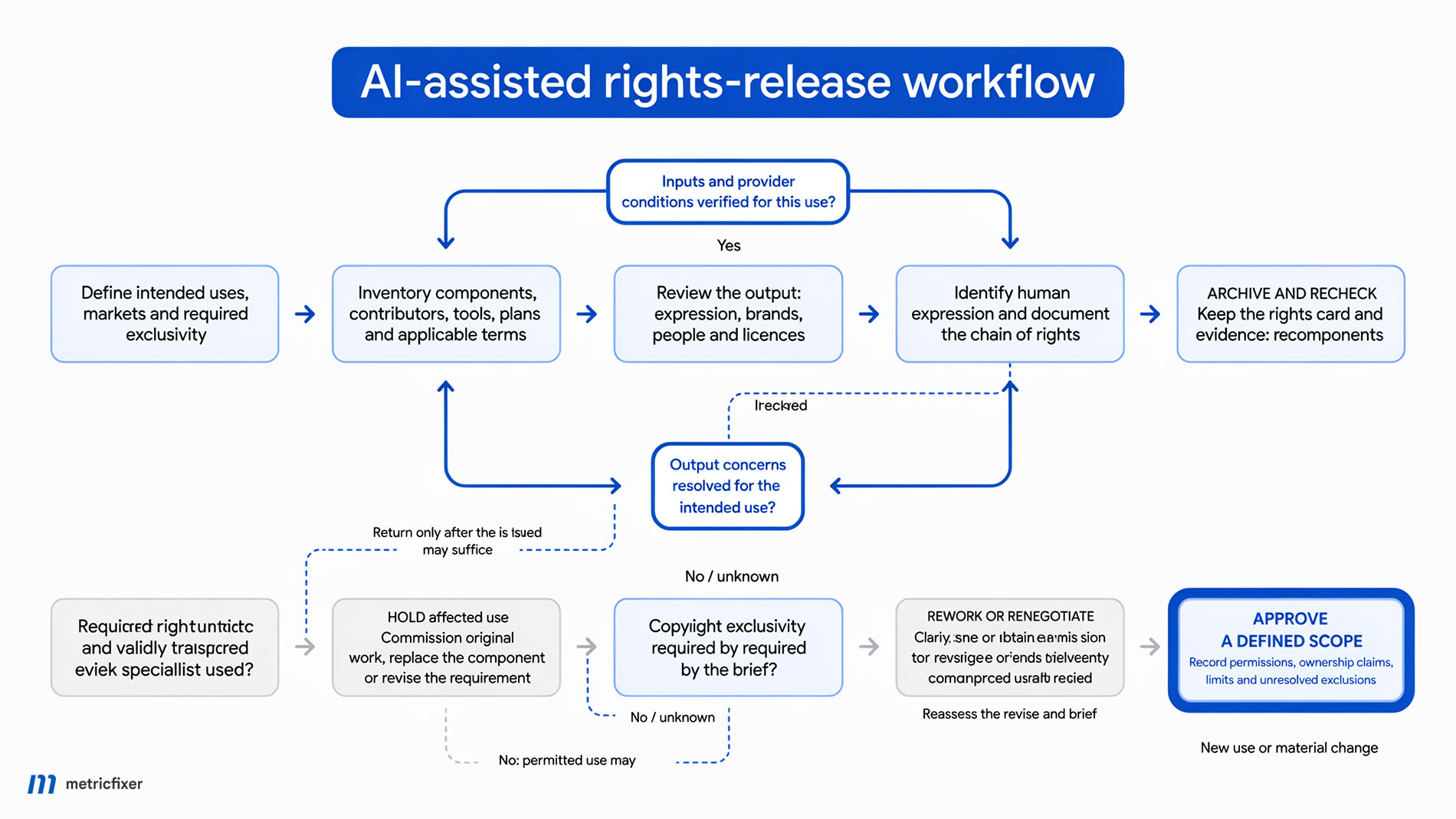
Reassess when the asset moves from internal use to publication, from an organic post to advertising, from one client's website to a resold template, or from a single market to a wider licence. Review substantial modifications and new provider-generated versions as well. The original approval should state its scope so that future teams can recognise when they have moved outside it.
The purchasing principle is straightforward: buy the rights and evidence your use actually needs. A documented, limited permission can be a sound decision. An expensive promise of undefined ownership, unsupported by human contribution, licences or a valid handoff, is not the same product.
Methodology and sources
This source-based review was checked on 21 November 2026. It prioritises statutes, court decisions, public agency guidance, official provider agreements and primary technical documentation. Links appear alongside the propositions they support. The analysis distinguishes binding legislation and judgments from agency reports, institutional briefings, provider contracts and metricfixer's operational recommendations.
The US analysis uses the Copyright Office's copyrightability report and registration guidance, the DC Circuit's Thaler opinion and the Supreme Court docket. The EU comparison combines general CJEU originality principles with selected 2026 German decisions and the European Parliament's October briefing; it is not a survey of all Member States. The UK section separates the statutory computer-generated-work provisions from the March 2026 reform proposal. Some UK statutory endpoints did not render directly; the relevant official indexed statutory text was cross-checked with the government report.
Provider examples use the document editions identified in the article. In particular, Suno's main terms page linked a newer edition effective 3 September 2026, which was used for the current comparison. No private order form, customer account, disputed asset or negotiated enterprise arrangement was inspected. A public agreement cannot establish which terms a particular customer accepted or whether that customer's output satisfies them.

The rights card, procurement checklist, contractor questions, examples and workflow are original editorial tools, not legal determinations or reports of client outcomes. No infringement search, registration application, software audit or provider-indemnity claim was performed. Model-training disputes, detailed conflict-of-laws questions, tax, comprehensive privacy rules, patents and a full survey of publicity or performer rights remain outside scope except where they affect the purchasing decision.
This article provides general business, editorial and operational information, not legal advice or an opinion on any particular asset. Copyright, related rights, contractual permissions and available remedies depend on jurisdiction, facts and the applicable agreement. Obtain qualified legal advice for important transactions, exclusivity claims, registrations or disputes. metricfixer is not affiliated with the courts, public bodies, standards organisations or AI providers mentioned. Laws, guidance, judgments, provider terms and product features may change after the research date.
Expert help with this topic
 AI Workflow Design and Infrastructure Integration Plan
Plan how AI, company knowledge and existing systems can work together, with editable design materials and a clear implementation path.
 AI-Assisted Content Management
Carry out an agreed content plan with AI assistance, human direction, fact checking, editing and controlled publication.
 Integrated AI Workflow Implementation
Implement and deploy an AI business process across named company systems, with authorized actions, human controls and operating handoff.
 AI for Business Processes
Plan an AI workflow, implement a named business process, or deploy a scoped telephony-connected voice agent with agreed knowledge and human controls.