
Published Nov 23, 2026
Google Ads Data Exclusions: When They Help and When They Add Risk
Google Ads data exclusions change bidding inputs, not reports. An anonymized case examines missing conversions, delayed intervention, broad scope and recovery risks.
Category: Online advertising · By metricfixer Expert Team
Google Ads data exclusions can protect automated bidding when conversion tracking breaks. They can also introduce unnecessary disruption when an old incident is treated as an account-cleaning exercise. This investigation explains what the feature changes, why historical reports remain visible, and how to assess its timing and scope. The anonymized ecommerce case comes from a client account that metricfixer configured and managed until 13 November 2026. Later interventions were made by the client's in-house team. The case illustrates the difference between a documented tracking problem, a plausible bidding effect and a causal claim the available evidence cannot establish.
Practical starting point: do not exclude a period merely because its CPA looks bad. Establish whether measurement was unreliable, which bidding goals were affected and which click dates require protection. Missing conversions caused by broken tracking can justify an exclusion; a small but accurate dataset does not. Treat recovery and any account migration as separate decisions.
Contents
Executive summary
The useful question is not whether data exclusions are good or dangerous. It is whether a particular exclusion is a proportionate response to a verified measurement incident. A missing purchase event, duplicate sales and an incorrect revenue value are different problems, but each can make a campaign's feedback unreliable. An exclusion is not a substitute for repairing the source of that feedback.
metricfixer originally configured the campaigns and brought them to stable performance before a checkout change stopped some purchases made through one payment method from reaching analytics. The tracking problem was reportedly repaired on 26 October 2026. While metricfixer still managed Google Ads, successive strategy adjustments returned reported CPA to approximately $55 by 3 November. Day-to-day campaign management passed to the client's in-house team on 13 November. Under that team's management, a broad exclusion was created on 16 November for an October interval, and less than four minutes later the Performance Max target CPA was raised from $65 to $90. The client contacted metricfixer on 20 November after a substantial reported CPA increase. Since then, metricfixer has performed an audit and submitted a recovery proposal, not resumed routine campaign management.
This is a meaningful incident, but not a controlled experiment. It supports questions about delayed intervention, scope, incomplete handover and concurrent target changes. It does not establish that the exclusion alone caused the deterioration, that clicks were deleted from reporting, or that the account became permanently unusable.
The editorial conclusion is therefore narrower, and more useful, than a warning never to use this feature: apply measurement safeguards deliberately, evaluate results on mature data, and do not turn an uncertain diagnosis into an unsupported account-reset prescription.
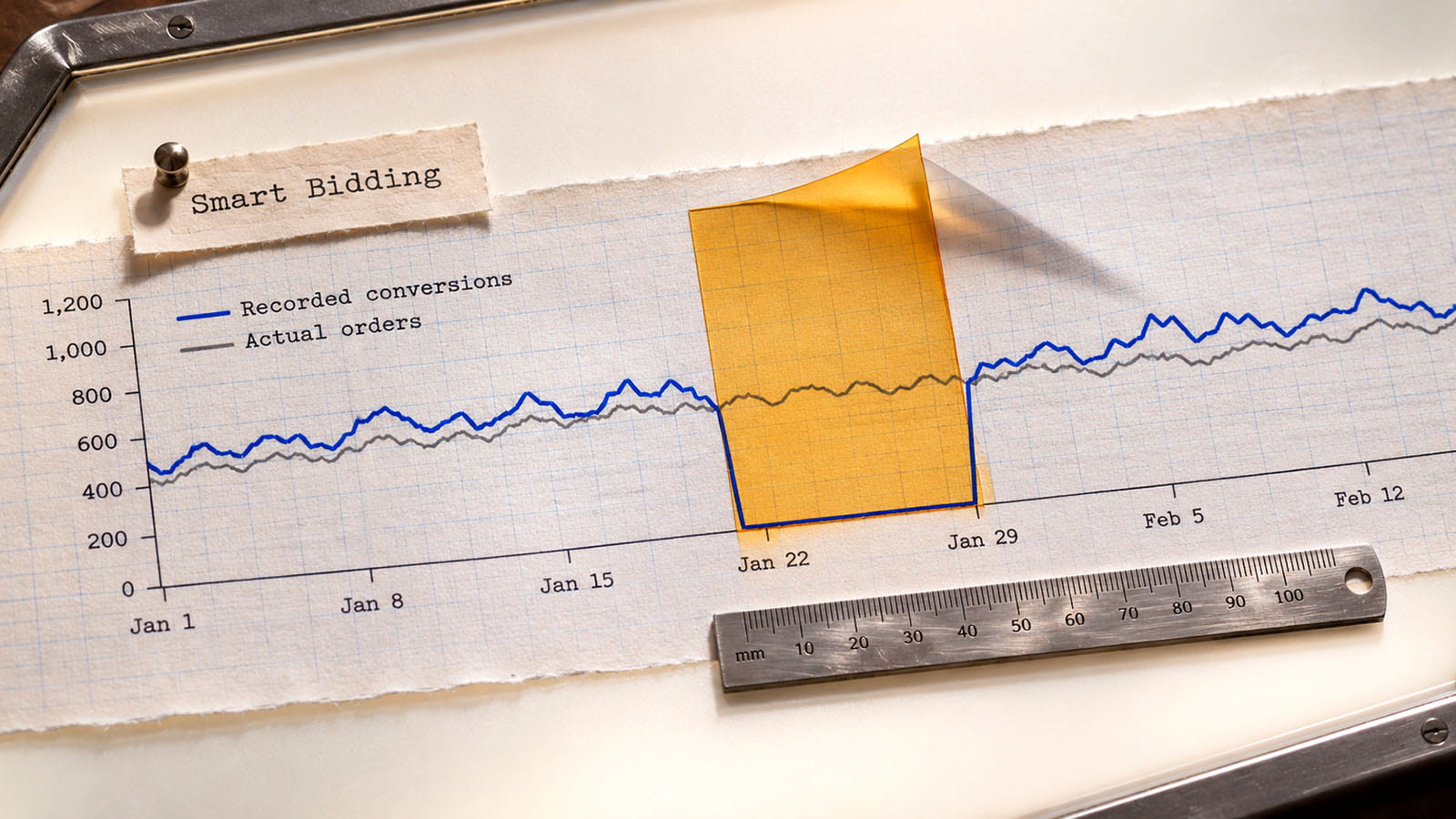
What data exclusions change, and what they leave alone
Google's data-exclusion documentation describes a Smart Bidding safeguard for unreliable conversion counts or values. It applies to conversion-based and conversion-value-based bidding in supported Search, Display, Shopping and Performance Max campaigns; Hotel and Travel campaigns are not supported. Its date selection concerns clicks and their associated conversions. It changes bidding inputs, not conversion reporting.
Consequently, a historical dashboard remaining unchanged after an exclusion is not evidence that the setting failed. The feature is not a report filter, a refund request or an instruction to erase GA4 events. An October exclusion created in November cannot reverse auctions or spending that already happened in October.
Two separate paths: recorded advertising activity remains available for reporting → the exclusion identifies an affected click interval and scope → Smart Bidding is instructed to disregard the relevant data for bidding → subsequent delivery can change, while the historical report is not rewritten by this setting.
This distinction also limits what an analyst can infer. The presence of an enabled exclusion shows a configuration, not a measurable percentage of an internal model that has been erased. Public documentation does not expose a model-state audit that would let us calculate how much a specific historical interval influenced every later auction.
The case: a tracking incident followed by a late intervention
The following chronology combines metricfixer's firsthand campaign-management history through 13 November, the subsequent events reported during the client's in-house management, and evidence metricfixer reviewed after being asked to audit the account on 20 November. We have authorized access to the client's Google Ads account and captured the three interface views reproduced below; access for audit does not mean we managed the campaigns during the period under review. We distinguish our operational history, information about the website incident and directly visible advertising settings. The advertiser's identity is not necessary to understand the incident.
| Date or period | What happened | Evidence and qualification |
|---|---|---|
| October incident | Before the incident, metricfixer had configured the Google Ads campaigns and established stable performance. While metricfixer still managed advertising, a checkout change by the client's website-development team reportedly prevented some purchases through one payment method from reaching analytics. | metricfixer's campaign-management history and information about the client's website incident. The underlying release records, complete affected-order list and payment-method reconciliation are not reproduced in this article. |
| 26 October 2026 | The checkout tracking problem was identified and reportedly repaired on the website. metricfixer continued managing the Google Ads campaigns and monitoring their performance recovery. | metricfixer's operational record of the incident and subsequent performance recovery. The repair date is distinct from the later exclusion's 16–28 October label; this article does not reproduce the website deployment log. |
| By 3 November | While metricfixer still managed the campaigns, our successive bidding-strategy adjustments brought reported CPA back to approximately $55. | Result from metricfixer's campaign-management history, not independently reconstructed from the overview screenshots reproduced here. Achieved CPA is not the same as a configured target CPA. |
| 13 November | metricfixer's day-to-day campaign management ended, and the advertiser's in-house team assumed control. metricfixer offered an explanatory handover call about the account and the recent tracking incident, but the client declined the call. | metricfixer's direct handover history. The change in operational responsibility is relevant context; the absence of a call does not establish the cause of subsequent performance. |
| 16 November, 08:30:27 | While the client's in-house team operated the account, it created a data exclusion with a campaign-type scope covering Search, Display, Shopping and Performance Max; metricfixer did not make this change. | Visible in Change history. The configured interval runs from 16 October at 01:00 to 29 October at 01:00, displayed as EDT. |
| 16 November, 08:34:01 | During the same in-house management period, the client's team increased the Performance Max target CPA from $65 to $90; this was not a metricfixer change. | Visible in Change history: a 38.5% increase, 3 minutes and 34 seconds after the exclusion. |
| 20 November | After managing the campaigns in-house since 13 November, the client contacted metricfixer about a substantial reported CPA increase and concern that its recent strategy adjustments were not producing the expected results. metricfixer was asked to audit the situation, not to resume day-to-day campaign management. | metricfixer's subsequent consultation and audit history. The performance views reproduced for this review extend through 21 November; their reported conversions may still be subject to attribution delay. |
| At the time of this review | metricfixer has completed its audit and submitted a proposal to rebuild the advertising setup in a new Google Ads account with a new GA4–Google Ads link. We have not implemented that proposal or resumed routine management of the campaigns. | An audit recommendation from metricfixer, not a completed migration, a Google requirement or evidence that the existing account is permanently damaged. Any implementation and results would need separate evaluation. |
The change-history view shows two changes in its displayed 13–18 November selection, not just an exclusion. Both recorded actions occurred after the 13 November handover, when the client's in-house team, not metricfixer, was operating the campaigns. Its top bar also shows filters. Although metricfixer had authorized account access for the subsequent audit, this filtered view is evidence of the visible actions only, not a complete audit of every account change, website deployment or analytics setting.
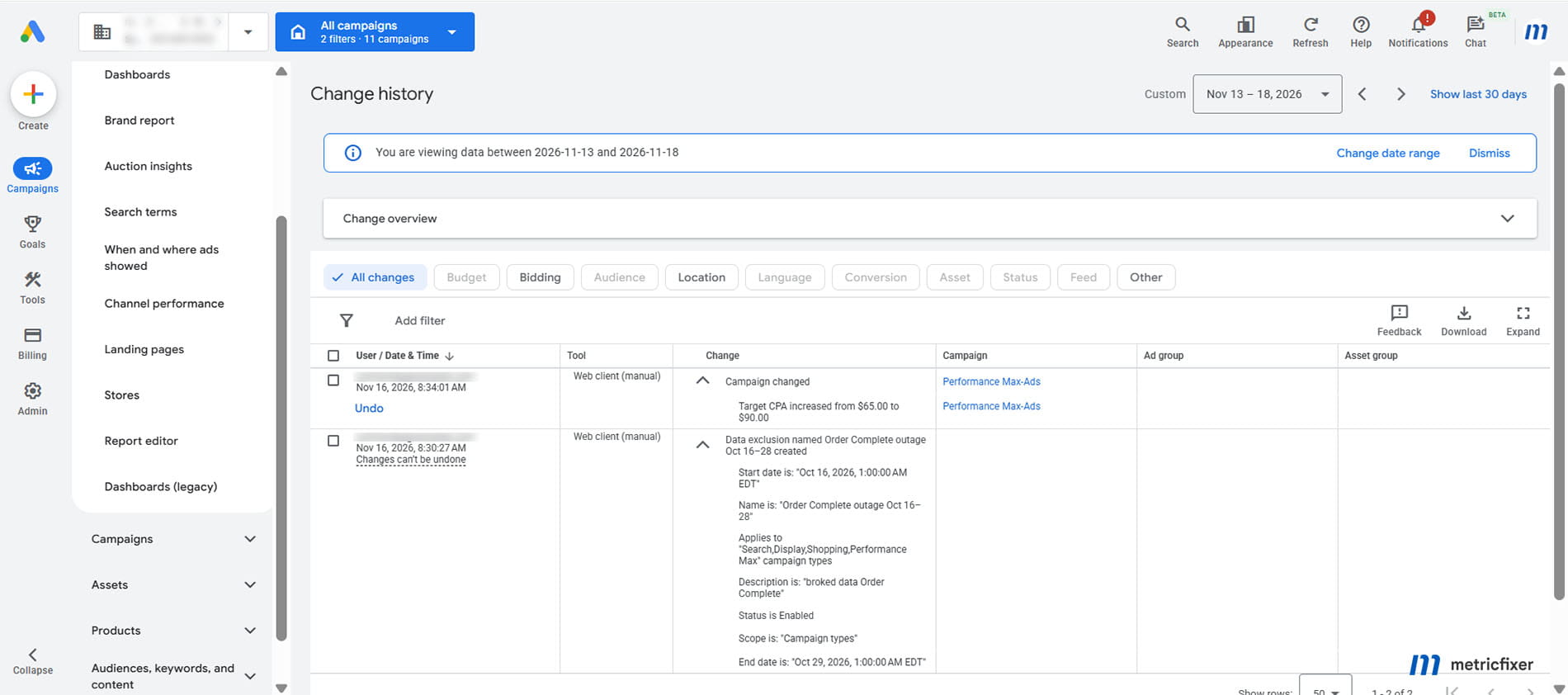
The dates themselves require investigation. A repair on 26 October and an exclusion ending on 29 October are not automatically contradictory: validation, delayed reporting or a broader incident may explain the difference. However, no such explanation is established by the screenshots. A publication should preserve that uncertainty rather than silently changing the repair date or declaring every hour of the selected interval defective.
What the performance screenshots support
The six-day comparison
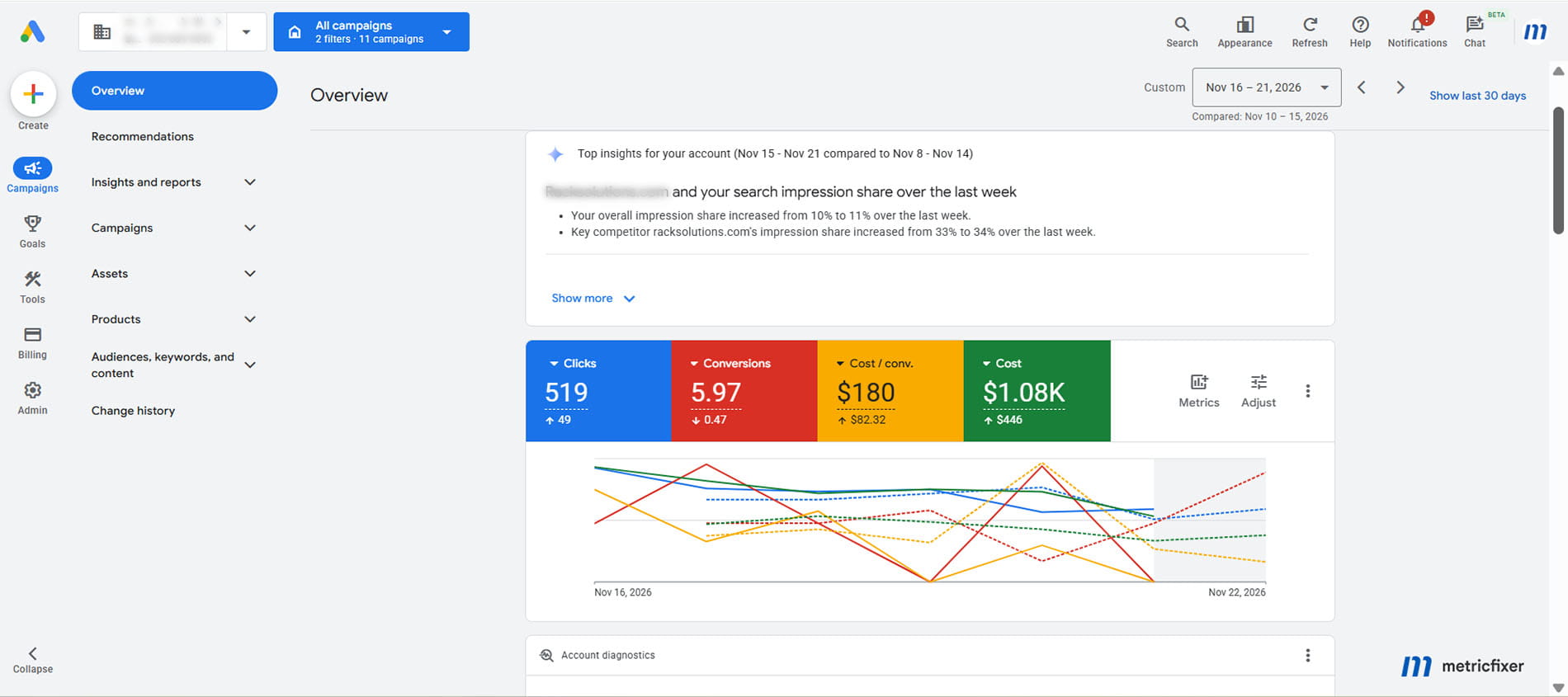
The overview compares 16–21 November with 10–15 November 2026. It shows an All campaigns view with two filters and 11 campaigns in its displayed context. The client's in-house team was responsible for campaign management during this interval; metricfixer's involvement from 20 November was limited to an audit and recommendations. It should not be presented as an isolated Performance Max report or an independently verified unfiltered account total.
| Metric | 16–21 November | What the displayed comparison establishes |
|---|---|---|
| Clicks | 519 | 49 more than the comparison period: a calculated increase of approximately 10.4% from 470. |
| Conversions | 5.97 | 0.47 fewer: a calculated decrease of approximately 7.3% from 6.44. |
| Cost per conversion | $180 | $82.32 more: approximately 84.3% above the displayed comparison value of $97.68. |
| Cost | Approximately $1.08K | A displayed increase of $446. The abbreviated total should not be treated as a precise raw-data export. |
The deterioration deserves attention. But the comparison baseline is $97.68, not the approximately $55 reportedly achieved earlier. The two figures refer to different evidence, dates and potentially different campaign scopes. They cannot be substituted for each other to create a cleaner before-and-after story.
Nor should 5.97 conversions be described as exactly six paid orders. Google's conversion-column documentation explains that reporting depends on conversion actions, attribution and counting settings, and can include modeled conversions. The screenshot does not identify the complete conversion-action mix behind the total.
Concurrent changes and immature results
The $65-to-$90 target change is a material alternative explanation for changed delivery. Google's guidance on target adjustments explains that raising a CPA target can allow more spending and that substantial target changes can materially affect volume or spend. This does not prove the increase was inappropriate: it may have had a legitimate recovery rationale. It does mean the exclusion cannot be evaluated as the only intervention.
It is also inaccurate to say that the algorithm could not react within a few days. Google's Smart Bidding learning guidance distinguishes immediate auction-level responses to settings from results that develop over a conversion cycle. Fast bidding response and slow performance evaluation can both be true.
Recent CPA can look worse while spend is already recorded and conversions have not yet arrived. Google explicitly discusses this in its conversion-delay guidance. From metricfixer's experience managing these campaigns, the project has a relatively long conversion cycle, but this publication does not include the account's measured click-to-conversion delay distribution for the periods compared. We cannot determine how much of the displayed comparison would change after maturation. The two six-day periods also contain different weekday mixes.
The longer Performance Max view
A separate screenshot covers 1 October–21 November for a single Performance Max campaign. It shows 78.16 conversions, $93.71 CPA and approximately $7.32K in cost across that entire selection. Its hovered weekly point, the week of 26 October, shows 540 clicks and $212.53 CPA. That weekly bucket is not the exclusion's full 16–28 October interval, and the overall totals are not the six-day post-change results.
The screenshot also shows a $170 average daily budget and a Limited by budget status at capture. These establish settings at that moment, not the complete budget history. Google's current guidance for budget-constrained target-based campaigns makes the stated target important even under budget constraints. The documented rollout was completed in August 2026; it is background context, not evidence of a new platform change on 16 November.
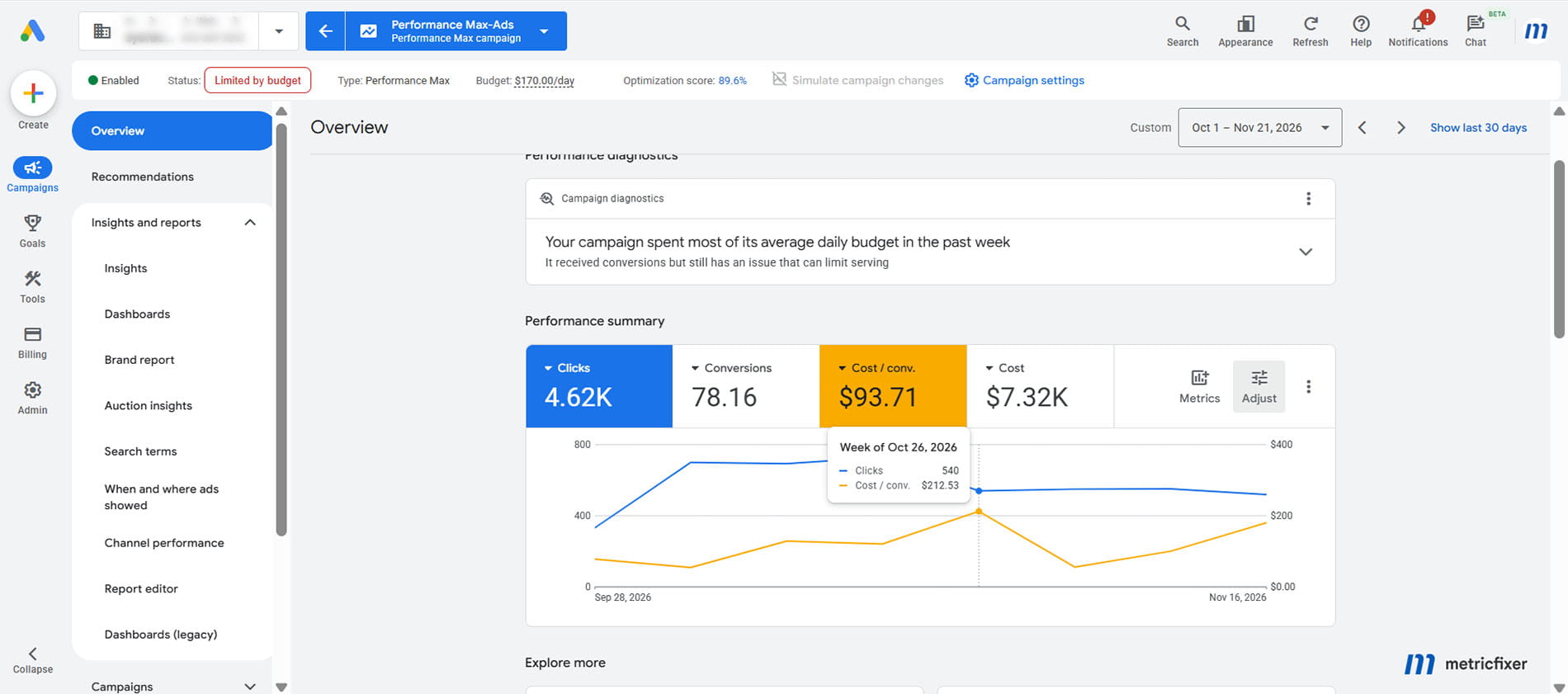
What remains unproven: the screenshots do not identify the individual contribution of the exclusion, the target change, delayed attribution, changing traffic costs or any remaining tracking issue. They justify an investigation, not a percentage allocation of blame.
Missing conversions are not the same as too few conversions
This is the central decision distinction. Missing because measurement failed means the feedback is inaccurate. Few because only a few eligible customers converted means the feedback may be accurate but statistically limited. Treating these as the same problem leads to poor decisions in both directions.
Google specifically includes broken tracking and interrupted conversion uploads among the intended uses in its conversion-outage guidance. Therefore, an exclusion is not reserved for invented or inflated conversions. A genuine purchase that never reaches the bidding system can also create misleading feedback.
Consider a simplified, hypothetical example. A fixed set of clicks produces 20 real purchases, but a broken payment-return path records only 10. The business still received 20 purchases; the measured conversion rate reflects only half of them. Contrast that with a healthy implementation that correctly records 10 actual purchases. The dashboard totals match, but the diagnostic conclusions should not.
The following decision matrix is metricfixer's operational interpretation, not a claim that Google requires an exclusion in every listed case.
| Situation | What must be established | Proportionate response |
|---|---|---|
| A checkout release stops purchase tracking | Confirmed missing events, affected routes and material impact on the relevant feedback. | Repair and validate the implementation; assess a prompt, scoped exclusion. |
| A purchase tag fires on non-purchase pages | False positives reach an advertising conversion action, rather than only a diagnostic report. | Stop the faulty signal and assess protection from the affected interval; handle reporting correction separately. |
| Duplicate purchases or incorrect values | The duplicate mechanism or value error is verified, with affected records and dates. | Repair deduplication or value mapping; compare a scoped exclusion with eligible record-level corrections. |
| An offline upload pipeline stops | Actual business events exist but the expected delivery process has failed. | Repair delivery, quantify the interruption and coordinate any exclusion with a controlled backfill plan. |
| One payment method loses tracking | The missing share, order values, campaign exposure and repair validation are known. | Assess materiality. Partial loss can justify action, but a whole-account response needs a separate scope justification. |
| A healthy campaign has only a few conversions | Measurement works and the low count reflects actual eligible activity. | Improve evaluation, structure or acquisition strategy; do not exclude accurate data simply to make learning look cleaner. |
| Recent clicks have not converted yet | The delay is consistent with the normal sales and reporting process. | Use mature comparison periods and monitor delivery; do not classify ordinary latency as an outage. |
| Sales genuinely deteriorate | Pricing, stock, demand, competition or the customer experience explains weaker outcomes. | Address the business and campaign problem. Do not suppress inconvenient but accurate performance history. |
| An old, repaired incident is discovered during a handover | There is a current, documented reason to intervene, rather than only a desire to tidy the past. | Review timing, present performance, alternatives and scope before changing anything. |
A website outage deserves particular care. Google's feature overview includes website outages among possible use cases; it would be too broad to say they can never justify an exclusion. Nevertheless, excluding data does not make a broken checkout usable. Where customers cannot buy, containment and repair come first.
For the case in this article, a one-payment-method failure was a real reason to investigate measurement. What has not been established is the missing share or whether the late, campaign-type-wide exclusion was the best response after the reported recovery. Neither blanket approval nor blanket rejection follows from the words partial outage.
Click dates, conversion delay and scope
A calendar of purchases is not a calendar of clicks
The most consequential configuration mistake is to copy the dates of missing purchases into an exclusion without reconstructing their earlier advertising interactions. Google's outage guidance recommends accounting for conversion delay and covering at least 90% of clicks associated with the affected conversion data.
In a hypothetical five-day conversion cycle, purchases lost during 10–12 June may relate to clicks before 10 June. Starting an exclusion on 10 June can miss part of the affected click population. Conversely, clicks during an excluded interval can produce correctly recorded purchases after the tracking repair. This is why the date range is a trade-off, not a precise filter for defective purchase records.
Applied to the October case, a pre-16 October click might have led to a purchase during the measurement failure, while a 20 October click might have produced a valid November purchase. The first might fall outside the configured interval and the second inside it. These are explanatory possibilities, not reconstructed customer journeys from this account.
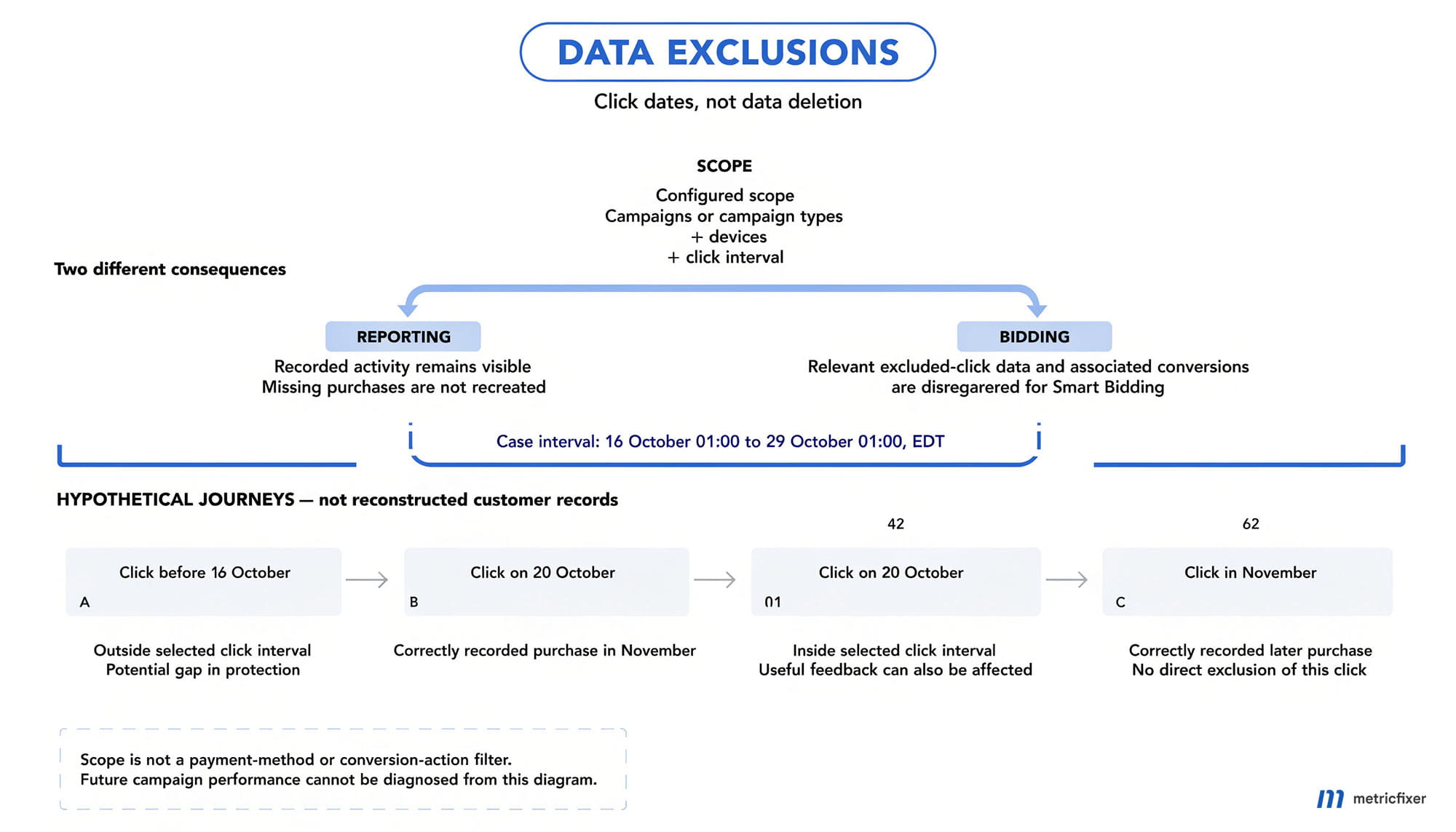
Build the delay estimate from a healthy, sufficiently mature period where possible. An outage-distorted sample can underrepresent precisely the purchase paths that disappeared. Document the typical lag, its longer tail and any important differences between payment methods or high-value orders. Do not extend the range by an arbitrary number of days and call that a delay analysis.
The name does not limit the exclusion
Naming an exclusion after Order Complete does not make it specific to that action. The Google Ads API configuration guide describes campaign or channel scope, optional devices and start/end timestamps. It does not provide a payment-method selector or a conversion-action selector for this resource.
That matters when only one path fails. A broad selection can disregard useful feedback alongside unreliable feedback. However, selecting every affected campaign may still be reasonable when they all depend on the same broken checkout. The relevant test is shared exposure to the incident, not whether the scope looks large in isolation.
Check the actual goals of each campaign, including custom goals, rather than assuming that every analytics event has the same bidding role. Google's primary and secondary action guidance makes this distinction important: custom goals can use actions for bidding regardless of their primary or secondary label.
Timestamps and the 14-day interval
The API field reference defines an inclusive start and exclusive end, with a maximum interval of 14 days. The screenshot's 16 October 01:00 to 29 October 01:00 selection is a 13-day interval. Its label does not mean a midnight-to-midnight selection of all of 16–28 October.
Record the configured time zone and compare it with deployment logs and payment records. A valid interval length establishes that a configuration fits a technical constraint; it does not establish that the chosen dates are appropriate. Do not split a long period into consecutive exclusions merely to bypass a limit without a defensible incident plan.
Late exclusions need a current case for intervention
The client's in-house team created the exclusion on 16 November, 21 calendar days after the reported 26 October repair and 18 days after its configured end date of 29 October. According to metricfixer's own management history, reported CPA had returned to approximately $55 by 3 November, before the client took control on 13 November. metricfixer was no longer managing the campaigns when the exclusion was applied. That makes the question different from emergency protection during a live measurement failure.
Google's Shopping and Performance Max bidding guidance emphasizes catching issues promptly. It also advises against using exclusions to fix issues that have existed for more than 14 days for Search and Display, or 60 days for Shopping. These are usage recommendations, distinct from the API's maximum length for one exclusion. That passage does not give a separate numerical cutoff for Performance Max; we should not invent one.
For this incident, the delayed timing warrants review, particularly because the selected scope included Search and Display. It does not prove that the Performance Max exclusion was rejected, inactive or harmful. Nor does it establish a universal rule that an exclusion has no effect after a fixed number of days.
A reasonable retrospective decision record should explain what current problem remains, which historical data is thought to be contributing, what verified recovery has already occurred, and why another intervention offers a better expected outcome than leaving the repaired setup stable. The argument should be stronger than those dates contain bad numbers.
There is also a difference between irreversible spending and permanent model damage. Money already spent during a poor intervention cannot be recovered by toggling a setting. That is a practical risk. It does not demonstrate that a bidding system can never learn effectively again.
A safe decision and implementation workflow
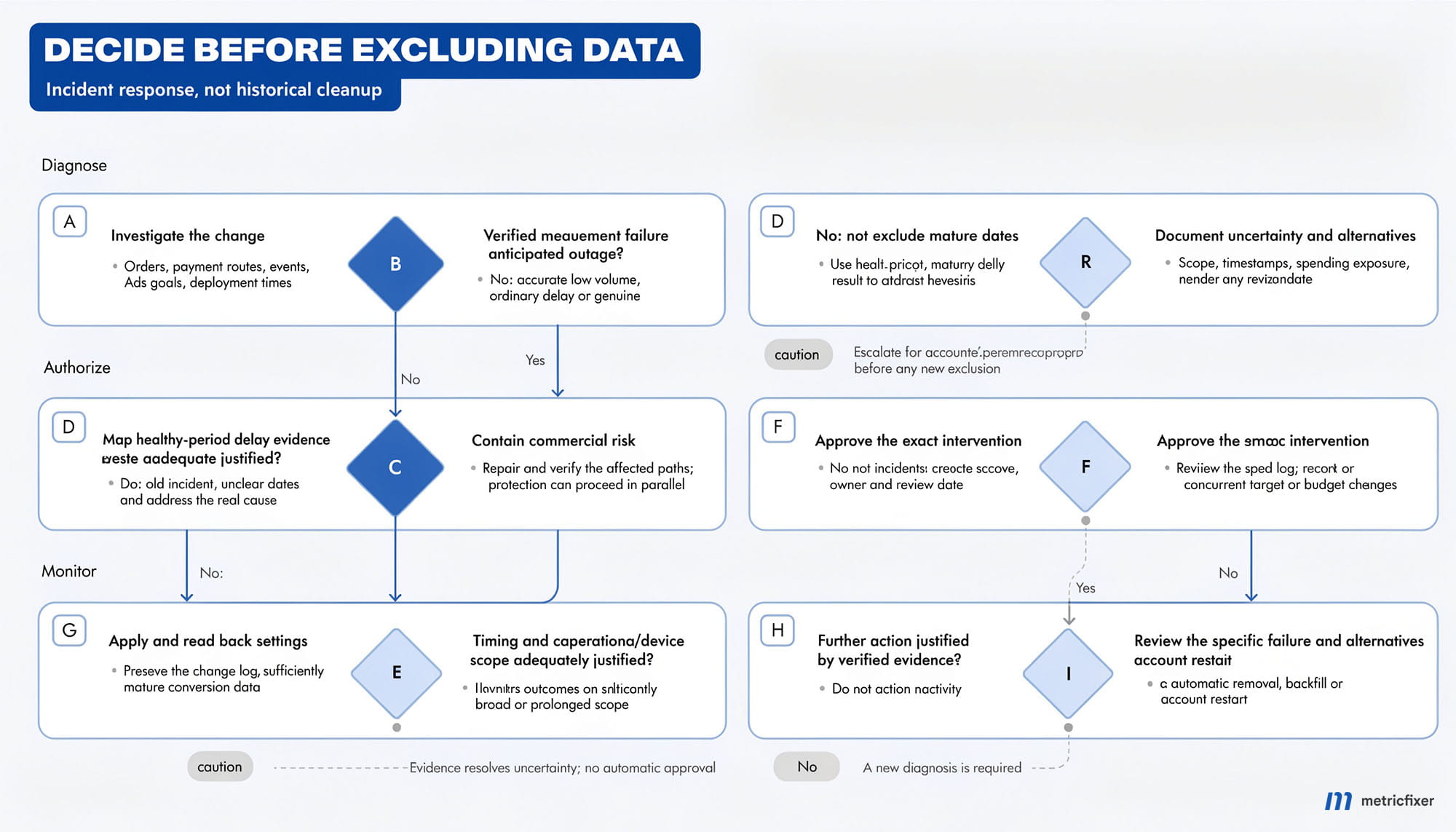
The following is a proposed operational control, not a mandatory Google procedure. Its purpose is to make a high-impact setting reviewable before it changes a live account.
Establish the incident before selecting dates
Start with an incident record: what changed, when it changed, which customer paths failed, how the failure was reproduced and when each path passed a repair test. Reconcile paid orders with emitted purchase events, GA4 records and the relevant Google Ads actions. These totals need not match one-to-one because eligibility and attribution differ; investigate the expected relationship rather than treating any difference as a defect.
For a payment-specific failure, compare the affected method with unaffected methods before, during and after the release. Verify transaction identifiers, value, currency and duplicate prevention. A passing test on one payment route does not validate the whole checkout. Our article on testing, attribution and Smart Bidding develops the same distinction between business events, successful delivery and attributed advertising conversions.
For a live, verified outage, this assessment can run in parallel with repair. Waiting for every delayed conversion to mature before protecting bidding would defeat the purpose. Approval should establish enough evidence to act, not postpone justified incident containment.
Approve the smallest justified scope
- [ ] Identify the affected Google Ads actions and the campaigns whose relevant feedback is unreliable.
- [ ] Record the incident interval separately from the proposed click-date interval, with the same explicit time-zone reference.
- [ ] Document the missing or incorrect share and the delay evidence used to choose the dates.
- [ ] Justify each selected campaign type and device; do not use account-wide scope merely because it is convenient.
- [ ] Record existing targets, budgets, goals and other active adjustments before saving a new one.
- [ ] Agree who approves the change, the acceptable spending exposure, the review date and the conditions for earlier intervention.
Where the incident is old, already repaired, difficult to delimit or close to the tool's limits, obtain an account-specific technical review before extending scope. Where commercial losses are occurring now, apply the agreed spending containment immediately rather than waiting for a perfect retrospective model of the incident.
Save and read back the actual settings
The documented interface route is Tools → Adjustments → Exclusions. Review the live account interface before acting. Enter the approved explanation and interval, inspect campaign and device selections, and read the saved configuration back against the incident record. Do not infer settings from the exclusion's name.
For a technical audit, the following read-only Google Ads Query Language query retrieves enabled exclusions. It does not create, remove or modify anything, and it does not reveal the internal effect on bidding models. Run it in the relevant client account using an authorized reporting tool.
SELECT
  bidding_data_exclusion.resource_name,
  bidding_data_exclusion.name,
  bidding_data_exclusion.description,
  bidding_data_exclusion.status,
  bidding_data_exclusion.scope,
  bidding_data_exclusion.start_date_time,
  bidding_data_exclusion.end_date_time,
  bidding_data_exclusion.advertising_channel_types,
  bidding_data_exclusion.campaigns,
  bidding_data_exclusion.devices
FROM bidding_data_exclusion
WHERE bidding_data_exclusion.status = 'ENABLED'
The API resource belongs to a client account even where an operator manages it through a manager-account workflow. A read-only export is useful for preserving exact scope; it is not a recommendation to automate live changes.
Recovery after an exclusion has already been applied
Start by stabilizing the evidence, not by adding more changes. Preserve the exclusion configuration and change history, confirm that the repaired purchase paths still work, and separate a genuine spending emergency from an immature efficiency report. Do not assume that a higher dashboard CPA alone identifies which setting should be reversed.
Google's bidding FAQ warns against routinely removing an applied exclusion and against uncoordinated backfills. Its exclusion guidance allows reporting-oriented backfills only after a minimum five-day wait and advises keeping the exclusion in place. This is not a universal promise that historical events can be reconstructed, nor a reason to upload estimated purchases.
Likewise, a Changes can't be undone label in Change history is not proof that the account is irreparably damaged. Google's API supports updating or removing exclusion resources. Technical editability does not mean removal is a safe recovery shortcut or that it restores an earlier model state. An incorrectly scoped exclusion should receive account-specific review, not an automatic delete it response.
For substantial historical exclusions, Google's published guidance allows for instability extending across one or two conversion cycles. A cycle is related to the time needed for the relevant outcomes to arrive, not an automatic seven-day waiting rule. For evaluation, Google's automated-bidding performance guidance recommends accounting for conversion delay rather than treating the newest incomplete period as final.
A useful recovery review has two tracks. Daily operational monitoring checks spending, delivery, payment completion and measurement health. Scheduled performance evaluation compares sufficiently mature periods using consistent campaigns and goals. Waiting for mature conversions does not mean ignoring runaway spending or another broken checkout.
Record every necessary target or budget adjustment and its rationale. Google's exclusion guidance allows such adjustments; the rule is not never touch anything. The problem is repeatedly changing objectives without allowing a clean evaluation window. Our discussion of daily monitoring and deliberate Google Ads changes explains this operating distinction.
In this case, the client's frequent performance checks during its period of in-house management helped surface a concern quickly enough to request metricfixer's audit on 20 November. That attention was useful, even though metricfixer had not resumed operating the campaigns. The analytical mistake would be to convert a rapid warning into a final conclusion that the bidder had failed to react or that the historical exclusion was the sole cause.
Choose the tool that matches the problem
Several controls can look like ways to repair bad conversion data while doing fundamentally different jobs.
| Problem to solve | Relevant approach | Important boundary |
|---|---|---|
| Unreliable feedback during a measurement incident | A justified data exclusion. | Protecting bidding is not the same as correcting historical reporting. |
| A supported recorded conversion needs correction | Conversion adjustment: restatement of value or retraction, where eligible. | Check the conversion source, identifiers, timing and supported operation before uploading. |
| A forecast short-lived change in genuine conversion rate | A seasonality adjustment where appropriate. | This is a forecast about expected behavior, not a way to erase a tracking outage or ordinary poor performance. |
| The campaign is optimizing toward the wrong business outcome | Review goals and conversion-action configuration. | Changing an objective is a separate intervention, not a surgical repair of a historical incident. |
| Management needs trustworthy historical business reporting | An annotated incident period and order-level reconciliation. | An advertising-platform total and a finance ledger answer different questions; do not invent ad attribution. |
Google's conversion-adjustment documentation distinguishes restating value from retracting a conversion and explains their effects on reporting and bidding. Do not assume every GA4-imported action supports the same correction workflow as a directly tracked or uploaded conversion.
Google's seasonality guidance concerns expected conversion-rate changes, particularly short events. It is not a general-purpose correction for every seasonal fluctuation. Selecting the right control requires identifying whether the problem is measurement, expected demand, the optimization goal or the business itself.

Does a broad exclusion require a new Google Ads account?
Not on the evidence available here. After the client contacted us on 20 November, metricfixer carried out an account audit and proposed rebuilding the advertising setup, including a new Google Ads account and a new GA4–Google Ads link. At the time of writing, our work following the handover has consisted of the audit and that proposal: we have not resumed routine management or carried out a migration. The proposed rebuild is a risk-management option for this project, not a Google-prescribed remedy or proof that the existing account's learning has been permanently contaminated.
There is a legitimate concern behind the question. Google's Smart Bidding overview says optimization can use data across campaigns. Therefore, simply creating a new campaign should not be described as a guaranteed isolation boundary from the rest of an account.
However, that does not establish the opposite claim that every future campaign must learn incorrectly. An exclusion has a defined scope and time interval. A campaign launched after the interval does not acquire October clicks merely because it is new. How historical information influences its predictions is a separate question; the reviewed documentation does not provide an account-specific answer or a permanent-damage diagnosis.
Nor is a new GA4 link a data repair. Google's linking documentation describes product connections and data sharing. Its conversion-import guidance states that historical data from before the import is not included. A link cannot recreate purchase events that were never collected, and rebuilding the destination does not fix a faulty event definition upstream.
For this particular client, metricfixer has proposed a rebuild as a way to manage uncertainty, but the proposal must be evaluated alongside continued recovery within the existing setup as a separate commercial and technical project. Assess who owns the accounts and conversion actions, which links and goals will change, what reporting continuity is lost, what can be validated before spending resumes and what new uncertainty the move introduces. A restart is not a lower-risk choice merely because its dashboard begins empty, and proposing it does not establish that the original account cannot recover.
Where a migration has an independent justification, preserve access to the old evidence, define the cutover, validate all payment methods, review conversion ownership and bidding goals, prevent unintended duplicate signals, and agree a fresh evaluation period. Do not present either the same-account or new-account path as a guaranteed performance recovery.
metricfixer has not implemented the proposed migration, and we have no verified post-migration results to assess. Our intervention since 20 November has been an audit and a proposal, not a completed operational turnaround. It would therefore be premature to describe the proposed rebuild as a successful case outcome.
AI advice and handover controls
During the period when the advertiser's in-house team managed the account, its staff reportedly consulted an AI chat before deciding to exclude the historical period on 16 November. metricfixer did not participate in that exchange, has not seen the original prompts or responses, and does not know which AI model or service the client used. We also cannot verify what information the team entered, what the assistant actually recommended, or whether it had any access to account data. It is possible that incomplete context contributed to an unsuitable decision, but that remains a hypothesis, not a finding about the client's prompt or the unidentified AI system.
The operational lesson does not depend on which assistant was used. A recommendation about an account-wide bidding control needs an evidence packet: incident and repair dates, affected payment routes, conversion sources, actual goals, missing share, conversion delay, recent recovery, current targets and budgets, concurrent changes and the proposed scope.
For illustration, an assistant told only some October conversions were missing would not be evaluating the same decision as a specialist who knew that metricfixer had managed the campaigns through the repair and recovery, that the client took control on 13 November, that the proposed exclusion would be retrospective and that a target CPA change was also contemplated. We do not know whether the client's actual AI conversation included any of those facts. Even a technically correct description of the feature can become an inappropriate instruction when the situation is incompletely specified.
Require any AI-assisted recommendation to separate observed facts, platform documentation and inference; identify what would change the recommendation; and remain read-only until a qualified operator approves the exact write. A persuasive answer is not evidence that the account was inspected. Additional customization alone is not proof of reliable diagnosis either.
Handover should transfer the same incident record. In this case, metricfixer offered a call at the 13 November transfer to explain the account, its repaired tracking problem and the strategy work that had restored performance. The client's in-house team declined that call and assumed responsibility for subsequent changes. The receiving team still needed to know not just which settings existed, but why they existed, which earlier problems had been repaired and when outcomes were expected to mature. The missing walkthrough is relevant process context, not proof that it caused the 16 November exclusion or a basis for assigning personal blame.
The practical takeaway
Data exclusions are neither a forbidden last resort nor a historical cleanup button. They deserve a clearly defined measurement problem, justified click dates and scope, and a plan for spending control and evaluation.
For the case reviewed here, the important warning is not that missing conversions should never be excluded. It is that a late, broad intervention after a reported recovery, combined with a substantial target change and evaluated over a short window, is difficult to justify and diagnose without the missing operational evidence.
Protect the bidding signal when measurement fails. Do not hide accurate weak performance, confuse configuration with data deletion, or treat an unexplained setback as proof that an advertising account must be abandoned.

Methodology and sources
This review was prepared on 22 November 2026 by metricfixer, which configured and managed the client's campaigns until 13 November and retained authorized access to the Google Ads account for an audit after the client requested assistance on 20 November. It combines our direct campaign-management history, the subsequent client-side change history and three account-interface screenshots captured during our review with public Google Ads Help, Google Analytics Help and Google Ads API documentation. The client's in-house team, not metricfixer, operated the campaigns from the 13 November handover through the 20 November request for assistance; metricfixer has since audited the account and submitted a proposal only. Official documentation establishes published product behavior, and the screenshots establish the settings and metrics visible in the selected views. The underlying website and payment records were not independently reconstructed for publication.
The core feature review uses Google's explanations of data exclusions and conversion outages, its Shopping and Performance Max guidance, and the API configuration and field references linked in the relevant sections. The bidding interpretation uses Google's learning, target-adjustment and performance-evaluation materials. The recovery comparison draws on conversion adjustments, seasonality controls, conversion-goal settings and GA4 linking/import documentation. Existing metricfixer articles are related operational reading, not independent proof of this case's cause.
Documentation scope matters. The API's 14-day interval constraint is not the same claim as Google's timing recommendations for particular campaign types. No unsupported Performance Max cutoff has been inferred. Manager-interface operation is distinguished from the client-account API resource. Public documentation does not reveal this advertiser's internal model state or establish that a replacement account is required.
Calculations use the displayed values and differences: 470 prior clicks, 6.44 prior conversions, $97.68 comparison CPA and a 38.5% target increase. Abbreviated spend is treated as approximate. The reported $55 CPA is not substituted for the screenshot's comparison baseline. The October repair date and exclusion interval remain explicitly distinct.
Although metricfixer has authorized access to the client's Google Ads account and carried out an audit, this publication does not present an exhaustive unfiltered change-history export, all raw campaign and conversion records, payment-processor reconciliation, a measured click-to-conversion delay distribution or a complete goal-by-goal configuration. We have not seen the client's AI conversation and cannot identify the AI model it used. We have not implemented the proposed migration or assessed verified results from one. There was no randomized or controlled experiment. The article therefore makes no quantified causal claim about the exclusion and offers an incident-management framework rather than a guarantee of recovery.
This article is written by metricfixer from its campaign-management experience and subsequent audit of a client account, and is intended to provide general technical and operational guidance. Our authorized access to that account and the screenshots reproduced here do not make the findings transferable without further examination to another advertiser; readers should obtain an audit of their own circumstances before taking high-impact action. No advertising result is guaranteed. The case reflects the evidence available at the review date and does not establish permanent account damage or the necessity of migration. metricfixer is not affiliated with Google. Product interfaces, eligibility, documentation and bidding behavior may change after publication.
Expert help with this topic
 Expert-Led Google Ads Account Audit
Get a PPC-specialist-led review of your Google Ads account, with clear evidence, priorities, limitations, and practical next actions.
 Google Ads
Choose an audit, tracking work, a campaign launch, ongoing management, supported self-service, or help with a specific Google Ads issue.
 Google Ads Management
Ongoing Google Ads strategy and optimization around one agreed primary KPI, with scope and priorities confirmed before paid work begins.
 Google Ads Full Setup
Launch Google Ads around a clear business goal, with a tailored strategy, an agreed scope, and 30 days of post-launch management. Start with a free strategy outline and estimate.