
Published Nov 18, 2026
AI Content on Facebook: Pages, Reposts and Monetization Risk
A practical guide to AI content on Facebook: manage Pages, groups and reposts, verify claims and permissions, handle disclosure, check monetization and correct every controlled copy.
Category: SEO & Web Marketing · By metricfixer AI Studio
AI content becomes a publishing risk on Facebook when nobody can explain where it came from, what it claims or who approved it. This guide explains how Pages, creator profiles and groups can handle synthetic media, member submissions and reposts without confusing an AI label with factual accuracy, originality or permission to earn money.
Practical starting point: give every publication a responsible editor, verify the story separately from the image, and recheck disclosure whenever a file changes hands. Keep publication, recommendations, monetization and advertising as separate decisions. This review reflects public documentation checked on 15 November 2026; account-specific tools and eligibility still need an in-account check.
Contents
Executive summary
A Facebook Page can publish a well-disclosed illustration and still make a false claim in its caption. A group member can share an authentic photograph with the wrong date. A creator can have permission to reuse a video without satisfying Facebook's originality requirements. These are different problems, and a single "AI approved" checkbox cannot resolve them.
Meta's approach to manipulated media generally favors context and labels for organic content, while material that violates other policies can still be removed. Separately, its recommendation framework distinguishes content that is allowed from content it is willing to recommend. Neither decision is a promise of payment.
The useful question is therefore not simply "Does Facebook allow AI?" It is "Can this account publish this version, with this claim and disclosure, for this purpose?" The workflow below is designed for teams receiving content from employees, agencies, members and other publishers, not just for an individual using a generator.
| Decision | What to establish | What does not prove it |
|---|---|---|
| Publication | The content meets applicable rules, and factual claims and permissions have been checked. | A visible AI label or the absence of a removal notice. |
| Recommendations | The content and account meet the relevant recommendation and originality requirements. | Being able to publish or seeing a few early views. |
| Monetization | The account, program, format and individual content are eligible. | A large audience, permission to repost or another creator's earnings. |
| Paid promotion | The final ad, rights, disclosures and destination have passed a separate advertising review. | Organic publication or creator-monetization eligibility. |
This is an editorial decision framework, not a new set of Meta account statuses. Use it to keep different checks from being merged into one unsupported conclusion.
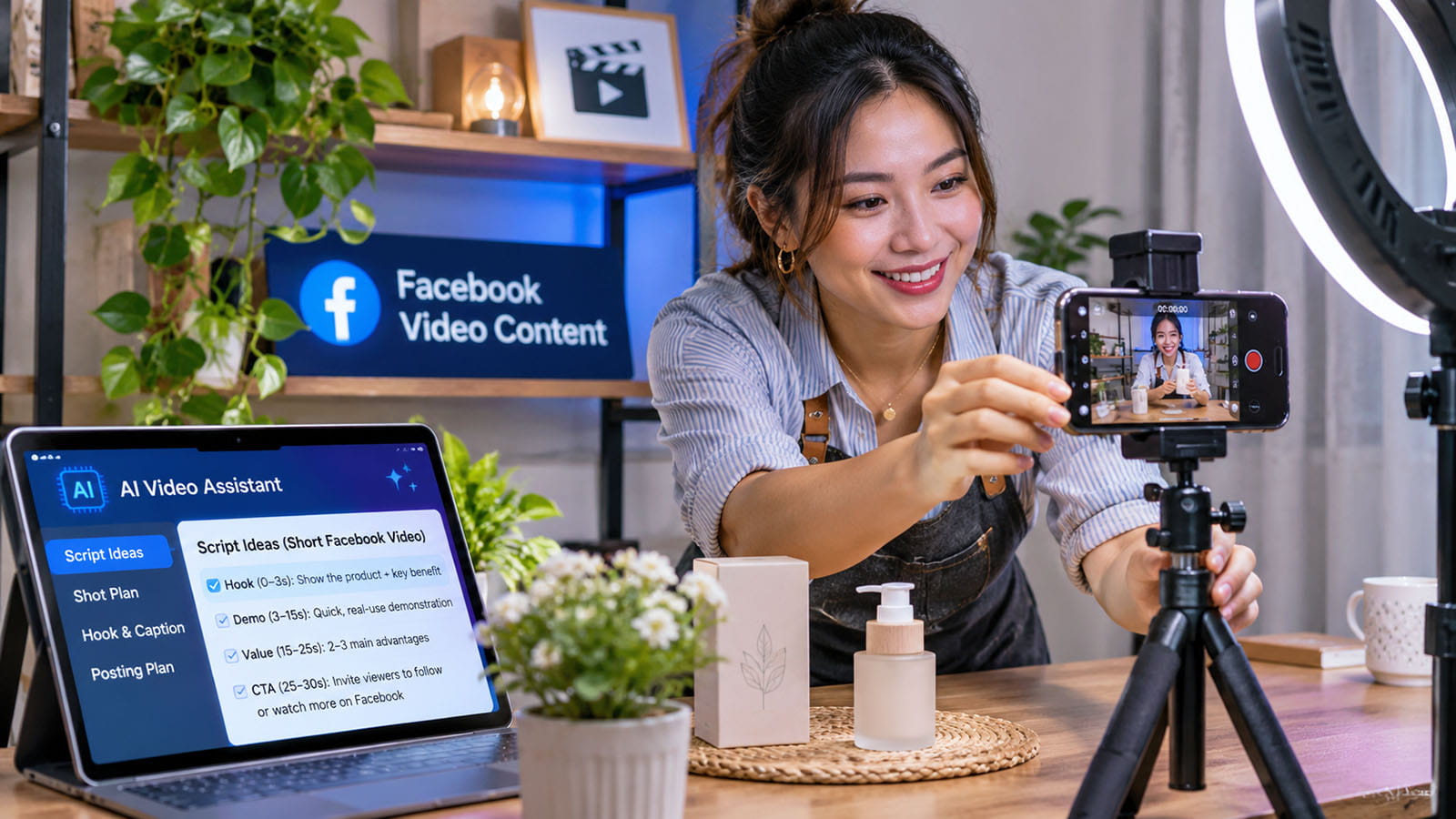
Pages, creator profiles and groups need different controls
Pages and creator profiles: approve the complete publication
For a brand Page, assign an editor to the entire package: media, caption, links, scheduled date and intended audience. The designer may know how the image was generated, while the account manager knows whether the promotion is current. Neither should assume the other checked both.
Apply the same rule to a creator profile, including a profile using professional tools. An apparently personal voice is not a substitute for a production record. A synthetic presenter should not casually acquire a fictional history of visiting a location, attending an event or using a product simply because the caption was written in the first person.
Groups: moderate submissions without turning them into endorsements
A group administrator needs a submission policy, a review queue and a correction route. Those controls differ from commissioning and publishing a Page's own material. Make clear whether a post is a member's contribution, an administrator's announcement or a commercial collaboration. Do not use "approved by an admin" as a public assurance that every underlying claim has been independently verified.
When a brand selects a member's post and republishes it on its Page, treat that as a fresh editorial decision. Ask for the source, permissions and relevant disclosures again. The move from a conversation to a brand communication can change what the audience understands the material to mean.
Contractors: require a handover, not just an export
Ask suppliers to deliver the approved file together with its source references, AI-tool involvement, permission records, caption and restrictions on reuse. Identify who can answer questions later. A contract saying "all rights cleared" is not an operational substitute for knowing which footage, voice, music and likenesses are present.
The responsibility assignments in this article are recommended working arrangements. They do not determine legal liability for every Page owner, moderator or contributor. For broader editorial controls when the same material also appears on a website, see metricfixer's guide to AI content, SEO and editorial responsibility.
When an illustration becomes a claim about reality
Start with the likely reader interpretation. A synthetic picture of a community hall might be harmless concept art. Put it beside "Thank you to everyone who attended last night's fundraiser" and it appears to document attendance. The production method has not changed; the claim has.
For factual material, verify the event, date, location and people independently of the asset. Request the original source or contact the organizer through a known channel. Use a reverse-image search or provenance check as a lead, not a verdict: finding no earlier copy does not establish that a scene happened. Do not publish a serious allegation merely because a detector classifies the image as probably real.
| Scenario | Risk to the reader | Recommended editorial treatment |
|---|---|---|
| Local incident or news illustration | A generated scene looks like evidence of a specific event. | Verify the report separately. Prefer a verified photograph, a neutral graphic or text; identify an illustration beside the image. |
| Fundraising or an emotional personal story | A fictional person or scene appears to be the beneficiary or proof of need. | Verify the organizer, beneficiary and payment destination independently. Do not invent evidence of suffering or a personal history. |
| Celebrity or expert appearance | The audience infers participation, a quotation or an endorsement. | Verify the actual involvement and permission. Do not use an AI disclosure to excuse a fabricated recommendation. |
| Event recap or customer success story | Synthetic people, crowds or results appear to document a real outcome. | Use verified records. Keep illustrative material visibly separate from evidence and avoid invented first-person testimony. |
| Creative, fictional or satirical post | The work loses its context when copied into another group. | Make the fictional premise clear in the publication itself, not only in the Page biography or a later comment. |
These are proposed editorial controls, not a claim that Meta automatically removes every misleading example in the table. An effective house rule can be stricter than the minimum conditions for a post to remain online.
A useful disclosure explains the particular limitation: "AI-generated illustration; not a photograph of this event." That is more informative than a generic reference to AI. But it still cannot rescue a caption that falsely says the pictured event happened. Change the claim, change the asset or do not publish.
Facebook AI labels: what they do and do not establish
Meta's AI-content help page describes automatic labeling from detectable signals and disclosure by the person posting. It also warns that not all AI content contains information its systems can identify. A missing label is therefore not evidence of camera capture or an unedited original.
The same guidance says the disclosure requirement concerns photorealistic video or realistic-sounding audio that was digitally created or altered, including realistic AI voiceovers. It explicitly distinguishes images: that particular requirement does not apply to images, although images can receive automatic labels. Meta also reiterated the organic video/audio disclosure requirement in its February 2026 transparency explanation. Do not turn a media-specific platform rule into "every AI-assisted post requires the same switch."
Equally, do not read the image distinction as a universal exemption. A still image may need a reader-facing explanation under the law or your editorial policy even where Meta does not require that particular self-disclosure. The legal checks below are separate.
Meta's September 2024 label update distinguished generated content from content only edited with AI, moving information about the latter into the post menu. Its documentation uses "AI info"; wording and placement can evolve. Check the actual label and information panel in the account and format you use rather than prescribing one universal button location.
The help page also describes an optional account-level AI creator label for accounts that mainly publish AI-generated or modified material. Treat that as background about the account, not a substitute for a required disclosure on a particular upload or an explanation of a specific factual claim.
Before scheduling, inspect the available disclosure controls in the real composer. After publication, view the post as a reader and open its information menu where relevant. Confirm that the caption, media and visible disclosure agree. When a required control is unavailable in the chosen publishing route, pause that route and use a supported one; do not assume a third-party scheduler made the selection for you.
For an apparently incorrect label, retain the original file and editing history and use the explanation, feedback or review route actually offered. Do not promise colleagues that an automatic label can always be removed. Re-exporting solely to conceal AI involvement is not a correction strategy.
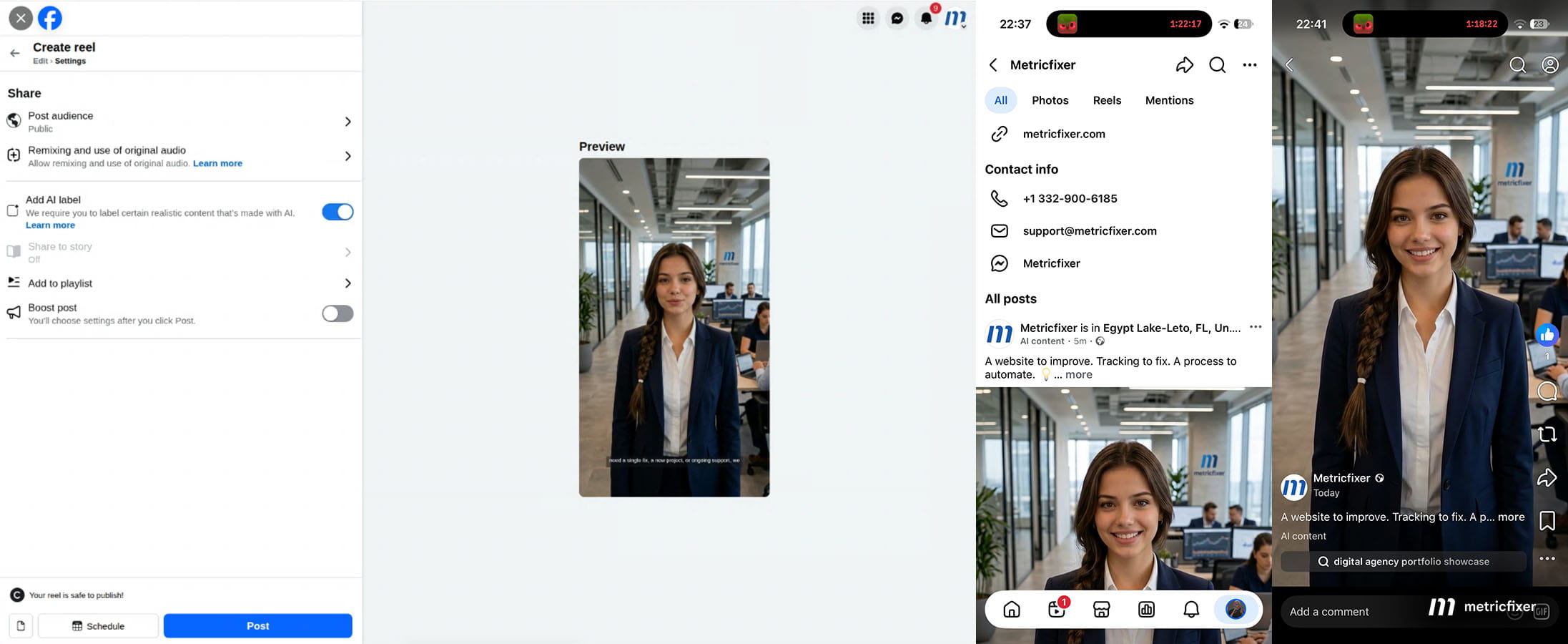
Reposts: preserve the source, then check the new publication
Reposting creates two different questions: can the team trace the material, and will the new audience receive the necessary context? Keeping the source file addresses the first. Checking the final Facebook post addresses the second.
C2PA's explainer describes Content Credentials as provenance information, not a truth certificate. It also explains that provenance can be incomplete or removed, and that supported durable credentials may help recover information through mechanisms such as fingerprinting or watermarking. Neither the presence nor absence of credentials settles whether a claim is true.
Do not make a blanket assumption that Facebook always preserves, always strips or always displays every signal. The route, file format and tooling matter. The following table is a verification plan, not a measured compatibility test of Facebook, Instagram or individual editing products.
| Reuse route | What to inspect | Safe working practice |
|---|---|---|
| Native sharing of an existing post | The original source, its present availability and the context visible beside the share. | Check the new introduction as carefully as the original caption. Do not imply endorsement or verification you have not performed. |
| Download and re-upload | The source record, permission and disclosures on the new upload. | Retain a source-to-copy link internally. Reassess labeling; do not assume the original post's label travels with the file. |
| Screenshot or screen recording | What source, date, correction or disclosure is missing from the captured view. | Treat the capture as a derivative, not the original evidence. Preserve a link and restore necessary context. |
| Crop, montage, translation or new voiceover | Whether the edit changes the meaning, realistic audio or the claimed event. | Review the final combination. An approval for an earlier version does not cover a materially different one. |
| Cross-post from Instagram or another platform | The Facebook caption, disclosure, audience and intended monetization or promotion. | Check each destination independently, including a reader-side inspection after publication. |
Test your actual production path with harmless material before using it at scale. Keep the source, exported file, publishing route and observed result together. A test showing that one file retained a label is evidence about that test, not a guarantee for all future uploads.
Prefer source-linked sharing where it meets the editorial need, but do not describe native sharing as automatically safe or monetizable. A link can preserve useful context while still pointing to a false story. For material moving through TikTok as well, use the separate TikTok AI-content workflow rather than transferring Facebook's rules to another platform.
Originality and recommendations are not the same as copyright
In its March 2026 originality update, Meta says content produced directly by a creator or Page/profile owner is original. For Reels incorporating third-party material, it emphasizes a creator presenting genuinely new information, analysis or substantial narrative improvement. Merely watching, stitching clips together or narrating what is already visible does not provide that value.
Meta also identifies low-value modifications such as borders, captions or speed changes to someone else's material as unoriginal. Repeatedly publishing primarily unoriginal content can affect recommendations and monetization at account level. Its announcement provides an appeal route for originality decisions.
For an editor, three permissions must therefore remain separate: permission to use the underlying material, a credible claim of creative contribution, and eligibility under a particular distribution or payment program. A license is evidence for the first question, not an automatic answer to the other two.
An AI narration of someone else's clip is not made substantively new simply by using a different voice. Conversely, do not declare every AI-assisted production unoriginal. Ask what the team actually contributed: verified reporting, an explanation, a demonstration, an argument or a clearly designed fictional work. Keep evidence of that contribution rather than treating a generator's export date as proof of creative value.
Volume introduces a different risk. Meta's spam enforcement announcement identifies unrelated captions, distracting hashtag-heavy tactics, coordinated fake engagement and networks repeating spammy content as behaviors that can reduce distribution or monetization. This is not a published universal daily limit on AI posts. The practical response is to remove manipulative publishing patterns, not to hunt for an allegedly safe number of uploads.
When reach falls, record the actual notice, if any, and separate it from a performance change. Compare topic, format, audience, posting frequency, retention and available account-status information. A drop after adding a label is a sequence of events, not proof that the label caused it. Do not remove required disclosure to test that theory.
Monetization: check the account, program and format
There is no defensible blanket promise that AI content earns money on Facebook, and no basis here for a blanket claim that AI use alone disqualifies everything. Evaluate the actual program and publication.
Meta's 2026 Content Monetization explanation describes Facebook Content Monetization as invite-only, with an interest form in the mobile Professional Dashboard under Monetization and Content Monetization. It lists eligible short- and long-form videos, Stories, photos and text posts. Eligibility is the important qualifier: the announcement is not approval for every post in those formats.
The same announcement distinguishes qualified views, an approximate earnings rate per 1,000 qualified views, and non-qualified views. Do not calculate expected income by multiplying every visible view by an assumed fixed rate.
Before building a commercial production plan, make the following checks in the relevant account. Save the date and evidence rather than copying a threshold from a tutorial about a different program.
| Check | Evidence to retain | Decision it supports |
|---|---|---|
| Account and location | The actual Page or profile, its country and the current program's availability information. | Whether this account can participate; not whether another account in the same country can. |
| Program access | An invitation or active enrollment, accepted terms and any outstanding setup steps. | Whether the program is available and ready, not merely visible as an interest form. |
| Policy standing | The exact recommendation, originality or monetization notice and affected content. | Whether a restriction is content-specific, account-wide or unrelated to AI disclosure. |
| Format and execution | The rules shown for the actual format and program. | Whether a photo, narrated slideshow, Reel or other execution is eligible in that context. |
| Payment measurement | Eligible performance and estimated versus finalized earnings. | Whether views translate into payable results, rather than just attention. |
Do not confuse a photo post with a static-image video, or assume that adding music and motion to a slideshow creates an eligible production. Equally, do not quote an old video-format restriction as proof that all photo posts are excluded. Check the current rules for the chosen program and execution.
A group's membership count is not evidence of a Page's or profile's monetization eligibility. Keep Content Monetization separate from Stars, subscriptions, sponsorships and any other commercial arrangement; verify each product's terms and availability rather than pooling them into "Facebook monetization." This review did not audit a logged-in account or establish a definitive country list.
For reporting, Meta's Page insights documentation describes monetization earnings as estimates that can change after reviews, copyright claims or other adjustments. Treat dashboard income as a financial record to reconcile, not proof that the underlying content was approved for every future use.
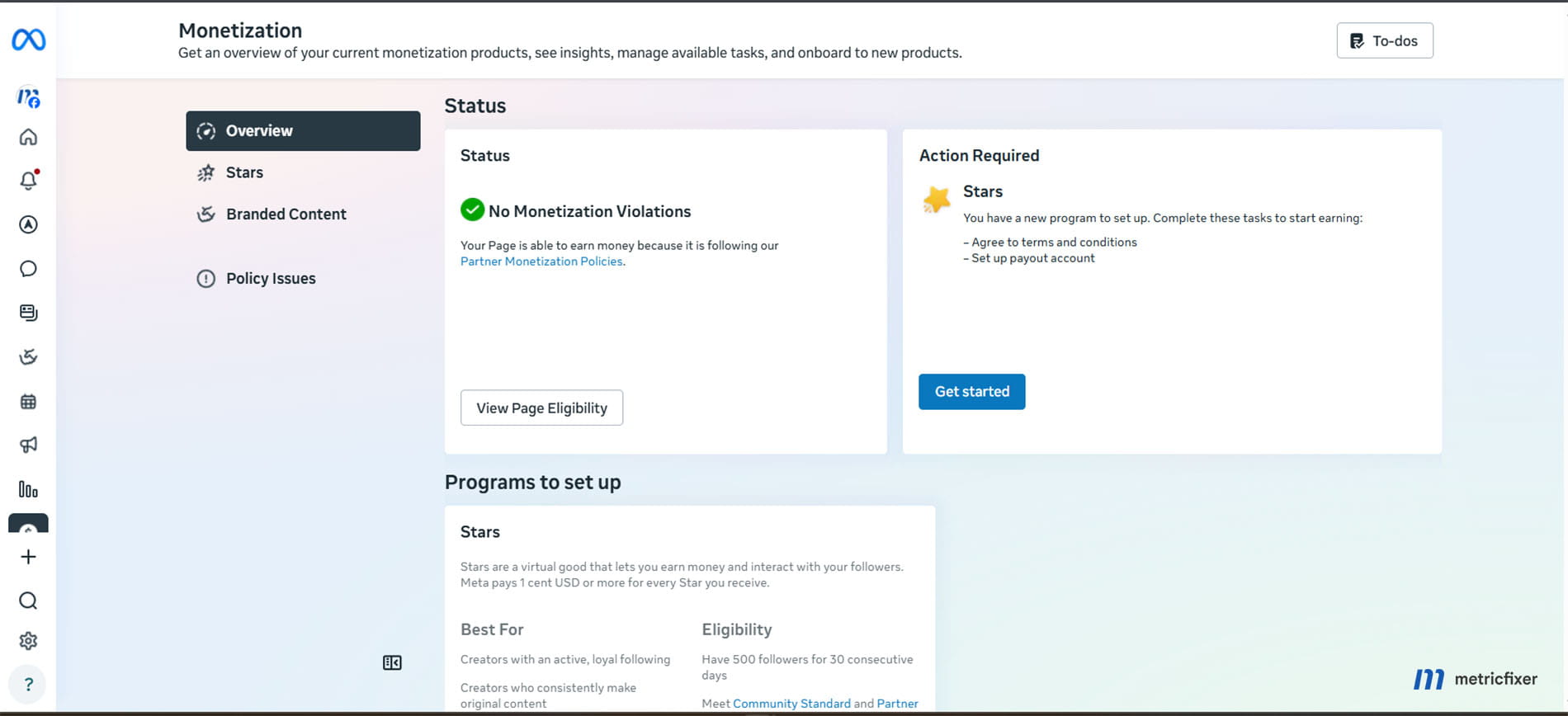
Moderate AI content through explicit group rules
A useful group rule describes the behavior members must follow. "No AI slop" leaves both contributors and moderators guessing. A better rule identifies synthetic illustrations, factual claims, source links, permission and correction duties.
Suggested group rule: Clearly identify realistic synthetic or materially altered media. Do not present fictional people, events, quotations or results as real. For factual claims, provide a source moderators can check. Share only material you are entitled to use, disclose commercial relationships, and cooperate with corrections. Moderators may hold, decline or remove submissions that lack sufficient context.
This proposed house rule deliberately goes beyond a narrow platform-label requirement. Publish it as your group's rule, not as a quotation from Meta. Explain how a member can supply missing evidence or challenge a moderation decision.
Use available approval controls to hold higher-risk submissions: fundraising requests, allegations, realistic depictions of public incidents, product testimonials and unexplained third-party media. Ask for the original source and the contributor's relationship to the subject. Where uncertainty cannot be resolved, decline the submission without publicly asserting that the member fabricated it.
Automation can sort a queue; it cannot approve reality
There is a relevant recent development. Meta introduced Forum as a dedicated app synced with Facebook groups. Its 23 October 2026 admin-tools announcement describes AI suggestions about whether pending posts follow group rules, more flexible Admin Assist conditions and a shared content calendar. It specifies Forum availability in the United States on iOS and Android; these are not universal instructions for every Facebook group interface.
Where available, use those features to route items for review, not to certify their factual accuracy or rights. A post can comply with the wording of a group rule and still contain an invented event. Keep a human decision for sensitive claims and review samples of automated approvals and declines.
Distinguish group Admin Assist from Page comment-moderation tools and from an AI-content label. They answer different questions. Meta's group-management documentation describes configurable moderation criteria; it does not turn those criteria into a source-verification service.
Never deliberately publish violating or misleading material to test enforcement. Use a harmless controlled submission to test the review queue. Give moderators a way to pause automation when a supplier, topic or account starts generating repeated problems.
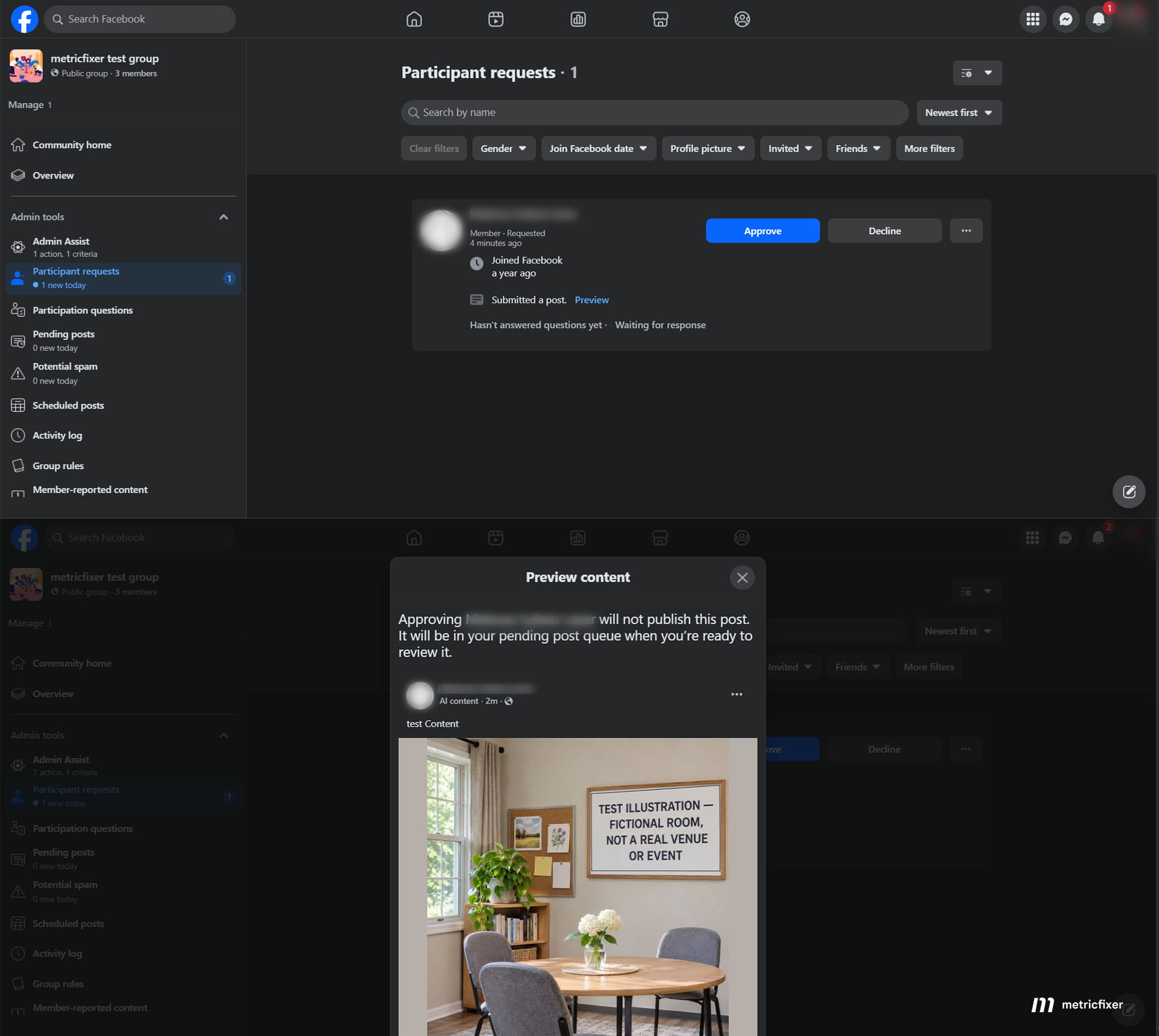
Correct the post and the distribution chain
A correction is not complete when the original author changes a caption. Your team may also control a scheduled copy, an Instagram version, a group share, a newsletter link or a boosted post. Maintain a record connecting the original asset to its published versions.
Use the following incident procedure as a starting point:
- Stop additional distribution. Pause queued copies, automated reposts and relevant paid promotion while the issue is assessed.
- Preserve proportionate evidence. Record the post reference, version, complaint and decision. Restrict access to sensitive material; do not circulate harmful content merely to document it.
- Choose correction or withdrawal. Correct a repairable factual mistake visibly. Remove material whose central claim is false or whose continued availability would cause unacceptable harm. A new AI label alone does not fix either problem.
- Reach the places you control. Update or withdraw your copies, contact collaborating admins and request corrections from known republishers. Do not promise control over independent downloads or shares.
- Explain what changed. State the false impression and the verified position without unnecessarily repeating the misleading asset. Keep the correction easy to find.
- Repair the process. Identify whether the failure was sourcing, permission, wording, automation or approval. Recheck other content affected by the same cause.
For example: "Correction: the image previously attached to this post was an AI-generated illustration, not a photograph of the event. We have removed it. The attendance figure was also unverified and has been withdrawn." Use only the parts that accurately describe the incident; do not introduce a new unverified assurance.
A report to Meta and a correction to your audience are separate actions. Meta's Community Notes announcement records the end of its US third-party fact-checking program on 7 April 2025 and the start of public Notes there. Do not describe that as a worldwide switch or wait for a note, label or platform decision before fixing your own publication.
When challenging an originality or monetization decision, retain the notice and submit relevant evidence through the offered review route: source files, creation history, permissions and a concise explanation of the contribution. A review request is not a guarantee of restored reach, income or a particular response time.
AI disclosure and commercial disclosure are separate obligations
EU AI transparency: assess the content and your role
The European Commission's Article 50 guidance states that the transparency obligations apply from 2 August 2026. Its limited grace period to 2 December 2026 concerns provider marking and detection under Article 50(2) for qualifying older systems, not a general postponement of publishers' disclosure duties.
Under Article 50(4) and (5), covered users of AI systems, called deployers, must disclose AI-generated or manipulated deepfakes, including qualifying still images. AI-generated or manipulated text published to inform the public on matters of public interest has a separate disclosure rule. That text rule has an exception where human review or editorial control has occurred and a person or organization holds editorial responsibility. It is not a general exemption for synthetic images or video. Evidently artistic, creative, satirical or fictional works have a tailored disclosure approach, not an unrestricted waiver.
The Commission distinguishes professional deployment from purely personal, non-professional use; regularly earning an economic benefit can matter. Do not assume every group member or person forwarding a post has the same legal role. Equally, using a contractor does not automatically move an organization's responsibilities elsewhere. Assess the actual activity and jurisdiction.
For practical disclosure, the Commission explains that a deployer cannot rely solely on machine-readable markings: people need understandable information at first exposure. It also distinguishes substantive editorial review from superficial spelling or grammar checks. Record who reviewed the factual substance, and do not treat a menu-only indication as automatically sufficient for every legal duty.
Sponsored posts need their own disclosure
An organically distributed post can still be commercial. "AI-generated" explains production; "Ad" or a clear sponsorship statement explains the commercial relationship. Neither replaces the other. Apply the appropriate platform branded-content controls where required, and separately check whether the audience can understand the relationship without hunting through menus or a profile biography.
| Market | Relevant guidance | Practical consequence |
|---|---|---|
| European Union | The Commission's influencer-disclosure guidance and enforcement overview covers promotions bringing revenue or other benefits. | Identify commercial content clearly and check the target country's language and local requirements. An AI label does not disclose a brand relationship. |
| United States | The FTC's Disclosures 101 covers material connections, including money, gifts and employment relationships. | Put understandable disclosure with the endorsement. For video, include it in the video, not only in its description; do not assume a platform tool alone is sufficient. |
| United Kingdom | The CMA's content-creator guidance covers incentivized posts, gifts, affiliate arrangements and own-business promotion. | Use a clear, prominent advertising label. Add an upfront Ad label where a platform tool does not clearly communicate the commercial nature. |
A synthetic spokesperson also needs a truthful role. The FTC's reviews and testimonials guidance does not impose a blanket ban on AI avatars, but fake underlying testimonials and deceptive endorsements remain a problem. Do not invent a customer who supposedly bought the product and achieved a result. Selecting a member's review for a brand's promotional use is not the same as merely hosting discussion.
Before boosting a post, reopen the approval: confirm advertising rights for the media, voice, likeness and music; validate claims and the destination; and check applicable ad disclosures. Organic publication is not advertising clearance. Complete that review before the post becomes an ad, even when its organic version has been online without a complaint.
A publication workflow for teams with multiple authors
The following workflow is a proposed metricfixer operating model, not Meta's official review procedure. Its purpose is to make approval reproducible and corrections possible. A small team can combine roles, but the checks should remain identifiable.
| Role | Owns | Evidence handed to the next person |
|---|---|---|
| Contributor or supplier | The source package and an accurate account of AI use. | Originals, references, tools used, permissions and reuse limits. |
| Editor | Meaning, factual claims, framing and the publish-or-hold decision. | The approved media-caption pair and unresolved issues, if any. |
| Page or program owner | Account access, intended distribution and commercial eligibility checks. | The relevant account, program status and scope of approval. |
| Publisher | The correct version, available disclosure settings and reader-side inspection. | The published reference, time, observed label and final version. |
| Moderator or incident owner | Reports, corrections and coordination across copies. | The decision log, affected publications and follow-up actions. |
For each item, keep a short record covering the source, rights, AI involvement, factual evidence, reviewer, approved version, disclosure decision and destination. Add commercial relationships, account/program checks and links to all copies where relevant. Store only what is necessary, restrict access and set retention appropriate to your obligations and risk; this is not a recommendation to retain private member information indefinitely.
Publication workflow: receive the source package → verify claims and permissions → hold unresolved items for evidence or revision → decide AI and commercial disclosure → check intended distribution and monetization → approve the final version → publish and inspect → monitor, correct or withdraw every controlled copy.
Separate a failure of publication requirements from a failure of monetization requirements. Material that is otherwise publishable may be unsuitable for an income plan; do not label it "approved for earnings". A monetization problem does not justify bypassing factual checks, and a truthful disclosure does not justify bypassing originality checks.
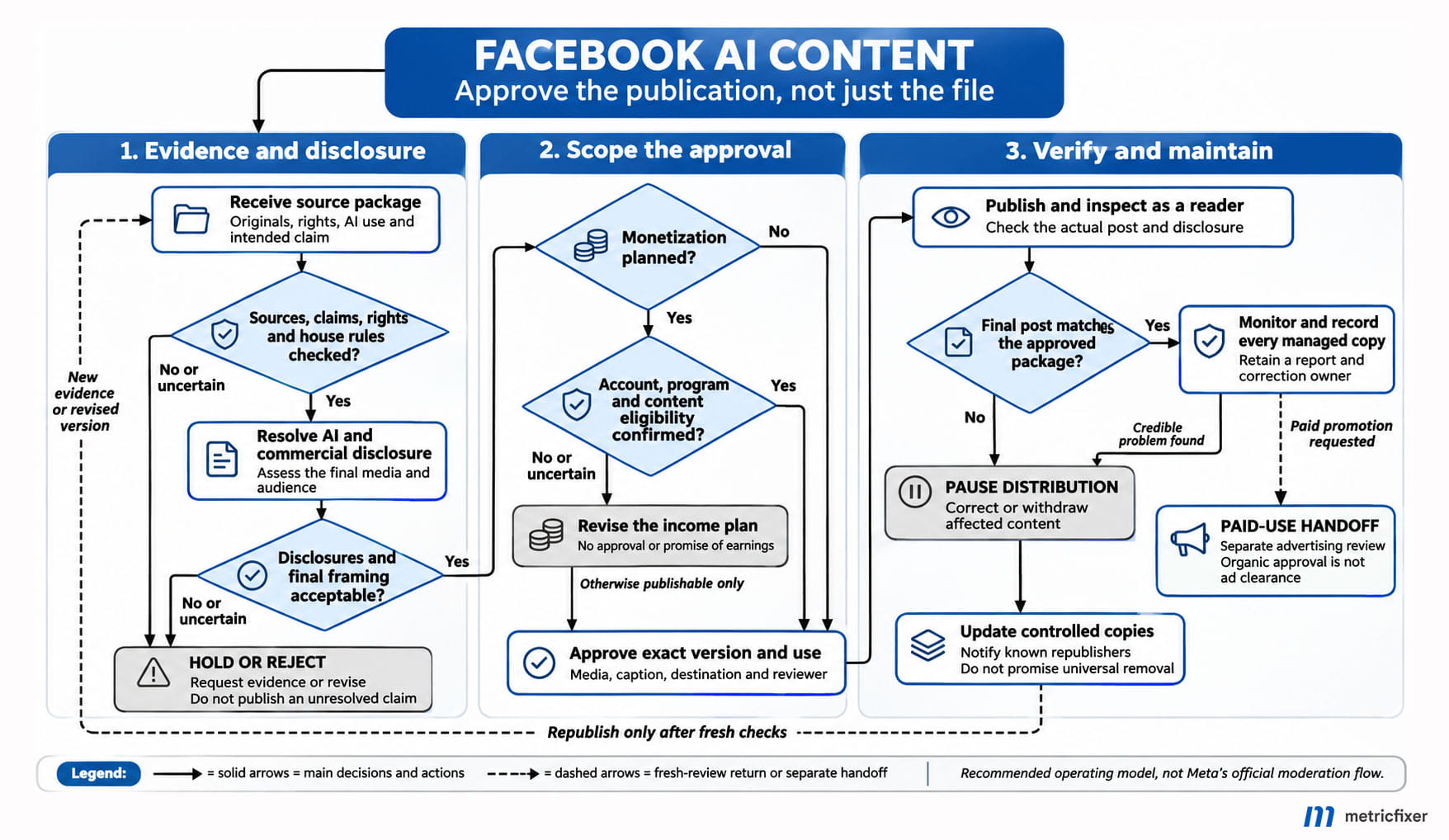
Automation should publish approved versions, not improvise claims
A scheduler should receive an approved package, not just an asset folder. Do not let an automated caption step turn a fictional illustration into a claimed news event after editorial review. Lock the approved wording, file and destination together, and require a fresh review when any of them materially changes.
Use a fail-closed rule for missing evidence: send the item back for review rather than publishing a fallback caption. Give the team one way to pause all queued uses of an asset. Review access when an agency or employee leaves, and separate permission to prepare drafts from permission to publish wherever your account setup supports that distinction.
Finally, inspect more than the composer preview. Check a sample of published posts on mobile, including truncation, media cropping and disclosure visibility. After changes to a scheduler or publishing integration, repeat the controlled path test before returning to unattended publication.
Repost and publication checklist
Use this checklist before approving a new publication or a materially changed copy. An unanswered item is a review task, not a reason to invent a reassuring default.
- Source: the original creator or source is recorded; a repost is not being mistaken for an original.
- Claim: the media and caption do not imply an unverified event, quotation, endorsement or personal experience.
- Rights: permission covers the actual material and intended use, including relevant music, voice and likeness.
- AI disclosure: the team has assessed the final media, platform requirements, applicable law and its own editorial explanation.
- Commercial disclosure: any relevant sponsorship, gift, affiliate or other material relationship is made clear.
- Distribution and payment: originality, account standing and program eligibility have been checked separately; no revenue outcome is promised.
- Version and destination: the scheduled file, caption, account and audience match the approval, including cross-posted copies.
- After publication: someone has checked the reader-facing result and owns reports, correction and withdrawal.
The central discipline is simple: verify the claim, explain the media and keep responsibility attached to every copy. AI can be part of a useful publishing process. It should not become the reason nobody knows what was published or who is supposed to fix it.
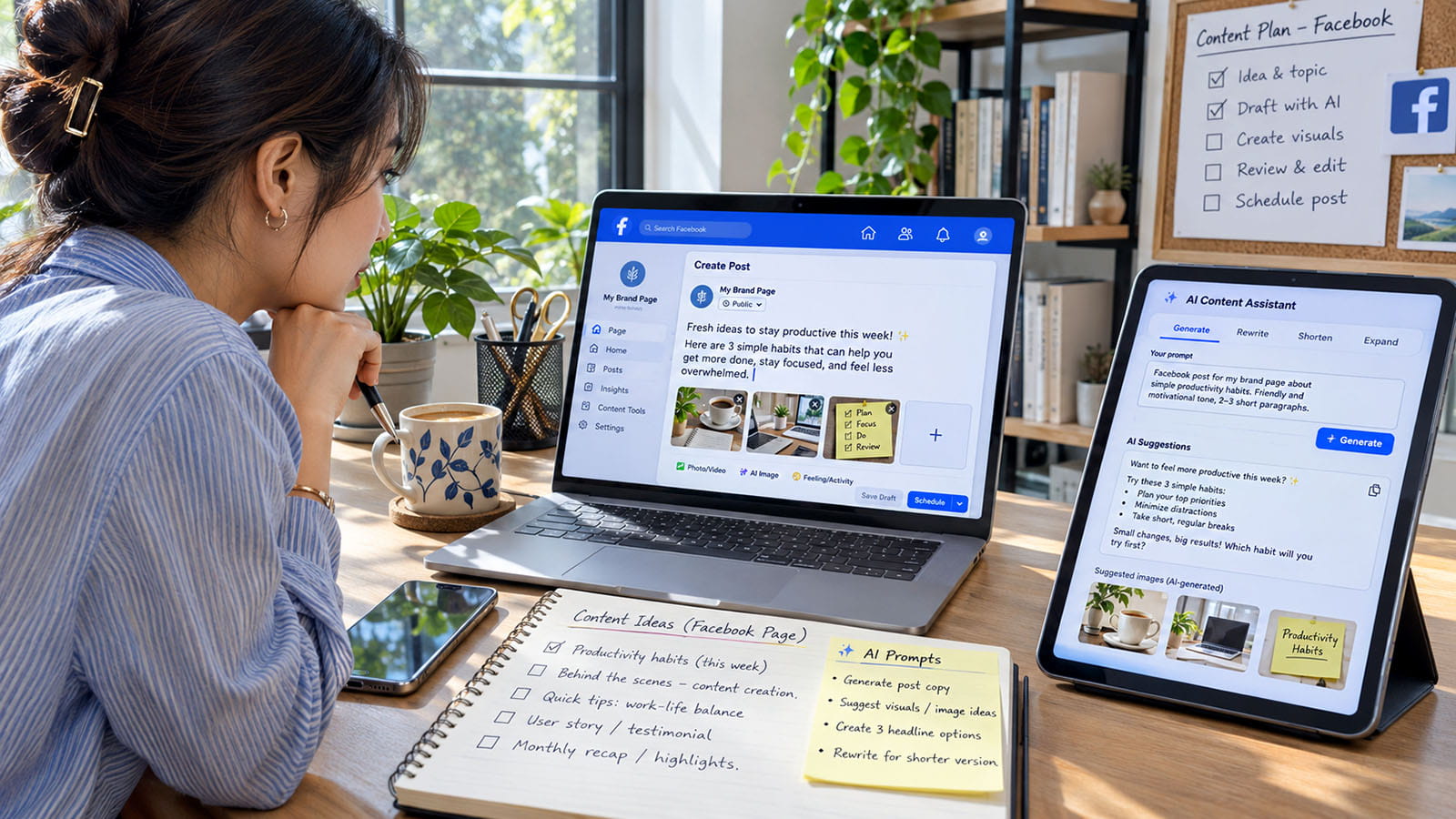
Methodology and sources
This article is a documentation-based review checked on 15 November 2026. It prioritizes Meta's AI-content help guidance, its labeling and recommendation explanations, the March 2026 originality and Content Monetization announcements, the Facebook spam update, and the September and October 2026 Forum announcements. Sources are linked beside the claims they support rather than repeated as a numbered reference list.
Legal context draws on the European Commission's AI Act Article 50 text and implementation guidance, its consumer-protection material, FTC endorsement and testimonial guidance, and the UK's CMA guidance. These are distinct legal and regulatory frameworks, not interchangeable global rules. C2PA documentation supports the explanation of provenance and its limits, not a claim about a tested Facebook export path.
No logged-in Page, creator profile, group, monetization account or publishing API was audited for this article. Some Facebook Business Help and Transparency Center pages did not provide readable public access during research; their inaccessible text was not treated as verified evidence. We do not claim a complete country-availability list, guaranteed interface paths, universal metadata preservation, an experimentally established AI-label effect on reach or an earnings forecast.
The scenario tables, group rule, responsibility matrix, correction procedure and workflow are metricfixer's editorial recommendations. They are not quoted Meta requirements or findings from a production experiment. An interface screenshot illustrates a particular account and capture context; it is not evidence of universal availability.
This article provides editorial, technical and operational information, not legal advice or a guarantee of publication, recommendations, monetization, account recovery or advertising approval. metricfixer is not affiliated with or endorsed by Meta, Facebook, Instagram, Forum, C2PA or the other organizations mentioned. Platform rules, interfaces, program eligibility and applicable laws can change. Check the current requirements for the account, content, intended use and jurisdictions involved, and obtain qualified advice for significant legal or commercial risks.
Expert help with this topic
 Meta Ads Full Setup
Launch Meta Ads from an agreed strategy with conversion readiness and 30 calendar days of initial management.
 Meta Ads Management
Manage Meta Ads around one primary objective with a coherent strategy and sufficiently representative business-outcome data.
 Meta Ads
Investigate a Meta Ads account, configure Pixel and suitable CAPI measurement, launch campaigns, or arrange ongoing management.
 Meta Pixel and Conversions API Tracking Setup
Measure meaningful customer actions with Meta Pixel and a suitable Conversions API path, validated across browser and server signals.