
Published Nov 9, 2026
GTM Beyond Tracking: Connecting Luch Shoppers with Dealer Stock
When Luch's online allocation of a limited watch collection sold out, a dealer still had stock. See how metricfixer used GTM for a transparent, reversible dealer handoff, and where measurement and compliance boundaries matter.
Category: SEO & Web Marketing · By metricfixer Expert Team
A sold-out product page does not always mean a product has disappeared from the market. When Luch's own online stock of its "108 Minutes" watches ran out while a dealer still had inventory, metricfixer used Google Tag Manager to give visitors a clear next step: buy from AllTime. The change was limited to selected Russian-language pages and could be withdrawn through one dedicated tag.
Practical takeaway: GTM can support a small, temporary change to the customer journey, not just measure it. The useful pattern is a clearly named dealer link, tightly defined page scope, honest product information and a tested off switch. It is not a replacement for an ecommerce platform, a way around advertising rules or proof of additional sales.
Contents
Executive summary
The commercial problem was not a shortage of interest. Shoppers were still looking for a limited watch collection, but the manufacturer's online store and a dealer had different stock positions. Customers contacted Luch, and its team manually directed them to the retailer that could still fulfil an order.
metricfixer proposed moving that next step onto the relevant product journey. A GTM-controlled change introduced a "Buy at AllTime" button and a price in Russian rubles on the Russian-language collection and model pages. The English and Belarusian versions were outside the change's scope.
metricfixer carried out the work as a specialist subcontractor to a European agency that directly serves Luch. The agency is not affiliated with metricfixer and is not named here. Luch was the end client, rather than metricfixer's direct contracting client. Our wider work in this arrangement covers marketing research, end-to-end analytics and advertising performance optimization.
This is an implementation case, not a conversion-lift study. Its documented result is a controlled route from existing product interest to an alternative seller, with a straightforward withdrawal mechanism. No sales uplift, revenue total or reduction in support workload is claimed.

The problem: demand and inventory were in different places
Luch, the Minsk watch manufacturer, releases distinctive themed and limited collections. Its "108 Minutes" collection includes an unusual 24-hour dial: the hour hand completes one revolution in a full day rather than twelve hours.
According to the project account, the Russian watch retailer AllTime purchased a substantial batch around the collection's launch. However, Russian customers who already knew the brand continued buying through the manufacturer's own online store. Luch's online allocation sold out while the dealer still had watches available.
Interested shoppers then wrote or called the manufacturer. Staff explained where the watches could still be bought and passed customers to the dealer's website. That process provided a useful answer, but only after the customer made an additional effort and someone at Luch responded.
The opportunity was therefore specific: make an existing, legitimate purchasing route visible where the customer was already looking. There was no need to recreate the product catalogue, take an order on the dealer's behalf or make the manufacturer's inventory appear replenished.
A permanent retailer-availability integration could have addressed a broader problem. For this collection, the immediate requirement was narrower: a reversible change that could stay active while the dealer had stock and be removed when it no longer helped customers.
What changed, and what stayed the same
The scope combined two conditions: the relevant collection or model page, and the Russian-language version of the website. It was not a site-wide replacement of purchase buttons.
| Page or element | Change described in the project | Boundary |
|---|---|---|
| Russian collection page | Dealer purchase messaging and a Russian-ruble price on the relevant collection content. | Only the selected "108 Minutes" collection. |
| Russian model pages | A button naming AllTime and a route to the dealer's store, with the price displayed in Russian rubles. | Only the relevant models, not unrelated products. |
| English and Belarusian pages | No changes from this GTM intervention. | Other language versions retained their existing presentation. |
| Manufacturer stock and checkout | The handoff did not itself replenish stock or create a dealer checkout inside Luch's store. | Buying from AllTime was a separate customer journey. |
| Merchant Center feed | The affected products were not submitted through Luch's feed because its stock was zero, as reported for the project. | This was a project-specific feed configuration, not a universal rule for sold-out products. |
The Russian button text was Купить в AllTime, meaning "Buy at AllTime." Naming the dealer mattered: it told the customer that the next purchasing step involved another store, rather than presenting an ordinary add-to-cart action on Luch's website.
The collection-level example is linked above. A model-level example is Luch model 77740961. These are live references, not permanent snapshots of the intervention.
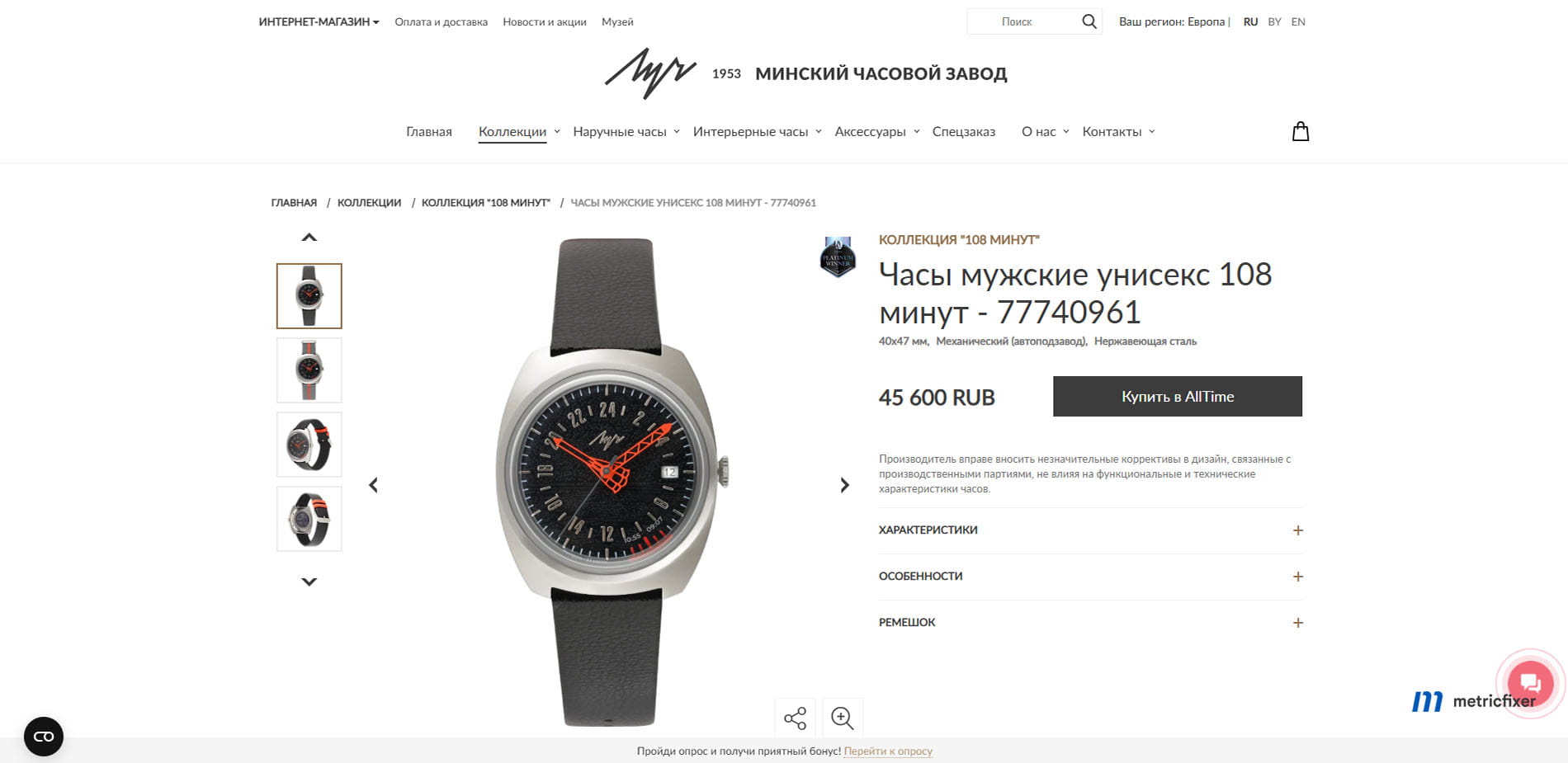
For comparison, the English collection page and English page for the same model were outside the intervention's scope.
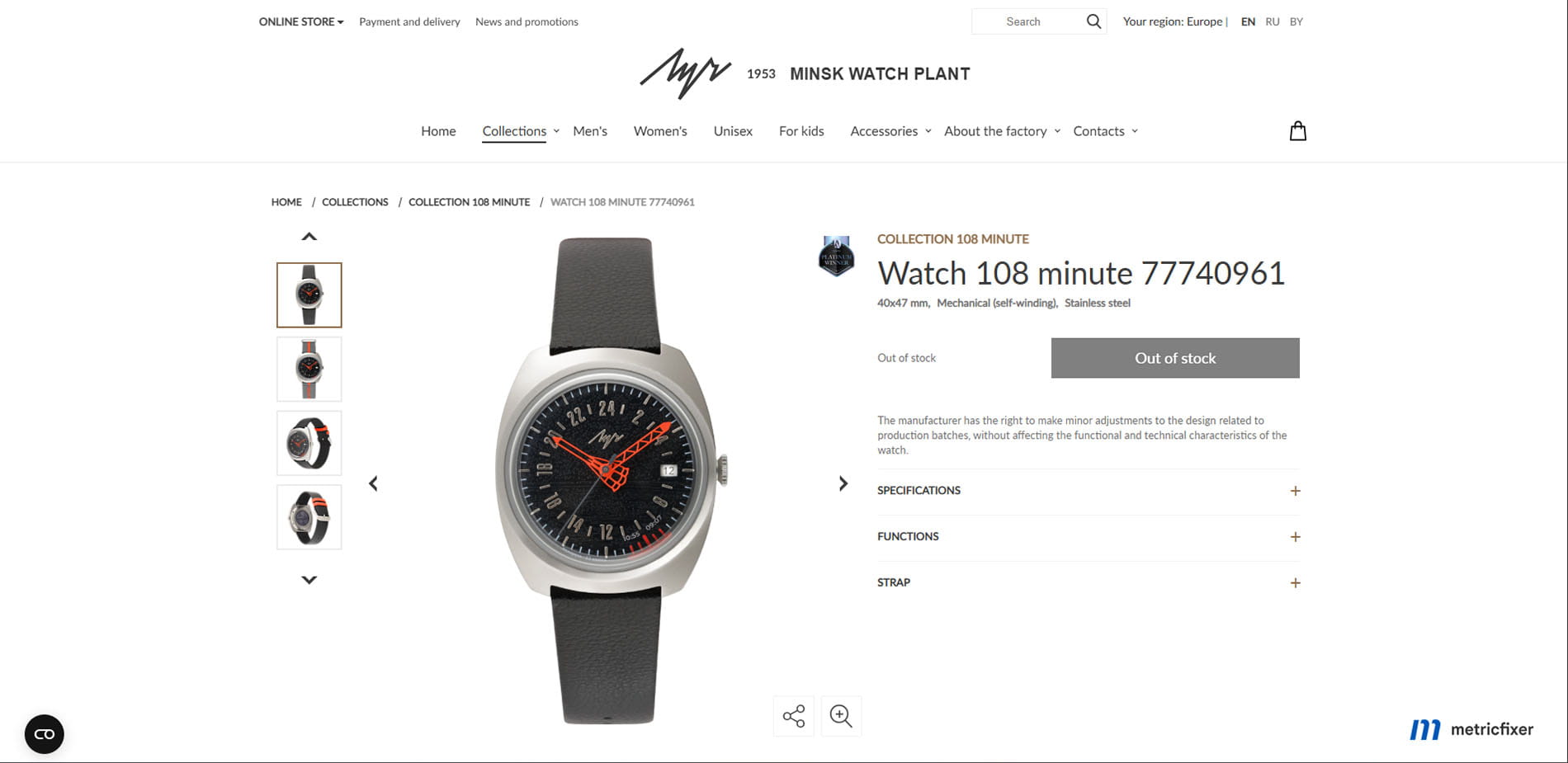
Russian-language targeting is not geolocation. A Russian-language page can be visited from many countries. The project used the language version associated with the intended customer journey; it did not establish each visitor's location, citizenship or delivery eligibility. Those distinctions matter when reusing the idea elsewhere.
How GTM delivered the change
GTM served as the deployment layer for a small piece of website behaviour. A dedicated tag delivered the logic that changed selected purchase-related content in the visitor's browser. The site continued providing the underlying collection and product pages.
This is technically possible because GTM can execute custom code. Google's custom-tag documentation describes using Custom HTML tags to deploy HTML and JavaScript. That capability explains the mechanism; it does not make GTM a recommended general-purpose replacement for website development.
The production tag and its exact selectors are not reproduced here. For a reusable implementation, the important design is an explicit allowlist of pages and products, a reliable language check, approved dealer destinations and targeted updates to the relevant page elements. A broad rule that changes every button containing "Buy" would not preserve the project's narrow scope.
Customer flow: visitor opens a relevant Russian-language Luch page → the active GTM change displays the AllTime purchase action and Russian-ruble price → the visitor chooses the dealer link → the purchasing journey continues on the dealer's website. Other language versions and unrelated pages remain outside the change.
Here, "redirecting the customer" means a customer-initiated handoff through the named button. It should not be confused with automatically forwarding everyone who opens the product page, or with changing an advertising click's destination behind the scenes.
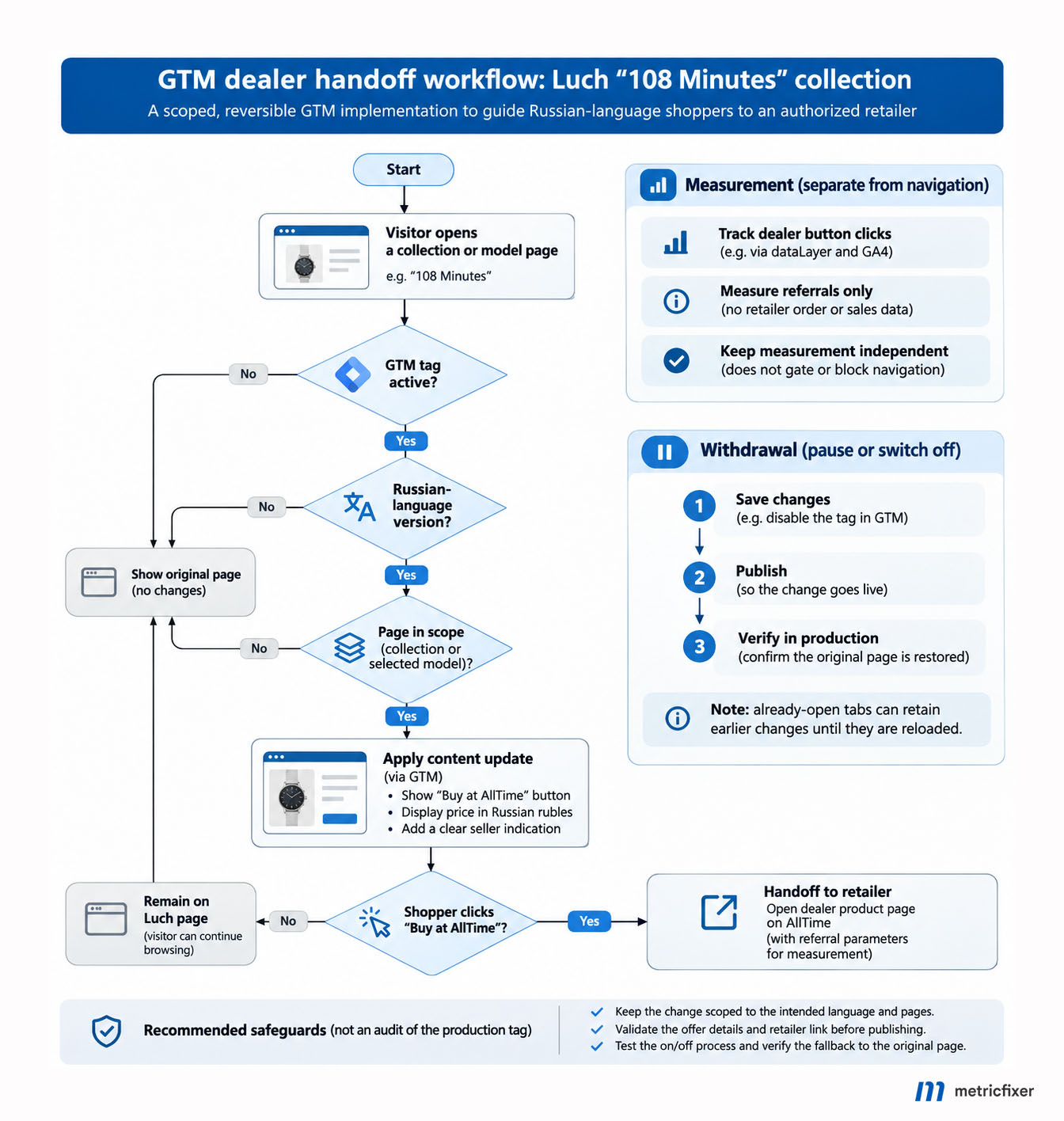
A good reproduction should also fail safely. When the expected page elements or an approved dealer mapping cannot be found, leave the original page intact rather than guessing a destination or displaying an incomplete offer. Keeping the change in a dedicated tag makes ownership and withdrawal easier to understand.
Transparency, advertising rules and product data
Make the seller change obvious
The design requirement was to help customers without misleading them. Naming AllTime in the button was an important part of that approach. For similar projects, the surrounding copy should also distinguish the manufacturer's availability from the dealer's offer, identify whose price is shown and explain that the purchase continues on the retailer's website.
A dealer's Russian-ruble price is not automatically a conversion of the manufacturer's price. Nor does displaying it confirm shipping to every Russian-speaking visitor. Assign responsibility for checking the actual offer, product variant, price and delivery restrictions. Where those details cannot be kept current, a clearly labelled "Check availability at the dealer" route may be more defensible than a precise but stale price.
These are transparency safeguards, not a legal certification. Seller disclosures, pricing, advertising and applicable trade restrictions need review for the actual parties and markets involved.
Language scoping is not an ad-review exception
Google's circumventing-systems policy distinguishes ordinary localization from content changes intended to hide policy violations. Different language versions are not, by themselves, evidence of cloaking. The implementation must not identify reviewers or crawlers and selectively hide the real customer offer from them.
There are separate destination rules to consider when paid advertising is involved. Google's destination-mismatch policy addresses final URLs that redirect to another domain, with limited approved exceptions. Its original-content requirements also prohibit destinations whose only purpose is sending users elsewhere. A substantive manufacturer product page with a clearly named dealer link is a different design from an empty forwarding page, but the label alone does not guarantee ad approval.
This case describes an on-site customer journey, not a method for bypassing market restrictions on advertising. It should not be read as evidence that Google Ads campaigns were serving to Russian users; Google's current Merchant Center notice continues to state that such ad serving is paused.

Feed exclusion does not remove other obligations
For this project, the affected products were absent from Luch's Merchant Center feed because the manufacturer's stock was zero. That avoided treating the new dealer-facing presentation as the manufacturer's active Shopping offer.
However, zero stock does not universally require deleting or omitting a product. Google's availability guidance supports out_of_stock when a merchant is not accepting orders and advises against deleting items merely to stop them temporarily. Feed omission here was the reported configuration, not a general recommendation.
Do not copy this price-changing pattern onto active Merchant Center landing pages without redesigning and reviewing it. Google's landing-page requirements require matching product, price, currency and availability information, and specifically warn against changing price or availability after initial loading. Products being absent from one feed also does not prove that no other product source, listing or campaign uses those URLs.
Visible content and structured product data need separate checks. A browser-side price change does not automatically update backend stock, feed data or Product/Offer markup. Google's structured-data guidelines require an accurate representation of the page. Do not describe a dealer's inventory as the manufacturer's own in-stock offer. The architecture trade-offs are covered in metricfixer's comparison of server-rendered and GTM-injected JSON-LD.
Measuring the handoff without inventing a sale
The change created a natural measurement point: the customer's decision to continue to the dealer. That is useful, but it is not a completed order.
The following measurement plan is a recommendation for this pattern, not a claim about tracking deployed in the Luch project. No event export, dealer order reconciliation or controlled performance comparison was supplied for this case.
| Signal | What it can show | What it cannot establish alone |
|---|---|---|
| Successful dealer-link display | The intervention was applied on an eligible page. | That a visitor actually noticed the button or intended to buy. |
| Dealer-link click | A recorded decision to continue toward AllTime. | Successful page arrival, checkout completion or revenue. |
| Dealer-side arrival | A visit observed by the retailer under an agreed reporting arrangement. | A sale or a complete match to every manufacturer-side click. |
| Verified dealer order | A commercial outcome confirmed through authorized retailer data. | That the intervention caused an incremental sale without a suitable comparison. |
For an ordinary outbound link, GA4 enhanced measurement can record a click event. Test the actual button implementation rather than assuming a visually button-like element is an ordinary link. A custom event can add the product, collection and placement context needed to distinguish this journey from unrelated external links.
For example, the following is an illustrative message to push when the dealer link is activated, not when the page loads. It is not the client's production code:
window.dataLayer = window.dataLayer || [];
window.dataLayer.push({
  event: 'dealer_referral_click',
  dealer_name: 'AllTime',
  product_id: '77740961',
  collection_id: '108-minut',
  page_language: 'ru',
  link_placement: 'product_detail',
  intervention_id: 'luch_108_minutes_dealer_handoff'
});
A data-layer message does not itself send anything to GA4. A corresponding event tag and parameter mapping are needed. Apply the appropriate consent controls, check for duplicate listeners and choose one counting definition if both enhanced measurement and a custom event observe the same click. Navigation should still work when measurement is unavailable.
Do not send this interaction as purchase, attach fictional revenue or let an old ecommerce payload turn it into an order. Google's ecommerce measurement guidance treats purchase as a distinct transaction event. A dealer handoff may be a useful secondary business signal, but it should not silently replace real sales in campaign optimization.
Adding the dealer's domain to GA4 cross-domain settings is not a shortcut to observing its checkout. Google's cross-domain setup requires compatible tagging with the same web stream on both sides; domains configured this way also stop generating the usual enhanced-measurement outbound-click events. An independent dealer requires a separate technical and data-sharing agreement. See metricfixer's cross-domain measurement guide for the distinction between a measurable handoff and a measurable end-to-end journey.
A useful diagnostic ratio is the share of measured sessions with a successfully displayed dealer action that also contain a dealer click. Use the same eligible population and reporting period for both counts. Call it a referral rate, not a purchase conversion rate, and report measurement and consent gaps alongside it.
The off switch: pause, publish and verify
The operational advantage was that the intervention lived in a dedicated tag. When the dealer's allocation sold out or the arrangement ended, the team could withdraw the change without redesigning the product pages.
There is an important detail behind the phrase "pause one tag." Google's pause-tag instructions require saving and publishing the change. Pausing a tag only in an unpublished workspace does not switch off its live version.
- Confirm that the dealer offer should end and identify the dedicated content-change tag.
- Pause the tag, save the change and review the version being published so unrelated edits are not accidentally included.
- Publish through the authorized workflow, then open fresh production page loads outside GTM Preview.
- Check the Russian collection and model pages, the excluded language versions and any separate referral-measurement tags.
Publishing a paused tag prevents future execution for page loads receiving that version. It does not undo changes already made in an open browser tab. A long-lived page needs a reload or deliberately implemented cleanup logic; a tag pause is not a universal live-session rollback.
The project was designed for withdrawal within minutes, but no timed rollback benchmark is reported. The defensible claim is simpler: one dedicated intervention tag, a published change and a verification step. metricfixer's GTM change-and-rollback guidance provides the broader deployment context.

Quality checks and technical limits
The convenience of deployment does not remove the limitations of client-side code. Google's web.dev guidance on tags and tag managers warns that tag managers are generally a poor default for immediate visual or functional site features: they can load late, cause layout changes and be blocked by visitors' tools.
For this pattern, the fallback should remain an accurate, usable manufacturer product page. A visitor who blocks GTM might not see the dealer route, but must not be left with a broken checkout or a false stock claim. If the dealer route becomes essential to ordinary sales, it belongs in the website's own rendering and commerce logic.
Before using a similar intervention, the following checks are worth documenting. They are recommended controls, not a retrospective claim that each was independently audited in this case.
- Page boundaries: test the intended collection and every mapped model, unrelated products, query-string variants and all language versions. Do not use language as proof of location.
- Offer accuracy: confirm the destination model, dealer attribution, currency, current price, delivery limitations and the person responsible for stock reviews.
- Rendering: test slow loading, late-rendered product cards, repeat execution and mobile layouts. Avoid duplicate controls and unbounded polling.
- Accessibility: preserve a descriptive link, keyboard access, visible focus and a clear indication of the destination. Do not require analytics to succeed before navigation.
- Failure behaviour: block the tag manager and test missing elements or missing mappings. The unmodified page should remain usable and truthful.
- Data consistency: inspect visible content, structured offers, feed configuration and ecommerce events separately. A cosmetic change is not an inventory update.
- Privacy and security: review consent behaviour, publisher permissions and Content Security Policy. Do not weaken security controls merely to make a marketing patch run.
- End of life: record an owner, review date and withdrawal condition; test the published off switch rather than relying on a workspace screenshot.
Keep the interface change separate from analytics collection. Google's GTM consent documentation explains tag-level checks; arbitrary custom code does not become consent-aware simply because it runs in GTM. Where permitted, a functional dealer link should not depend on analytics consent. If the site's consent setup blocks the whole container, use a suitable first-party implementation rather than bypassing that setup.
What the case achieved, and what it does not prove
The delivered change placed a named dealer route on the relevant Russian-language pages instead of leaving that information solely in a staff-mediated reply. It kept the intervention away from the English and Belarusian versions and provided a dedicated GTM control for withdrawing it.
That is a meaningful operational result: the manufacturer's website could explain the next purchasing step at the point of product interest. The implementation addressed the mismatch between where shoppers were looking and where stock remained.
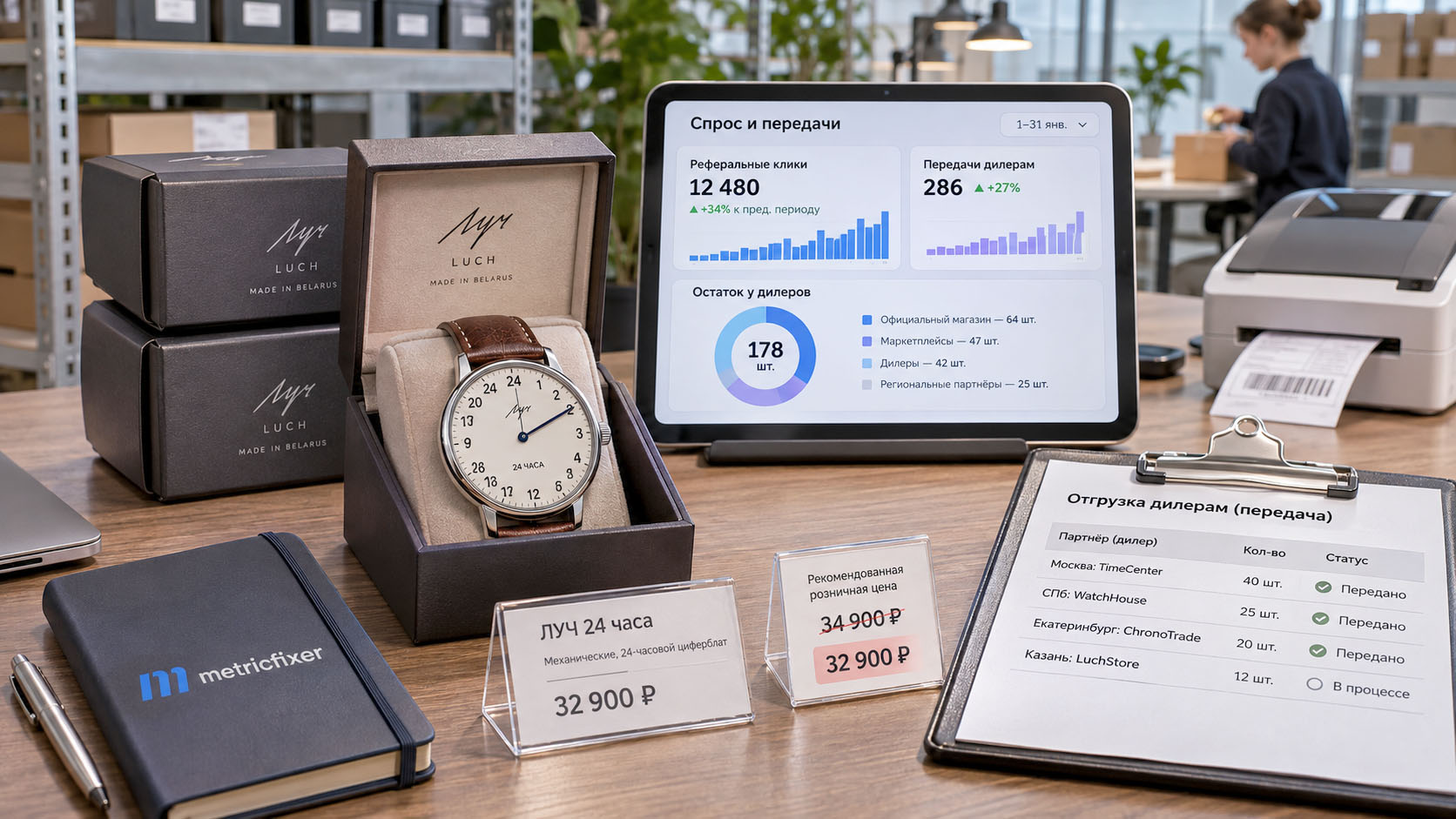
The available case material does not quantify how many customers used the route, how many orders AllTime received, whether support contacts decreased or whether total sales increased. It also does not establish live inventory synchronization or a dealer-side analytics integration.
Those limits do not make the implementation uninteresting. They define its lesson accurately: a small, reversible customer-journey change can solve a specific marketing problem without being presented as a full commerce integration or an experimentally proven revenue win.
When this pattern is worth using
Consider this approach when a small number of pages need a temporary, transparent dealer handoff; authorized GTM access already exists; the original page remains a safe fallback; and someone owns the destination, offer checks and withdrawal decision.
Prefer a CMS or application implementation when the route will be permanent, must work without GTM, spans a large catalogue, depends on constantly changing dealer stock, serves active Merchant Center offers or requires complex seller and delivery rules. In some cases, an ordinary CMS-managed dealer link is simpler and more reliable than a tag-based intervention.
The unusual part of the Luch case was not that GTM could alter a page. It was choosing a tightly bounded commercial problem for that capability: helping an interested shopper find the remaining stock, making the seller change explicit and keeping the intervention easy to retire.
Methodology and sources
This case combines metricfixer's first-party project account with public product references and official technical documentation reviewed on 8 November 2026. The project account is the source for the agency arrangement, stock imbalance, manual referrals, implemented language scope, dealer button, Russian-ruble display, feed omission and dedicated-tag withdrawal design. Luch is named and linked with permission; the European agency's identity is withheld.
The linked Luch pages document the collection and example URLs. Automated retrieval did not independently reproduce the GTM-rendered dealer controls, so it is not treated as a browser-level verification of the live intervention. Current page content, stock and prices may differ from the implementation period. The screenshot placeholders require authentic browser captures; the English comparison is not a historical baseline.
Technical and policy references are linked beside the claims they support: Google's GTM, GA4, Merchant Center, Google Ads and Search Central documentation, plus web.dev. The workflow diagram, event example and quality checklist are editorial recommendations. They are not a published container export or evidence of unreported production features.
No authenticated GTM inspection, Merchant Center account audit, dealer inventory feed, transaction export, legal opinion or controlled experiment was available for this article. Accordingly, the publication makes no claim of platform approval, measured commercial uplift or comprehensive legal compliance.
This article is for technical and operational information and is not legal advice. metricfixer's role was that of a specialist subcontractor in the project described, not the seller of the watches. References to Luch, AllTime and Google do not imply endorsement of this publication by those organizations. Advertising policies, product offers and website behaviour may change. Any similar implementation requires its own authorization, privacy, security, consumer-information and applicable legal review.
Expert help with this topic
 Custom Google Tag Manager Implementation
Scope non-standard GTM requirements through preliminary review, discovery where needed and a bounded custom implementation.
 Google Tag Manager
Choose GTM cleanup, browser or ecommerce measurement, an extra destination, iframe tracking, schema, Gateway, server-side or custom implementation.
 AI-Assisted Google Tag Manager Container Optimization
Review an existing GTM container with AI-assisted analysis, specialist-controlled small fixes and validation of affected paths.