
Published Nov 21, 2026
AI-Generated Ads: Platform Rules, Disclosure and Creative Risk
A practical review of AI-generated advertising across Google, Meta and TikTok: compare disclosures, claims, paid-use rights and creative controls before launch and during delivery.
Category: Online advertising · By metricfixer AI Studio
An AI-generated background, a virtual presenter and a fabricated customer testimonial are not the same advertising decision. This guide compares Google Ads, including YouTube advertising, Meta Ads and TikTok Ads, with focused Microsoft Advertising and LinkedIn comparisons. It explains how to review the finished message, apply the right disclosures, clear paid-use rights and control creative changes before and after launch.
Practical starting point: approve a specific use, not just a file. Record the platform, placement, market, product, claims, permissions, disclosure method and allowed automated changes. A label explains how content was made; it does not substantiate a promise or authorize someone else's likeness. Research reviewed: November 20, 2026.
Contents
Executive summary
The useful question is not simply whether a platform allows AI advertising. It is whether this version of this message can be shown to this audience in this format. Google explicitly keeps generated assets within its normal advertising review framework; TikTok distinguishes meaningful generation from minor editing; Meta is expanding the way it identifies AI involvement. These are different mechanisms, not a shared approval certificate. The relevant Google generated-image guidance, TikTok advertising policy and Meta transparency update should be read separately.
Older advice that treats AI disclosure as relevant only to political advertising is no longer a sufficient operating guide. Google's July 9, 2026 update introduced broader asset-labeling support and permitted AI labels inside image and video creatives. Microsoft's November 19, 2026 announcement likewise describes generally available AI-transparency controls. These tools support disclosure; they do not decide every legal question for the advertiser.
metricfixer recommends five separate approval gates: category eligibility, truthful claims, rights and permissions, appropriate disclosure, and controlled delivery. Failure at an earlier gate is not cured by adding a label. A synthetic host can present an accurately described offer; inventing a customer's experience is a different problem. The FTC's rule against fake reviews and testimonials is one concrete reason to keep those decisions separate.

Define the asset and its intended use
Start with an inventory of what the audience will receive. "Made with AI" is too broad to be a useful production record: it might mean a suggested headline, a translated voice, a fictional person, a modified product image or an automatically assembled combination of previously approved assets. Record both the production method and the meaning of the finished result.
| Component | What to document | What to verify |
|---|---|---|
| Copy and translations | Source facts, generated drafts, reviewer and final language versions. | Claims, prices, qualifications and tone survived generation and translation. |
| Images and product scenes | Real product references, generated regions, retouching and exports. | The scene does not invent features, scale, included accessories or a real location. |
| Video, voice and presenters | Script, avatar type, voice source, cloning or dubbing permissions. | The speaker's identity, expertise and claimed experience are not misrepresented. |
| Landing pages and feeds | Destination version, offer terms, product data and provenance metadata. | The click leads to the same product and promise, with necessary qualifications. |
| Platform-created variations | Enabled transformations, source assets and review controls. | Crops, animation, music, text and new combinations stay within the approved scope. |
A platform's own generator is not a pre-clearance service. Google warns that generated assets are not guaranteed approval. Its conversational campaign-creation guidance also leaves advertisers responsible for checking suggested material before publication. TikTok's Symphony editing documentation describes labeled exports that still undergo platform moderation. A file from an external tool requires the same substantive review, plus verification of that tool's applicable commercial terms.
For agency work, attach an intended-use record to the asset: advertiser, product, destination, countries, languages, placements, dates, creator identity, permitted edits and approval owner. This is a recommended control, not a platform-mandated form. Its purpose is to prevent a narrowly approved asset from becoming an unrestricted campaign library item.
What the platforms currently require
Google Ads and YouTube advertising
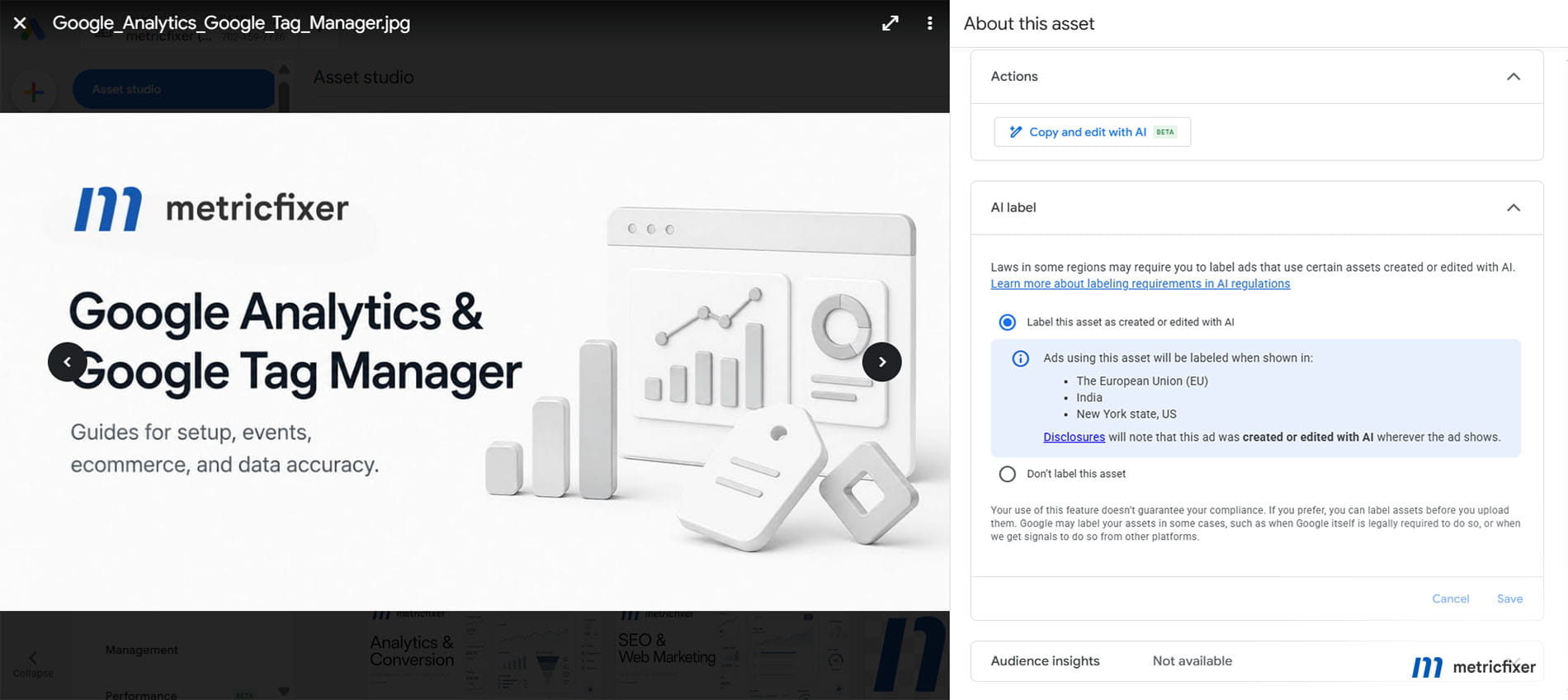
Google's AI label settings operate at asset level. Advertiser-designated assets can produce an AI disclosure in My Ad Center, with visible overlays in specified markets. Some labels applied from Google's own systems, legal requirements or signals received from another platform cannot be overridden. Review the actual asset status and target-market behavior rather than assuming that one setting produces an identical label everywhere.
The July 2026 policy update expressly permits AI-identification text or visuals within affected image and video creatives without treating those labels as prohibited overlays or watermarks. It also states that using Google's labeling feature does not guarantee compliance with local regulation. A platform-provided disclosure and an advertiser-designed disclosure therefore need a placement check, not just a settings check.
There is an additional YouTube distinction. Google's asset guidance says that uploading a video to YouTube from Google Ads can prompt the organic-video AI disclosure question. Completing that step does not resolve every paid-ad requirement. Channel monetization is another separate subject, covered in metricfixer's YouTube AI-content guide.
For product campaigns, retain machine-readable provenance as well. Merchant Center's AI-content guidance addresses AI-generated image metadata, including the IPTC DigitalSourceType field. Preserve the applicable provenance information through editing and export. This is not the same task as placing a reader-visible disclaimer on an ad.
Meta Ads
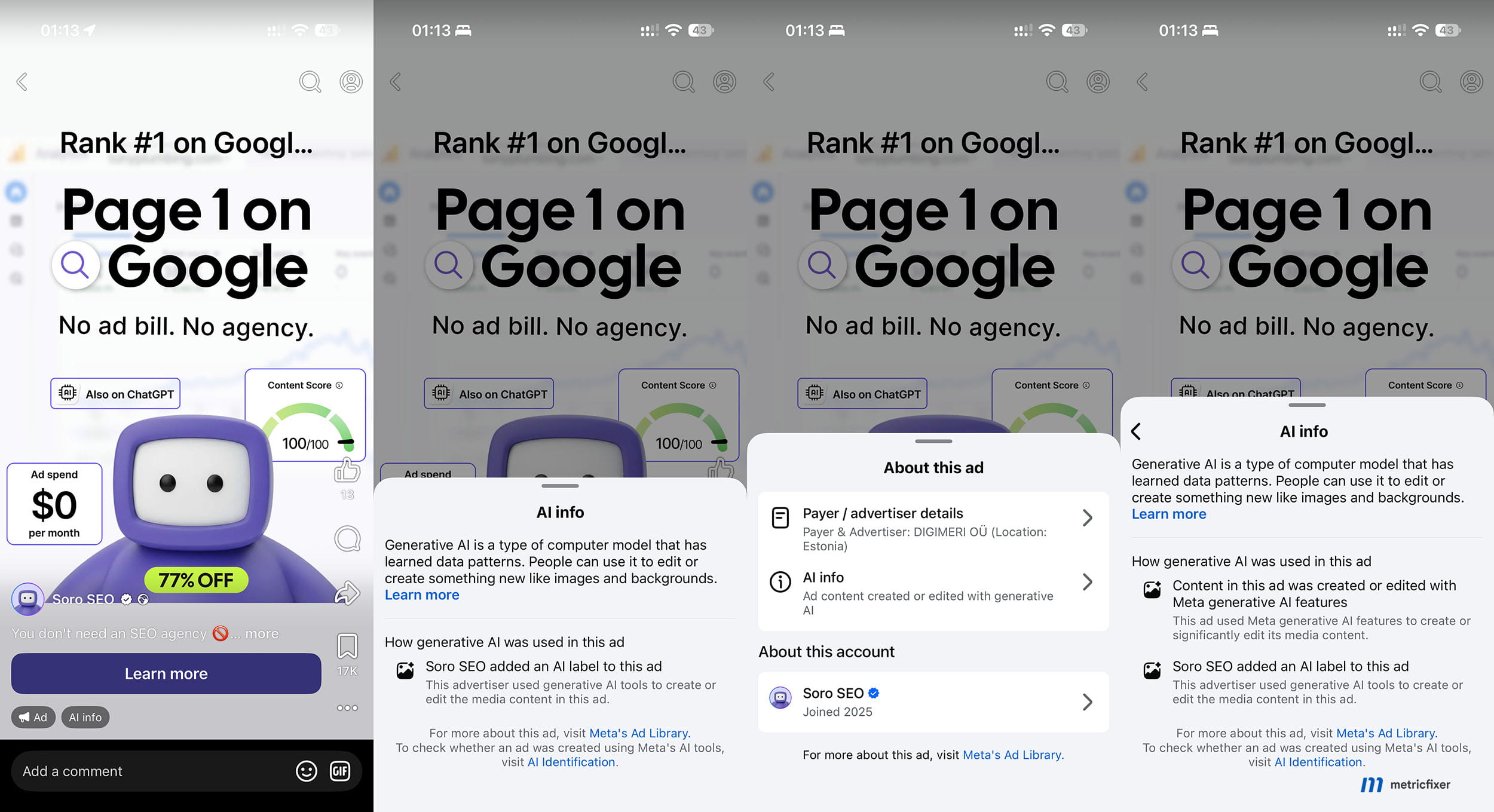
Meta's June 1, 2026 update describes a rollout of About this ad within the three-dot menu. It brings together transparency information, including AI info for relevant use of Meta's creative tools, and adds detection of third-party AI involvement through industry-standard signals. Meta says the experience can vary by region.
Older illustrations show different label placements. Do not assume one universal layout, or treat an absent automatic label as clearance. The public announcement describes transparency mechanisms, not a complete country-by-country disclosure checklist.
A separate, observed example appears in metricfixer's Instagram guide: an advertising setup asks about AI-created or edited media through an AI info control in a Complete requirements window. That supplied screenshot demonstrates a declaration route in that workflow, not a universal prompt or an identified legal trigger. Answer any applicable advertising declaration truthfully and inspect the paid placement separately.
TikTok Ads
TikTok's advertising policy on edited media calls for disclosure of wholly generated image, video or audio and significant AI modification. It gives lighting changes, denoising and background changes as examples of minor editing. That exception should not be read as permission to invent a product's performance or a misleading context. Undisclosed qualifying content can be rejected or restricted.
The AI disclaimer setup guide makes an operational distinction: the advertising toggle is for non-Spark TikTok ads. Spark Ads use disclosure on the underlying organic post. The same guide warns that creating or duplicating a campaign resets the AI toggle, even when a previously used ad is reused; after submission, changing the toggle generally requires changing the image or video.
Consequently, make AI disclosure a campaign-copying check, not a one-time property of the export. TikTok's broader disclaimer documentation also notes feature availability and how labels appear in the ad. A missing control requires investigation of the supported route, not an assumption that the requirement has disappeared.
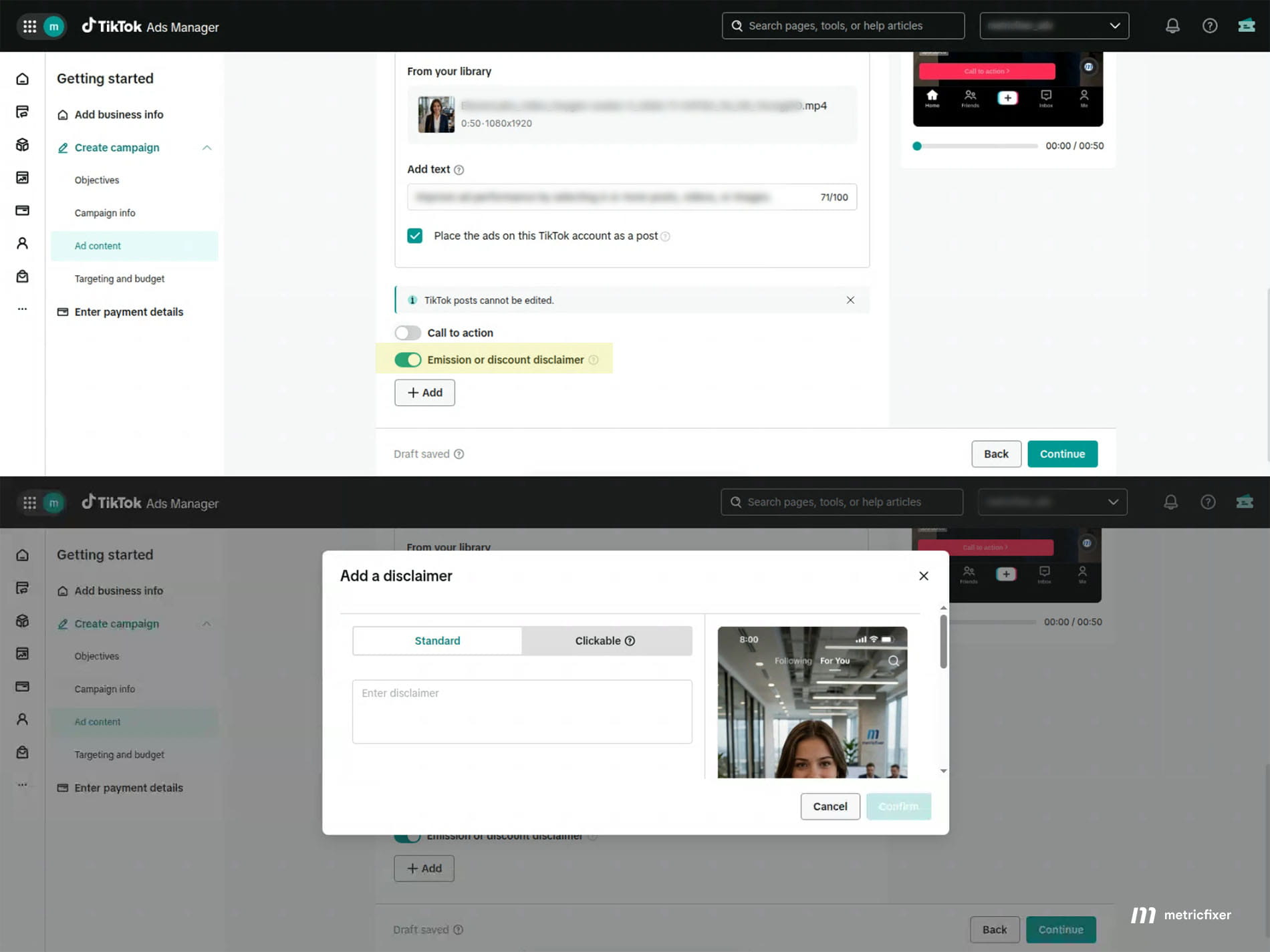
Observed interface, November 2026: in a documented TikTok Ads Manager Getting started campaign wizard for Video Views, the operator reported a US browser location and did not encounter This ad contains AI-generated content. Instead, the available Add a disclaimer dialog offered Standard and Clickable text options, with an underlying option labeled Emission or discount disclaimer. These are separately identified in TikTok's disclaimer overview; the generic text dialog is not evidence that the dedicated AI-declaration control has been enabled or that its native AI label will appear in a served ad. Browser location alone does not establish the advertising account's country.
Why the missing toggle is not a confirmed US-wide limitation: the captured wizard displayed a connected TikTok account and creative sources labeled TikTok posts and From your library. TikTok's Spark Ads creation guide also describes account-linked posts and library assets as Spark workflows. The capture does not prove that an eligible non-Spark configuration was selected, so it cannot establish that TikTok removed the non-Spark AI toggle or made it unavailable across US advertising accounts.
A separate disclosure route exists in the published policy. TikTok's edited-media advertising policy expressly describes an AIGC label or a clear advertiser-provided disclaimer, caption, watermark or sticker for qualifying AI-generated or significantly altered media. This does not mean every custom-text disclaimer field automatically fulfills every AI disclosure requirement. Before submitting an affected ad, establish whether the creative is Spark or non-Spark, check the controls actually available for that format and placement, and verify that the chosen notice is sufficiently clear. For Spark Ads, review the source-post disclosure; for non-Spark ads, check the documented dedicated control and available policy-compliant disclosure options. If the route remains uncertain, seek confirmation from TikTok rather than assuming disclosure is optional.
Microsoft Advertising and LinkedIn
Microsoft's November 19, 2026 product update announces generally available controls for declaring AI-generated images and videos, with visible watermarks where supported and management through Ads Studio, APIs and feeds. It separates Microsoft's detection signals from the advertiser's own declaration. Formats and workflows differ, so check the supported controls rather than assuming that general availability means identical implementation in every campaign.
For LinkedIn, the inspected Advertising Policies establish accuracy, substantiation, rights and restrictions on misleading affiliations or endorsements. They do not establish a separate universal AI-ad-label requirement in the material reviewed here. That is a limit of the evidence, not a finding that every synthetic LinkedIn ad can run without disclosure. Market-specific law and any applicable product-specific instructions still need review.
Compare six common AI-ad scenarios
The following table is a scenario-based application of the mechanisms above, not a list of guaranteed approvals. Read each row together with the product category, applicable law and finished message. A label may be necessary even where the production method is otherwise permitted.
| Scenario | Google Ads | Meta Ads | TikTok Ads |
|---|---|---|---|
| A real product on a generated background | Review the asset declaration and local disclosure need. Keep the product and implied setting accurate. | Check the applicable transparency presentation. Do not rely on absence of a label as clearance. | A minor background edit may differ from a wholly generated scene. Review meaning, not just the editing tool. |
| A photorealistic virtual model | Assess labeling, rights and whether the image implies a real wearer, fit or result. | Check AI information and local visible-disclosure obligations for the finished depiction. | Treat a wholly generated person as a disclosure case; verify the garment or product is represented faithfully. |
| Synthetic narration or translated speech | Review the complete video and voice permissions; do not substitute the organic upload answer for ad review. | Assess impersonation, translated meaning and relevant disclosure, including voice-cloning consent. | Review generated audio under the advertising threshold, not assumptions borrowed from ordinary creator posts. |
| An avatar saying it bought and used the product | Do not approve invented personal experience. A label does not supply evidence. | Do not present a fictional speaker as a genuine customer or independent expert. | Separate a disclosed promotional host from a fabricated testimonial. |
| AI alteration of skin, body shape or appearance | Check whether the edit creates a false product-effect claim and whether the category is eligible. | Review the promise conveyed by the image, not only the realism of the person. | Review edited-media disclosure and restrictions on misleading product-effect comparisons. |
| A generated demonstration or simulated result | Require substantiation for the performance implied by the sequence. | Do not portray simulation as documented evidence of an outcome. | Check the ad and destination together; labeling does not resolve an exaggerated outcome. |
These decisions build on the platforms' Google misrepresentation rules, Meta labeling explanation and TikTok edited-media and claims rules, alongside the market-specific requirements discussed below. The recommendations about evidence and permissions are approval controls, not claims that each platform exposes the same settings.
For example, replacing a studio backdrop with a neutral graphic is not the same advertising message as placing a suitcase underwater. The second scene may imply waterproof performance even without a spoken claim. Likewise, a virtual presenter explaining verified specifications is different from one claiming to have used the product for a month. Review what a reasonable viewer is being asked to believe.
Separate the different disclosures
A campaign can need several disclosures for different reasons. Do not force them into a single "AI" checkbox or assume that Sponsored answers every transparency question.
| Layer | Question it answers | What it does not establish |
|---|---|---|
| Advertising identification | Is this paid promotional communication, and who is responsible for it? | Whether the person, voice or demonstration is real. |
| AI or manipulated-media disclosure | Was relevant content generated or materially altered? | Whether the claim is true, substantiated or legally permitted. |
| Creator or endorser relationship | Is there a material commercial relationship behind the endorsement? | Whether the speaker actually had the stated experience. |
| Product and category qualifications | What limitations, conditions or sector-specific information matter? | Whether AI use or paid collaboration has been disclosed. |
| Machine-readable provenance | What origin or editing information accompanies the file? | Whether a person can perceive a legally required notice while viewing the ad. |
The FTC's influencer-disclosure guidance addresses material brand relationships separately from AI production. It advises clear placement with the endorsement, including disclosure in a video rather than only its description, and cautions against assuming a platform's disclosure tool is sufficient. Apply that distinction when converting a creator collaboration into paid media.
Keep provenance and viewer notices separate too. Google's asset guidance describes SynthID and C2PA for images and videos generated inside Google Ads. Those signals can support origin detection; they are not a replacement for every visible or audible disclosure obligation. Nor should missing metadata be treated as proof that a file was created without AI.
Special categories come first
Political advertising illustrates why eligibility precedes labeling. Google's political-content rules have a separate altered-or-synthetic-content disclosure route for qualifying election ads and regional restrictions. Meta stopped political, electoral and social-issue ads in the EU on October 6, 2025; its 2026 US advertising safeguards retain specified self-disclosure obligations alongside detection. TikTok generally prohibits paid political advertising, subject to defined exceptions.
A disclosure cannot turn a prohibited campaign into an eligible one. Apply the same sequencing to regulated commercial categories: determine the country, product, audience and required authorization first, then assess creative transparency. Google's industry-authorization guidance, for example, is a separate layer from the creative's AI status. This article is not a substitute for a healthcare, financial-services, gambling or other sector-specific review.

Check the market: EU, US and UK
European Union: distinguish providers from deployers
Article 50 of the AI Act separates the duties of an AI-system provider from those of a professional user, or deployer. Providers have machine-readable marking duties for relevant synthetic outputs, with a standard-editing exception. Deployers must disclose qualifying deepfake image, audio or video content. An agency or advertiser should map its actual role instead of assuming that the generator's watermark completes its own obligations.
There is also a distinct rule for AI-generated or manipulated text published to inform the public on matters of public interest. Article 50 provides an exception where appropriate human review or editorial control exists and an identifiable person or organization holds editorial responsibility. That is not a general exemption for synthetic images or video. Evidently creative or fictional works have an adapted disclosure requirement, not an automatic absence of one. Direct interaction with an AI system is another separate provision; a prerecorded presenter and an interactive sales agent need different assessments.
The Commission's current Article 50 FAQ states that the provisions apply from August 2, 2026. It describes a narrow grace period until December 2, 2026 for the provider-side marking and detection obligation for systems placed on the market before August 2. That is not a general postponement of advertisers' deployer disclosures.
The same FAQ explains that deepfake assessment includes plausible real-world subjects, not only recognizable impersonations. Do not automatically exclude a realistic fictional presenter. Where deployer disclosure is required, people should perceive it by first exposure without special tools or a dedicated action. An information panel that requires a click therefore should not be treated as sufficient by itself for that duty.
Operationally, review the version served in each placement: language, readability, timing, muted playback, cropping and interface overlays. These are recommended implementation checks, not a universal pixel specification. The Commission's EU labeling icons are optional; the underlying obligation is not made optional by choosing not to use an icon. The transparency Code of Practice is a compliance-support instrument, distinct from the legislation.
United States: testimonials and state-specific disclosure
The federal consumer-protection issue is not limited to identifying AI. The FTC's reviews and testimonials guidance distinguishes obvious fictional dramatization from material presented as a person's genuine experience. It does not impose a blanket ban on avatars. But a fictional speaker cannot supply a real customer history, and an unauthorized synthetic celebrity endorsement creates a different risk from a generic narrator. Agencies are not automatically insulated from responsibility for creating false testimonials.
State law can add a specific disclosure duty. New York's General Business Law section 396-b requires conspicuous disclosure in covered commercial ads when a producer or creator has actual knowledge that they contain a synthetic performer. Its definition reaches a simulated human performer who is not recognizable as an identifiable natural performer. A fictional person can therefore matter even without cloning a celebrity.
The statute includes exceptions, including audio advertisements, AI used solely to translate a human performer, and specified promotion of expressive works. These are boundaries of this particular provision, not universal permission to mislead or ignore other laws. New York's June 9, 2026 announcement describes the requirement as in effect. Do not extrapolate it into an identical rule across all US states or all AI imagery.
United Kingdom: review the overall impression
The ASA's guidance on AI disclosure takes a contextual approach rather than imposing a blanket AI label under the CAP and BCAP Codes. The question is whether the ad misleads, including through omission, and whether a disclosure genuinely clarifies the message. A small AI notice cannot repair a product demonstration whose central impression is false. The ASA's June 2026 deepfake guidance also emphasizes advertiser responsibility despite automated production.
This is a focused EU-US-UK review, not a worldwide clearance map. Campaigns reaching other jurisdictions need a separate assessment. Regional lists in platform help pages describe their product implementation; they should not be treated as a complete statement of the law in each listed country.
Review the claim, not just the image
Use two questions in the creative review: What would a viewer believe happened? and What evidence do we have for that belief? Include implications created by editing, sequencing, costume, setting and the landing page, not just words in the script.
| Proposed execution | Problem to resolve | Better approval direction |
|---|---|---|
| A generated customer says a supplement cured a condition. | Invented experience plus a potentially prohibited or unsupported health claim. | Reject the execution. Rebuild from eligible, substantiated claims; disclosure alone is not the remedy. |
| A virtual host explains verified appliance specifications. | Viewers must not be led to believe the host independently tested it. | Use a truthful promotional script, relevant disclosure and accurate product imagery. |
| An AI edit removes every wrinkle after a skincare application. | The image presents fabricated evidence of product performance. | Remove the misleading demonstration; evaluate any alternative against actual substantiation and category rules. |
| A genuine review is voiced by an avatar. | The portrayal could misstate who spoke, what was said or the reviewer's experience. | Verify the underlying testimony and permission; review the dramatization and overall impression separately. |
| A generated product scene contains an extra accessory. | The image may imply the accessory is included in the offer. | Correct the scene or the offer; do not rely on fine print contradicting the main image. |
The distinction between a fictional dramatization and a purported customer experience follows the FTC's explanation of avatars and testimonials. The misleading-result examples reflect the ASA's contextual disclosure approach. The suggested approval directions are metricfixer's operational synthesis, not advance decisions from a regulator or platform.
Review the whole click path. Google's misrepresentation policy addresses deceptive manipulated media, unsupported or unreliable claims and inconsistent or unavailable offers. TikTok's claims rules cover both ads and landing pages. For the campaign team, this means checking the advertised variant, price, eligibility, shipping conditions, subscriptions and qualifications against the live destination.
An AI-written landing page needs a named reviewer, not just an approved ad pointing to it. A regenerated headline can turn a qualified benefit into a guarantee after the original creative was signed off. Version the destination and any product feed alongside the ad. For the wider publishing workflow, see metricfixer's guide to AI content on websites.
Re-clear organic content for paid use
An organic post is a source asset, not a complete advertising clearance file. A creator's permission to publish on their own account, an AI tool's commercial license and a platform's technical authorization to promote a post answer different questions. Treat the move into paid distribution as a new approval event. For Page and community publishing before promotion, the separate Facebook AI-content guide covers repost and publication controls.
TikTok's Spark Ads documentation distinguishes use of a brand's own posts from posts authorized by other creators. That platform authorization does not, by itself, demonstrate that every underlying music, performance or third-party right covers the proposed paid campaign. For Meta creator partnerships, document both the applicable platform authorization and the contractual scope; this review does not assert a single permission workflow across every account.
| Permission or condition | What the campaign record should establish |
|---|---|
| Creator and account identity | Who may run the ad, from which identity, and who can authorize or revoke that use. |
| Media scope | Paid promotion, named platforms, countries, languages, start and end dates, and any agreed limits. |
| Editing and AI transformations | Permission for cuts, new captions, translation, synthetic dubbing, voice cloning, face changes and derivatives, where intended. |
| Music and other source material | A license covering the relevant recording, composition, footage, artwork and placement as applicable. |
| Claims and endorsements | The genuine source of any experience or opinion, evidence supporting claims, and necessary relationship disclosures. |
| Withdrawal and expiry | Who pauses ads, removes derivatives and verifies that delivery stops when a permission ends or a correction is required. |
Music deserves its own check. TikTok's Commercial Music Library guidance distinguishes commercial use from the general music library. Its selection instructions include region and usable-placement filters. Its creator-collaboration copyright guidance warns against assuming that platform-cleared sounds can be downloaded and reused elsewhere. A TikTok soundtrack is therefore not automatically cleared for the same export on Instagram or YouTube.
Review a creator's AI disclosure at source and the advertising disclosure in the destination workflow. For Spark Ads, this includes the organic-post route discussed earlier. The metricfixer TikTok publishing guide covers that creator-side context; its organic scenarios should not be substituted for TikTok's advertising threshold.
Contractually, ask the producer to identify the generator, relevant service tier and terms date, source inputs, stock components and permission evidence. Do not accept "commercial use allowed" as shorthand for ownership, exclusivity, non-infringement or unrestricted likeness rights. Those are separate issues to check; this article does not attempt to resolve AI copyright ownership across jurisdictions.
Build a brand-agency-producer approval workflow
The recommended workflow assigns an owner to each check without pretending that a contract can remove statutory responsibility. One person may hold several roles in a small team, but each decision should still be recorded.
| Owner | Decision | Evidence passed forward |
|---|---|---|
| Brand or advertiser | Define the offer, eligible markets and substantiated claims. | Product references, approved facts, qualifications and a named sign-off owner. |
| Producer or creator | Document how the asset was made and which rights are available. | Sources, generation/editing notes, licenses, releases, script and final exports. |
| Agency or campaign operator | Map the asset to platform, placement, market and automation settings. | Disclosure decisions, permissions, previews, destination and configuration record. |
| Brand and specialist reviewer where needed | Accept the specific use or require changes. | Version-specific approval with limits, expiry and unresolved issues closed. |
| Campaign operator | Verify submission, actual delivery and subsequent changes. | Status checks, observed renderings, changes, incidents and pause/reapproval decisions. |
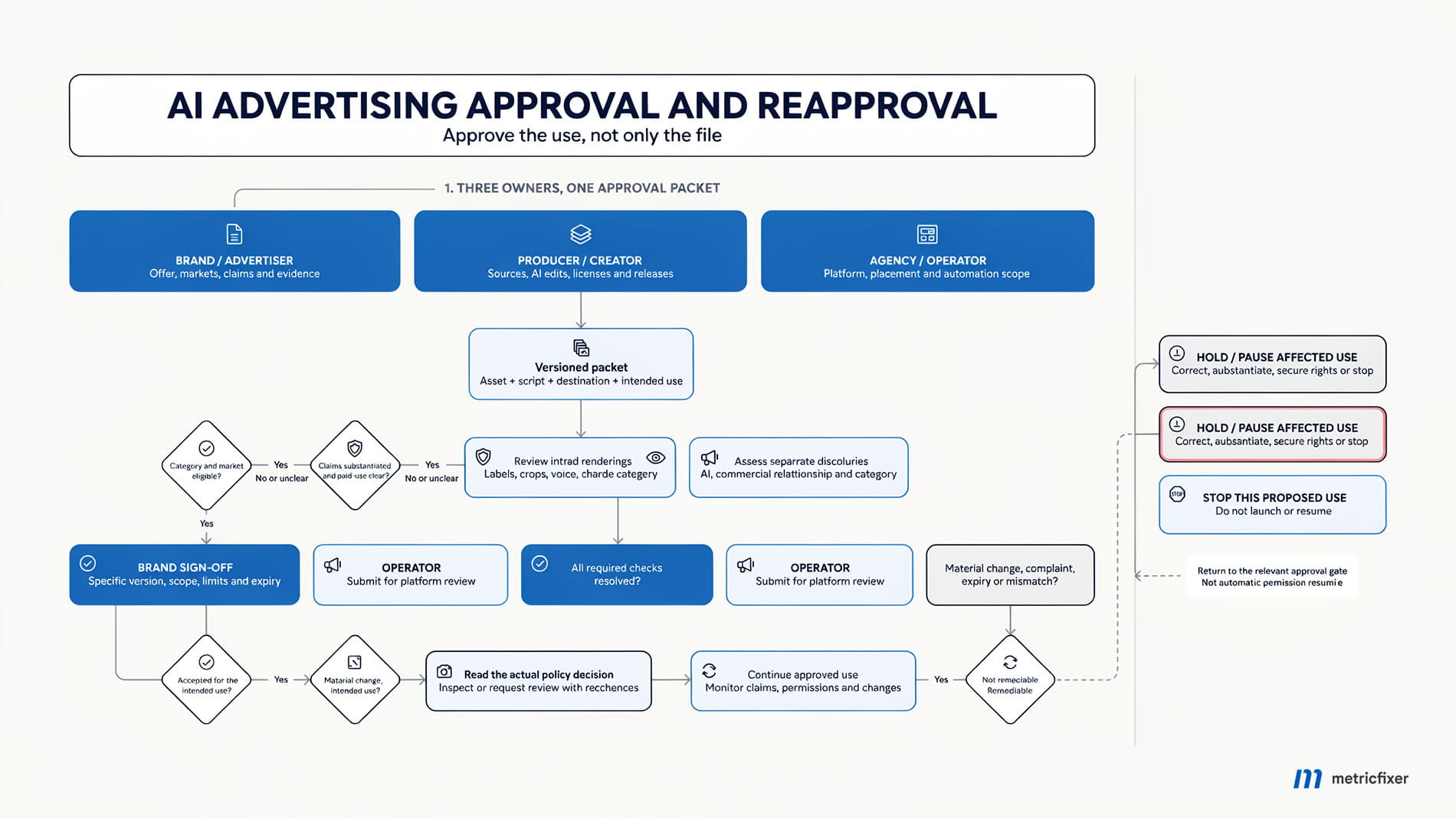
Give every approved version a stable internal identifier. A useful record includes the source and export files; script and translations; permissions and their expiry; claim substantiation; platform, markets and placements; AI and commercial disclosure decisions; destination version; approved automated transformations; approver and date. Keep personal data in access-controlled records and avoid collecting unrelated identity documents merely to make the file look thorough.
Define what can change without another review. A resize that preserves the product and disclosure may fit an approved scope; a new voice, product claim, model, offer, market or generated demonstration should return to the relevant approval gate. This is a recommended risk-based policy, not an assertion that all platforms use the same versioning system.
A sign-off should be specific enough to survive a handover: "Approved for these placements and markets using these claims and disclosures, through this date, with these transformations allowed." Avoid a global "AI creative approved" note that another operator could reasonably mistake for unlimited permission.
Pre-launch checklist
Use this checklist for the actual campaign version, including a duplicated or adapted campaign. A missing item is a question to resolve, not a box to mark optimistically.
- [ ] Scope: the platform, placements, markets, languages, dates and product category are recorded.
- [ ] Eligibility: any required category authorization is in place, and the campaign is not prohibited in the intended market.
- [ ] Generation record: AI-created and materially edited components, including audio, are identified.
- [ ] Truthfulness: explicit and implied claims are substantiated; no customer experience, expertise or endorsement has been invented.
- [ ] Product accuracy: images and demonstrations match the advertised variant, included items and supported performance.
- [ ] Rights: paid use, music, likeness, voice, translations and permitted derivatives are covered for the planned scope.
- [ ] Disclosures: AI, commercial relationships and relevant category notices are assessed separately and implemented truthfully.
- [ ] TikTok format check (where relevant): confirm Spark versus non-Spark and verify the actual AI disclosure route; do not treat a generic Standard/Clickable disclaimer dialog as the dedicated AI toggle.
- [ ] Rendering: required notices remain perceivable across crops, playback states and relevant placements.
- [ ] Destination: the landing page and feed match the offer and have a reviewed version.
- [ ] Automation: allowed enhancements are documented; transformations that could invalidate approval are limited or disabled.
- [ ] Record: the final files, settings, permissions, expiry and named approvals are archived.
- [ ] Ownership: someone is responsible for checking delivery, handling complaints and pausing or reapproving changed assets.
Monitor delivery, changes and policy decisions
Approval is not the end of creative review
Review what was submitted and what can actually be assembled or transformed. Google's Demand Gen creative-enhancement guidance and image-enhancement documentation describe mechanisms that can change presentation. TikTok's October 2026 Recommended Creatives documentation describes generation from product information and existing assets, including workflows that can add or refresh creatives during delivery when authorized. Approval should account for those mechanisms.
Where an embedded label is part of the compliance plan, inspect its survival. Google Ads Editor's AI-label guidance warns about trimming and enhancement behavior. Avoid edge placement, review aspect ratios and use available controls to prevent transformations that remove necessary information. Do not claim to have inspected every impression; record which placements and versions were checked and the residual uncertainty.
As an illustrative accountability case, the ASA's Stripe & Stare ruling considered an ad assembled through Performance Max from advertiser-supplied material. The advertiser remained responsible for the resulting ad. This is evidence about automated assembly and responsibility, not evidence that the image in that case was AI-generated.
Respond to the decision that was actually made
A rejected ad, a delivery restriction and an account suspension are different events. Google's policy overview distinguishes ad-level enforcement from account action, while its misrepresentation policy identifies serious deceptive practices that can trigger suspension without prior warning. Do not infer that every AI-label problem is an account-level violation, or that every suspension is caused by AI.
Preserve the decision and the exact submitted version. Identify whether the concern is disclosure, deception, rights, destination consistency, restricted category or account behavior. Correct the relevant issue or use the documented review route with evidence. Repeatedly resubmitting the same unresolved execution, removing truthful provenance or opening replacement accounts is not a sound remediation process.
Pause the affected use when a material permission expires, a claim becomes unsupported or a served variation contradicts the approval. Find related versions and placements before declaring the issue resolved. A revised source file does not prove that every active derivative has stopped serving.
Test performance without testing noncompliance
This review does not establish a universal delivery or conversion penalty caused by an AI label. It also does not establish that generated content will outperform photographed or filmed content. Platform documents describe rules and tools; they are not a controlled experiment on your campaign.
For a useful experiment, compare compliant creative concepts with truthful disclosures in every arm where required. Hold the offer, audience definition, destination, measurement and major delivery settings as comparable as the platform permits. Define a primary business outcome, such as qualified conversions or contribution after returns, rather than selecting a winner only from click-through rate. Record automated creative changes as a source of variation. These are methodological recommendations, not promised performance effects.
The operating principle is simple: approve the claim, the rights, the disclosure and the use together. Then preserve that approval through delivery. AI changes how quickly creative variations can be produced; it does not remove the need to know what each variation is asking people to believe.

Methodology and sources
This review was checked on November 20, 2026. It compares public advertising policies, product documentation and dated announcements from Google, Meta, TikTok, Microsoft and LinkedIn with the European Commission's Article 50 materials, New York's published statute, FTC guidance and ASA guidance and adjudication. Sources are linked beside the claims they support rather than repeated as a technical reference list.
The analysis separates legal duties, platform policies, interface behavior and metricfixer's recommended operating controls. Hypothetical examples are not reported enforcement cases. The approval workflow and checklist are an editorial synthesis; they are not official platform procedures or a legal safe harbor. The law discussion prioritizes the EU, selected US federal and New York issues, and the UK. Other markets and sector-specific requirements need separate review.
No advertiser account was accessed by the researcher, no campaign was submitted, no label rendering was tested live and no performance experiment was conducted for this article. Some documentation was available through publicly indexed official text when direct pages were rate-limited or login-gated. Rollout announcements are identified as announcements, not proof that a feature is enabled in every account. Localized help pages and interfaces can differ or lag; verify the current English policy and the applicable account workflow before relying on a control.
On November 21, 2026, the TikTok interface discussion was supplemented with screenshots provided by an authorized account operator. They document the onboarding wizard and its generic disclaimer dialog, not a test of the dedicated AI control in a confirmed eligible non-Spark setup. No paid delivery, review outcome or viewer-facing label was verified.
Availability of the dedicated AI control in a confirmed eligible non-Spark setup and visible AI label behavior remain untested in this review. Recheck the rules after a material policy change, a new market or category, a different format, or a significant alteration to the asset.
This article provides technical, operational and general regulatory information, not legal advice or a guarantee of advertising approval. Requirements depend on the jurisdiction, product, audience, platform configuration and final creative. metricfixer is not affiliated with Google, YouTube, Meta, TikTok, Microsoft, LinkedIn, the regulators or other organizations mentioned. Policies, laws, product availability and disclosure interfaces may change after publication.
Expert help with this topic
 Google Ads
Choose an audit, tracking work, a campaign launch, ongoing management, supported self-service, or help with a specific Google Ads issue.
 LinkedIn Ads
Compare LinkedIn account audits, Insight Tag website measurement, strategy-led launches and continuing management for a coherent business goal.
 Meta Ads
Investigate a Meta Ads account, configure Pixel and suitable CAPI measurement, launch campaigns, or arrange ongoing management.
 TikTok Ads
Choose a TikTok Ads audit, Pixel and Events API measurement, a campaign launch, or ongoing management with suitable approved creative.